• Welcome to Photrio!
    Registration is fast and free. Join today to unlock search, see fewer ads, and access all forum features.
    Click here to sign up

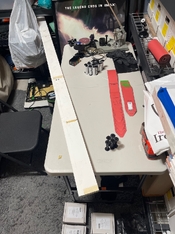
Paper backed roll film made with backing paper cut at home.

Recent Classifieds

Forum statistics

Threads
202,907
Messages
2,847,380
Members
101,534
Latest member
michaelhfreeman
Recent bookmarks
0
Might as well update to.

The FK127 slitter worked fine. All I needed was the slitter, anyone with a little experience doing darkroom games doesn't need the whole kit. I can slit down 120 backing paper to 127 size now. I can even do an entire roll with the film if would want to. I now have a source of home made 127 backing paper. I just have to score a baby Rollie and I'll be set.

I'm curious which cameras and spools you're using that 127 with. I got a FK127 slitter but the 127 strip it produces is half a mm too wide for any recycled spools I have (mostly original Kodak metal ones, some Efke and Rera plastic ones) and in fact doesn't really fit the film channel of my baby rolleiflex. I tried to shim the blade a bit to adjust but there's no way that I can find to fix it. Maybe the one I got was just a fluke.

I currently use one of the XKAES ones (i think he's around this forum) and it's pretty easy and produces a very accurate width, but of course needs to be used in total darkness.
 
I'm curious which cameras and spools you're using that 127 with. I got a FK127 slitter but the 127 strip it produces is half a mm too wide for any recycled spools I have (mostly original Kodak metal ones, some Efke and Rera plastic ones) and in fact doesn't really fit the film channel of my baby rolleiflex. I tried to shim the blade a bit to adjust but there's no way that I can find to fix it. Maybe the one I got was just a fluke.

I currently use one of the XKAES ones (i think he's around this forum) and it's pretty easy and produces a very accurate width, but of course needs to be used in total darkness.

I'm using standard spools I've collected over the years. Mostly metal, a few plastic and a couple really nice brass and silver colored. I've been shooting on a Yashica 44 with a crank Yashica 44 with a knob, Ricoh Super 44 and a few brownies of different kinds. If anything the paper is slightly narrow rather than wide. I tend to get some edge leaks.
 
I'm using standard spools I've collected over the years. Mostly metal, a few plastic and a couple really nice brass and silver colored. I've been shooting on a Yashica 44 with a crank Yashica 44 with a knob, Ricoh Super 44 and a few brownies of different kinds. If anything the paper is slightly narrow rather than wide. I tend to get some edge leaks.

Interesting, I guess there must be some variation from unit to unit. I wish I had been able to shim mine to cut a bit narrower.
 
My involvement in this is more along the lines of unobtainable or difficult to obtain backing papers, like the 116, 127, 828, and 103/109 sizes.

There probably isn't a huge demand for this stuff but things like 116 and 127 were made for over 80 years, so there are a lot of cameras out there that could be used again if backing paper was available.
Ohhh 127 and 828 backing papers would be awesome!!
 
I did not know that the 645 numbers are useful for 4x4. I've been marking the paper myself which is a pain.

You do get a little excess spacing (about 5 mm extra per frame) but the framing track is correctly located for either 127 or 828 cut from that edge of 120. I've done both a number of times. The 6x6 track is correctly located for the 4x6.5/4x3 on 127, too, if you cut for the 6x4.5 track but you'll have a few millimeters of frame overlap since the 127 full frame is 4x6.5. I've masked the frame in my Baby Ikonta and it works fairly well (double window on the full frame 127 track).
 
Be careful though, of which camera one loads with paper negative lengths attached to backing paper.

I have only done it once so far, but I put a roll in my Bronica SQB, and did an exposure test over the whole roll, to find the correct ISO for the paper I was using.

The paper negatives came out brilliantly across the range and I'm looking forward to trying to enlarge one or two of them.

When I mentioned this to someone, they warned me that the tension on the internals of the camera would be put to a lot harder work, than with film, which the cameras are designed for and should think of only using a more basic camera like a Holga etc. Good point I thought!

Terry S
 
Look at how much spring travel the pressure plate has in the camera you intend to use. If it's as much as 2.5 mm, it should be fine to use RC photo paper in place of film. No harm will be done to the spring leaves by compressing them more, as long as they're not mashed so flat the metal takes a permanent deformation.
 
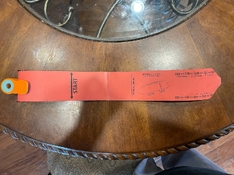
This paper likes inkjet, which means I can print on it! I think it turned out really well!
 

Attachments

  • IMG_3097.jpeg
    IMG_3097.jpeg
    399.9 KB · Views: 97
  • IMG_2910.jpeg
    IMG_2910.jpeg
    541.3 KB · Views: 93
This paper likes inkjet, which means I can print on it! I think it turned out really well!
Great job! I applaud you 👏 for your work. Maybe you could make some extra cash on the"classifieds" here. 127 and 122 film size would sell for sure.
 
This paper likes inkjet, which means I can print on it! I think it turned out really well!

Are you putting inkjet ink on the parts that will contact the film, or only on the ends? My concern would be a reaction between the inkjet ink and the film itself, as the former is less stable than something such as acrylic paint.
 
Are you putting inkjet ink on the parts that will contact the film, or only on the ends? My concern would be a reaction between the inkjet ink and the film itself, as the former is less stable than something such as acrylic paint.

+1 - inkjet frame numbers would be an invitation to wrapper offset issues!
 
Great job! I applaud you 👏 for your work. Maybe you could make some extra cash on the"classifieds" here. 127 and 122 film size would sell for sure.
If I figure out a way to slit the paper, then I’d love to sell paper in widths that could accommodate that. I couldn’t print anything on the paper, as my printer can’t do long rolls, and as mentioned inkjet ink wouldn’t work well in this case.

Are you putting inkjet ink on the parts that will contact the film, or only on the ends? My concern would be a reaction between the inkjet ink and the film itself, as the former is less stable than something such as acrylic paint.
Nope, that’s one reason why I feel comfortable making 220 paper like this, there’s no ink in contact with the film. That, and I can print it onto a single sheet of paper, cut it into 3 strips the right width, and tape the 2 strips that make up the leader together since that join doesn’t need to be light-tight.
 
The films look like a factory sample - congratulations :smile:

Are you putting inkjet ink on the parts that will contact the film, or only on the ends? My concern would be a reaction between the inkjet ink and the film itself, as the former is less stable than something such as acrylic paint.

With the 220 format this problem is minimized.
 
So far, Epson Ecotank black ink does not exhibit this problem when fully dry on this paper. Test started in December.
Thanks for that bit of testing. I was wondering if all ink from inkjet printer would leave wrapper offset. I wonder if the manufactures of film backing paper know this??? I can't believe they don't, but who knows.
 
I mean, it's still inkjet printed. The new kodak papers are simply calendared and varnished over the ink, because no one wants to wait for the ink to dry completely, it takes too long for commercial processes.

All those older papers that people still love to use? They were calendar printed. Nothing more than printed and fully dried. The big changes came when suppliers switched to high speed inkjet printing *because* it doesn't need that extra time to not rub off-it still is outgassing solvents and it's still wet, and many current inks will do so forever, because *it isn't important* for them to be dry for what the printer does 99.99% of the time anymore.
 
So far, Epson Ecotank black ink does not exhibit this problem when fully dry on this paper. Test started in December.
Out of curiosity, how are you testing these films? Do you just have some samples in the dark being pressed up against the ink, and you develop a bit every so often?
 
Yep, exactly that. I have some Foma 100 that I re-rolled in the red backing paper with the Epson ink, in big double-density black squares. It isn't the best reroll job and there is some edge fogging, and I'm only taking photos of a grey brick wall, but so far I can't see anything. I'm not refrigerating the rolls or anything, they're just in my desk drawer.
 
it's an air conditioned room, so not that much in the way of temp or humidity fluctuations. I checked in February, and I'll check again in july sometime.
 
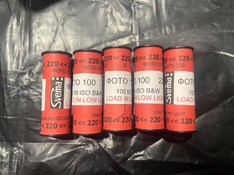
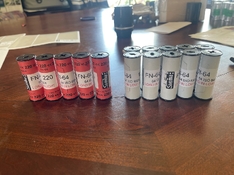
Made some film with the red backing paper today, 5 220 rolls. The 120 is still rolled on recycled paper but I have had great luck with the 220 papers I’ve made so far.
 

Attachments

  • IMG_3408.jpeg
    IMG_3408.jpeg
    414.2 KB · Views: 50
  • IMG_3410.jpeg
    IMG_3410.jpeg
    368.8 KB · Views: 50
Photrio.com contains affiliate links to products. We may receive a commission for purchases made through these links.
To read our full affiliate disclosure statement please click Here.

PHOTRIO PARTNERS EQUALLY FUNDING OUR COMMUNITY:


Ilford ADOX Freestyle Photographic Stearman Press Weldon Color Lab Blue Moon Camera & Machine
Top Bottom