

• Welcome to Photrio!
    Registration is fast and free. Join today to unlock search, see fewer ads, and access all forum features.
    Click here to sign up

Pan F+ is awesome!

PenStocks

A
PenStocks

  • 1
  • 0
  • 31
Landed Here

H
Landed Here

  • 4
  • 3
  • 46

Recent Classifieds

Forum statistics

Threads
201,833
Messages
2,830,868
Members
100,976
Latest member
Gorrunyo
Recent bookmarks
0

Anon Ymous

Member
Allowing Ads
Joined
Feb 7, 2008
Messages
3,679
Location
Greece
Format
35mm
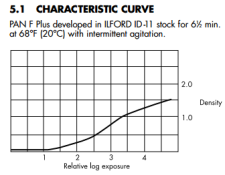
Somehow, I managed to ruin the attached characteristic curve graph in my previous post. Here we go again, PanF+ developed in ID11, according to Ilford (datasheet dated probably 3/1996):

attachment.php


Sorry but there has to be a shoulder; the characteristic curve cannot continue rising to infinity. Actually the term shoulder is a poor one when describing a curve. The correct mathematical term is inflection point. As previously pointed out the curve will always level out and then turn downwards. All characteristic curves have the same general shape regardless of the film or developer. (A graph showing the entire curve is often included in books on photographic development theory.) You can see from Ilford's documentation the curve is beginning to turn horizontal but Ilford truncates the curve just after this point. Kodak does the same thing for its HC-110 developer. Really a poor thing to do as it leads to confusion.

I didn't make myself clear. Indeed, there has to be a shoulder, but it's not always included in a characteristic curve provided in a datasheet. In the current datasheet, the curve is for PanF+ developed in Ilfotec HC, which doesn't show much/any shoulder at the same exposure levels.

My PanF+ bulk best before date was '04, I still get graduation in high lights.
On a 8x10 Delta100 and PanF+ similar...

I don't disagree with you. I was merely pointing out that developer choice (and dilution, agitation) can affect the shape of the characteristic curve. Regardless of that, just because there is a shoulder, it doesn't mean that highlights are blown out, or you don't get graduation. It means that the contrast of the highlights is lower that that of the midtones. If you get too far, then you'll reach the point of no graduation (flat curve), as Gerald points out. In any point, a more upswept curve means more contrast and vice versa. So, there is detail, but getting it on print could be tricky. Or you just don't care and everything is fine. :cool:
 

Attachments

  • panf+_curve.png
    panf+_curve.png
    34.6 KB · Views: 266

JW PHOTO

Member
Allowing Ads
Joined
May 15, 2006
Messages
1,148
Location
Lake, Michig
Format
Medium Format
The prints I have seen by Bill Spears on Pan F+ are stunning. Not sure if he still posts here on APUG though.

I believe he uses Perceptol 1+2 and rates Panf+ at around ISO 20. My two favorite developers for PanF+ are Perceptol 1+2(sometimes 1+3) @ ISO 25-32 for 19 min at 70 degrees and Rodinal 1+100 semi-stand for 1hr at 70 degrees. I really don't know which I like best, but do lean toward the Perceptol for PanF+. I think PanF+ works with many developers, but watch your developing times closely or you're sure to scorch your highlights beyond the burning in stage.
 

markbarendt

Member
Allowing Ads
Joined
May 18, 2008
Messages
9,422
Location
Beaverton, OR
Format
Multi Format
Somehow, I managed to ruin the attached characteristic curve graph in my previous post. Here we go again, PanF+ developed in ID11, according to Ilford (datasheet dated probably 3/1996):

attachment.php

Nice, that is helpful. Very interesting shape, kind of a gentle S, the toe reminds me vaguely of TXP moving gently up to the mid tones, the slight flattening in higher tones is different. Developed this way it seems it could lean toward either "compensating nicely" or "muddy" in the highlights.

I didn't make myself clear. Indeed, there has to be a shoulder, but it's not always included in a characteristic curve provided in a datasheet. In the current datasheet, the curve is for PanF+ developed in Ilfotec HC, which doesn't show much/any shoulder at the same exposure levels.

I don't disagree with you. I was merely pointing out that developer choice (and dilution, agitation) can affect the shape of the characteristic curve. Regardless of that, just because there is a shoulder, it doesn't mean that highlights are blown out, or you don't get graduation. It means that the contrast of the highlights is lower that that of the midtones. If you get too far, then you'll reach the point of no graduation (flat curve), as Gerald points out. In any point, a more upswept curve means more contrast and vice versa. So, there is detail, but getting it on print could be tricky. Or you just don't care and everything is fine. :cool:

I can imagine using this film being shot very nicely on the ID-11 curve by pegging the mid-tones into the steepest section. It would take a bit of testing to find the sweet spot.

The only reasons I haven't spent time and money on Pan-F so far is the speed and that FP-4 is so darn nice to work with, may have to break down and play with it.
 

DREW WILEY

Member
Allowing Ads
Joined
Jul 14, 2011
Messages
14,874
Format
8x10 Format
FP4 is more of a general purpose, mid-speed film, and distinctly versatile. Hard to go wrong with it. There are times when you might want something a bit higher resolution for small camera use. But you are correct in implying that with something like ID-ll or D76, you do want to surf the silvery midtones of a film like Pan F.
 

Xmas

Member
Allowing Ads
Joined
Sep 4, 2006
Messages
6,398
Location
UK
Format
35mm RF
Somehow, I managed to ruin the attached characteristic curve graph in my previous post. Here we go again, PanF+ developed in ID11, according to Ilford (datasheet dated probably 3/1996):

attachment.php


I didn't make myself clear. Indeed, there has to be a shoulder, but it's not always included in a characteristic curve provided in a datasheet. In the current datasheet, the curve is for PanF+ developed in Ilfotec HC, which doesn't show much/any shoulder at the same exposure levels.


I don't disagree with you. I was merely pointing out that developer choice (and dilution, agitation) can affect the shape of the characteristic curve. Regardless of that, just because there is a shoulder, it doesn't mean that highlights are blown out, or you don't get graduation. It means that the contrast of the highlights is lower that that of the midtones. If you get too far, then you'll reach the point of no graduation (flat curve), as Gerald points out. In any point, a more upswept curve means more contrast and vice versa. So, there is detail, but getting it on print could be tricky. Or you just don't care and everything is fine. :cool:
None of my negatives are easy to print, whatever film I use.
 

markbarendt

Member
Allowing Ads
Joined
May 18, 2008
Messages
9,422
Location
Beaverton, OR
Format
Multi Format
None of my negatives are easy to print, whatever film I use.

This is a point that I think is both important and more universal than people think.

To really do photography well takes work.

Many people settle for/are plum happy with, straight printing and they just accept whatever falls onto the paper and view negs that don't straight print easily as failures. I do this a fair bit even, most of us probably do; not every frame we shoot is worth a lot of work and a proof is as far as we might go.

Not all of the work to raise ones game is hard, sometimes it's as simple (and inconvenient) as being willing to use a monopod or tripod or a handheld meter, other times it's a matter of burning and dodging to change the placement of a face on the paper or to bring in more detail in sky or shadow.

For people like George Hurrell it was designing studio sets as needed. Designing a studio set just moves "the burn and dodge work" away from the enlarger and into the studio.
 

DREW WILEY

Member
Allowing Ads
Joined
Jul 14, 2011
Messages
14,874
Format
8x10 Format
There is an enormous Hurrell print in our family collection, and I've had some long conversations with one of Hurrell's still-living long-term
darkroom assistants. Like certain other established portrait studios, he developed certain signature lighting and printing techniques, then
expected his assistants to religiously follow them. Having big 8x10 or 11x14 old-school thick-emulsion films made life a lot easier if you had to make a zitty, freckled, or crowline-wrinkled Hollywood babe look the way people expected them to look, instead of what they actually were. Lots of cresosine dye, smudged soft pencil, burning-in with diffuse sheets. And superb lighting skills in the first place. Interesting stuff, and in many ways easier to do old-school style than using the modern Photoshop clone programs. Pan-F is not such a film; but in soft lighting there is no reason why excellent Caucasian portraits could not be done with it. For mixed ethnicity group shots, or dark
complexions per se, I really prefer a fine-grained, soft-edge film that digs way down, with excellent shadow separation, like TMax. FP4
would work unless the lighting ratio is extreme, which sometimes is a problem in unposed outdoor portraiture. Hurrel did a mix of studio
lighting, including some relatively hard fresnels, Arri I presume. I still have my Arri gear, just in case.
 

Hatchetman

Member
Allowing Ads
Joined
May 27, 2011
Messages
1,553
Location
Chicago, IL
Format
Multi Format
Here's a print from 35mm PanF+ @25, DD-X 9 minutes. Some genius here told me to try that. Works great. Scan isn't great, but building back left is almost white in bright sun. There is more shadow detail in the negative, but that's not how I printed it.

Monroe St Bridge by Rob F, on Flickr
 

Xmas

Member
Allowing Ads
Joined
Sep 4, 2006
Messages
6,398
Location
UK
Format
35mm RF
This is a point that I think is both important and more universal than people think.

To really do photography well takes work.

Many people settle for/are plum happy with, straight printing and they just accept whatever falls onto the paper and view negs that don't straight print easily as failures. I do this a fair bit even, most of us probably do; not every frame we shoot is worth a lot of work and a proof is as far as we might go.

Not all of the work to raise ones game is hard, sometimes it's as simple (and inconvenient) as being willing to use a monopod or tripod or a handheld meter, other times it's a matter of burning and dodging to change the placement of a face on the paper or to bring in more detail in sky or shadow.

For people like George Hurrell it was designing studio sets as needed. Designing a sthudio set just moves "the burn and dodge work" away from the enlarger and into the studio.

All to apt.
When I shoot (shot) weddings kchrome 25 every frame was perfect apart from a distressing frequency of closed eyes.
And they went on cibachrome after a single test strip. Sometimes I needed to train a bridesmaid how to use a reflector.

Monochrome street shoots I can waste a box of 8x10 and a weekend and they are each (all) rejects.
 

markbarendt

Member
Allowing Ads
Joined
May 18, 2008
Messages
9,422
Location
Beaverton, OR
Format
Multi Format
Cool info Drew
 

markbarendt

Member
Allowing Ads
Joined
May 18, 2008
Messages
9,422
Location
Beaverton, OR
Format
Multi Format
All to apt.
When I shoot (shot) weddings kchrome 25 every frame was perfect apart from a distressing frequency of closed eyes.
And they went on cibachrome after a single test strip. Sometimes I needed to train a bridesmaid how to use a reflector.

Monochrome street shoots I can waste a box of 8x10 and a weekend and they are each (all) rejects.

Great examples
 
Photrio.com contains affiliate links to products. We may receive a commission for purchases made through these links.
To read our full affiliate disclosure statement please click Here.

PHOTRIO PARTNERS EQUALLY FUNDING OUR COMMUNITY:


Ilford ADOX Freestyle Photographic Stearman Press Weldon Color Lab Blue Moon Camera & Machine
Top Bottom
