
• Welcome to Photrio!
    Registration is fast and free. Join today to unlock search, see fewer ads, and access all forum features.
    Click here to sign up

Palladium toner staining paper (reacting with fixer)

Kulwulton River in Flood

A
Kulwulton River in Flood

  • sly
  • Feb 5, 2026
  • 2
  • 0
  • 22
MV Shirley

A
MV Shirley

  • 2
  • 0
  • 24

Recent Classifieds

Forum statistics

Threads
202,177
Messages
2,836,298
Members
101,151
Latest member
Ceylon
Recent bookmarks
0

cirwin2010

Member
Joined
Jan 3, 2021
Messages
249
Location
Massachussetts
Format
Analog
I've been having issues with palladium toner staining my paper once placed in the fixing bath. To rule out that this is not due to any of the steps in my process for Kallitypes, I performed the expirment below. I do want to stress that I ONLY put paper directly into the toner. No sensitizer, development, or clearing bath were used for my tests. The issue is exclusively with the toner, fixer, and paper.

1. Soak a piece of fresh paper in the palladium toner for 15 minutes
2. Rinse for 20 seconds
3. Cut paper in half
4. Fix half of paper for 2 minutes
5. Compare fixed paper with unfixed paper.

Palladium toner formula:
-1L water
-10g citric acid
-15 drops of Sodium Chloropalladite 15% solution

Fixer formula:
-1L water
-50g of sodium thiosulfate

Paper:
Legion Revere Platinum


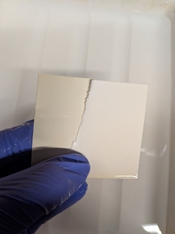
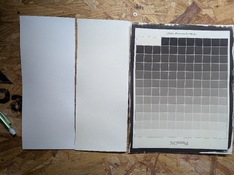
As you can see in the attached image (where I am holding the paper), there is a very distinct yellow stain. This only appear after the paper enters the fixer and gets worse when the paper dries and is unsightly (see image of test strips). The stain is present on the front and back of the paper and almost looks like tea toning. It does not wash out once stained despite by best efforts.

I did a bunch of testing and came to the following conclusions:
1. Stain is dependent on toner strength (fresh vs exhausted)
2. Stain is dependent on duration in toner (5 minutes yeilds less stain than 15 minutes)
3. Stain is dependent on wash prior to fixing (less stain with longer wash time -- I could not completely clear the paper)
4. Stain is NOT dependent on fix time (appears immediately)
5. Platinum toner (Potassium Tetrachloroplatinate) does NOT stain the paper
6. Stain is paper dependent (Hahnemühle Platinum Rag has comparatively minimal stain)

My best guess is the palladium salt is getting embedded (or reacting) with the paper fibers or paper sizing then reacting with the sodium thiosulfate to form either metallic palladium or some other visible, insoluble compound. But I'm not a chemist so I couldn't say for sure.

Has anyone managed to solve this problem? I did order some amount of palladium solution instead of platinum because it was cheaper... oops?
 

Attachments
  • PXL_20251214_034349708.jpg
    PXL_20251214_034349708.jpg
    1.6 MB · Views: 37
  • PXL_20251214_024834895.jpg
    PXL_20251214_024834895.jpg
    644.3 KB · Views: 35
Last edited:
OP
OP

cirwin2010

Member
Joined
Jan 3, 2021
Messages
249
Location
Massachussetts
Format
Analog
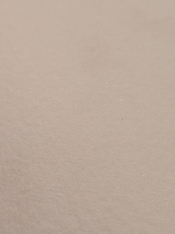
Another interesting discover. I was making some new calibration profiles for my Arches Aquarelle cold press paper and noticed that the sheet I palladium toned literally sparkles. Not just where the paper was coated with the sensitizer, but also the uncoated back side. Might lend credence to the stain being metallic palladium?
Almost looks like a very fine glitter at certain angles. Its kinda cool tbh.
 

Attachments

  • PXL_20251214_232745951.MACRO_FOCUS.jpg
    PXL_20251214_232745951.MACRO_FOCUS.jpg
    654.8 KB · Views: 30
OP
OP

cirwin2010

Member
Joined
Jan 3, 2021
Messages
249
Location
Massachussetts
Format
Analog
I tried a few things and I could not fix (no pun intended) the staining issue with the palladium toner. I tried a few things such as acid baths before and after fixing, very long washes, etc, but to no avail.
My conclusion are still as such.

1. Palladium toner will stain paper
2. Time and strength of toner determines the level of stain
3. Paper choice determines the level of stain
4. Platinum toner does not stain
5. The palladium toner stain does not appear until the paper is placed in a sodium thiosulfate bath

The stain is not very strong with HPR paper which is what I think many folks use and may be why this issue is not widely reported.

I was also unable to reproduce the sparkly Arches Aquarelle paper phenomena despite by best efforts. I thought I knew the variables that lead to that result, but I'm definitely missing something from the equation. If I knew if the sparkly crystals were silver or palladium would help.

Maybe one day I'll create some sort of resource online documenting some of this for the community, but these forum posts will have to do for now.
 

mshchem

Subscriber
Allowing Ads
Joined
Nov 26, 2007
Messages
16,193
Location
Iowa City, Iowa USA
Format
Medium Format
I tried a few things and I could not fix (no pun intended) the staining issue with the palladium toner. I tried a few things such as acid baths before and after fixing, very long washes, etc, but to no avail.
My conclusion are still as such.

1. Palladium toner will stain paper
2. Time and strength of toner determines the level of stain
3. Paper choice determines the level of stain
4. Platinum toner does not stain
5. The palladium toner stain does not appear until the paper is placed in a sodium thiosulfate bath

The stain is not very strong with HPR paper which is what I think many folks use and may be why this issue is not widely reported.

I was also unable to reproduce the sparkly Arches Aquarelle paper phenomena despite by best efforts. I thought I knew the variables that lead to that result, but I'm definitely missing something from the equation. If I knew if the sparkly crystals were silver or palladium would help.

Maybe one day I'll create some sort of resource online documenting some of this for the community, but these forum posts will have to do for now.

Watch the sparkles for tarnish. Palladium metal should keep it's sparkles. Expensive process 😎
 
OP
OP

cirwin2010

Member
Joined
Jan 3, 2021
Messages
249
Location
Massachussetts
Format
Analog
I had not seen this! This person is describing my experience exactly. During my testing I did try Arista hypo wash, but I didn't get any change from this. But... it was mixed up at least 2 years ago at this point and it contains more than just sodium sulfite (potassium metabisulfite and disodium EDTA).

I don't usually use hypo clearing agents in my darkroom as I usually elect to just wash my prints for 30-60 minutes. Never had been an issue and I have a nice print washer for my silver gelatin paper. I digress...

I looked through my chemistry and it turns out I do have some sodium sulfite. I'm going to try this later and post the results.

Thanks!
 

revdoc

Member
Allowing Ads
Joined
Apr 12, 2015
Messages
318
Format
35mm
Definitely time to freshen up your hypo clear. In solution, sodium sulfite slowly oxidises to sodium sulfate. If it's more than a few months old, I'd discard it. Same thing if it has been used a lot.
 

nmp

Member
Allowing Ads
Joined
Jan 20, 2005
Messages
2,101
Location
Maryland USA
Format
35mm
Sodium thiosulfate is a mild reducing agent. So it might be reducing palladium salt to metallic palladium. Or perhaps it is forming some from of complex with it that is not easy to wash out. Which means, as suggested by @RalphLambrecht above, a thorough wash prior to fixing might be required to remove all presence of the toner before fixing can be done.

:Niranjan.
 

retina_restoration

Member
Allowing Ads
Joined
Jan 28, 2023
Messages
1,608
Location
Wilammette Valley, Oregon
Format
35mm RF
During my testing I did try Arista hypo wash, but I didn't get any change from this. But... it was mixed up at least 2 years ago at this point and it contains more than just sodium sulfite (potassium metabisulfite and disodium EDTA).

These packaged hypo clearing agents don't last that long. My guess is that the clearing agent is way past it's "best before" date and is not doing its job.

I no longer use these pre-made clearing agents and rely instead on making it fresh every time from Sodium sulfite powder. It's simple to dissolve a teaspoon of it in a liter of water and away you go — easy and reliable.
 
OP
OP

cirwin2010

Member
Joined
Jan 3, 2021
Messages
249
Location
Massachussetts
Format
Analog
I didn't spend too long testing this, but sodium thiosulfate does seem to do the trick! I used a 3% solution for 1 minute. This looked sufficient when wet, but there is still some stain I can see after drying. Likely needed longer in the solution or a stronger solution.

Sodium thiosulfate is a mild reducing agent. So it might be reducing palladium salt to metallic palladium. Or perhaps it is forming some from of complex with it that is not easy to wash out. Which means, as suggested by @RalphLambrecht above, a thorough wash prior to fixing might be required to remove all presence of the toner before fixing can be done.

:Niranjan.

I'd be curious to know what is going on between the palladium toner, paper base, and sodium thiosulfate. The paper is involved to some degree. I did try putting small amounts of solution together to see if it would change color, but it doesn't. Also the stain varies from paper to paper.
I also did some testing with washing between toning and fixing. This reduces the stain, but only by so much. I didn't see a difference between a 5 minute wash or a 30 minute wash.
 
Photrio.com contains affiliate links to products. We may receive a commission for purchases made through these links.
To read our full affiliate disclosure statement please click Here.

PHOTRIO PARTNERS EQUALLY FUNDING OUR COMMUNITY:


Ilford ADOX Freestyle Photographic Stearman Press Weldon Color Lab Blue Moon Camera & Machine
Top Bottom