Here are a few takeaways from my test with the material. This will concern the NC 500 emulsion. The NC 400 emulsion will be discussed in another post at a later date.
The tests were conducted with material cut down from long rolls with BH 1866 perforation, not with 135-36 finished material.
I've been fortunate enough to have been able to (technically) test a few stages of the emulsion over the last months and must say, that they have come a long way. Making a color film from scratch is not an easy task - some would have called it impossible. Yet, Orwo and the engineers and emulsioneers at Innoviscoat managed to come up with a new color emulsion - in record time. I suggest to take a moment to appreciate this.
Many here and elsewhere have been very sceptical and sometimes even demeaning. If you have a problem with the brand, or those associated with it, please refrain from commenting - marketing and distribution of the product is not subject of my short review here. I want to talk about the emulsion.
Film Speed:
Even though the Film is called NC 500, the sensitometrically determined film speed of the emulsion, processed in a monitored ECN-2 process is close to 320. Under practical conditions, I suggest the film be exposed at E.I. 250.
Granularity:
Compared to 5219 and 5207, Orwo NC500 is noticeably grainier. This, however, isn't necessarily a bug, but more a feature. The film is not a Vision3 emulsion, and does not even come close. But it does not have to, in my opinion. Compared to any available modern emulsion, the NC 500 has a distinct grain structure / dye distribution pattern that resembles early chromogenic emulsions. Some will like the look, others will not. That's a matter of personal taste.
Sharpness:
Sharpness and especially acutance could be improved upon, but again, in this regard as well the film is distinctly not a Vision3 film.
Antihalation:
Since the film has no remjet backing, one might assume halations could be an issue. However, I am pleased to say that the integral anti halation layer present in the emulsion works very well in surpressing both reflection and diffusion halations.
Color Reproduction:
Color Saturation is overall on the lower end of the spectrum. Especially the yellow dye forming layer fails to form sufficient dye density, which results in muted blues, especially apparent in a blue sky. Overall color reproduction is acceptable.
Conclusion
Someone who only shoots on 5203 / 50D will probably not enjoy NC 500. If you like to try a new look that is distinctly not as clean as Vision3, or any other Kodak / Fuji Stock for that matter, but more in line of color negative films found in the late 1960s and early 1970s, this might be a good way to explore that route.
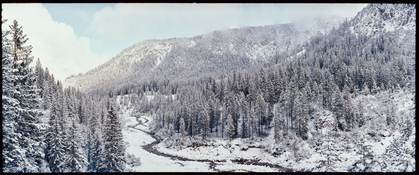
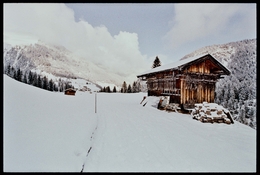
Here are a few example shots taken last weekend in the mountains:
The tests were conducted with material cut down from long rolls with BH 1866 perforation, not with 135-36 finished material.
I've been fortunate enough to have been able to (technically) test a few stages of the emulsion over the last months and must say, that they have come a long way. Making a color film from scratch is not an easy task - some would have called it impossible. Yet, Orwo and the engineers and emulsioneers at Innoviscoat managed to come up with a new color emulsion - in record time. I suggest to take a moment to appreciate this.
Many here and elsewhere have been very sceptical and sometimes even demeaning. If you have a problem with the brand, or those associated with it, please refrain from commenting - marketing and distribution of the product is not subject of my short review here. I want to talk about the emulsion.
Film Speed:
Even though the Film is called NC 500, the sensitometrically determined film speed of the emulsion, processed in a monitored ECN-2 process is close to 320. Under practical conditions, I suggest the film be exposed at E.I. 250.
Granularity:
Compared to 5219 and 5207, Orwo NC500 is noticeably grainier. This, however, isn't necessarily a bug, but more a feature. The film is not a Vision3 emulsion, and does not even come close. But it does not have to, in my opinion. Compared to any available modern emulsion, the NC 500 has a distinct grain structure / dye distribution pattern that resembles early chromogenic emulsions. Some will like the look, others will not. That's a matter of personal taste.
Sharpness:
Sharpness and especially acutance could be improved upon, but again, in this regard as well the film is distinctly not a Vision3 film.
Antihalation:
Since the film has no remjet backing, one might assume halations could be an issue. However, I am pleased to say that the integral anti halation layer present in the emulsion works very well in surpressing both reflection and diffusion halations.
Color Reproduction:
Color Saturation is overall on the lower end of the spectrum. Especially the yellow dye forming layer fails to form sufficient dye density, which results in muted blues, especially apparent in a blue sky. Overall color reproduction is acceptable.
Conclusion
Someone who only shoots on 5203 / 50D will probably not enjoy NC 500. If you like to try a new look that is distinctly not as clean as Vision3, or any other Kodak / Fuji Stock for that matter, but more in line of color negative films found in the late 1960s and early 1970s, this might be a good way to explore that route.
Here are a few example shots taken last weekend in the mountains: