• Welcome to Photrio!
    Registration is fast and free. Join today to unlock search, see fewer ads, and access all forum features.
    Click here to sign up

One film and one developer or many films and developers ?

PenStocks

A
PenStocks

  • 3
  • 0
  • 41
Landed Here

H
Landed Here

  • 4
  • 5
  • 56

Recent Classifieds

Forum statistics

Threads
201,835
Messages
2,830,898
Members
100,977
Latest member
Earl_matveev
Recent bookmarks
0

markbarendt

Member
Allowing Ads
Joined
May 18, 2008
Messages
9,422
Location
Beaverton, OR
Format
Multi Format
This is fine for the context of history and arguments of semantics. Taking pictures; the act of pointing a camera at an object or scene and exposing a light sensitive material to capture an image. No more, no less.

I think it should be noted that an enlarger can and should be considered a camera. The object (scene) being photographed is the negative (or negatives), the paper is the light sensitive material.
 

eddie

Member
Allowing Ads
Joined
Jul 24, 2005
Messages
3,259
Location
Northern Vir
Format
Multi Format
When I taught photography, I had a one film/one developer rule for their first 20 rolls (Plus-X/D76). After that, they were allowed to change either film, or developer, for a minimum of 10 rolls. After that, all choices were their own. The lessons learned by sticking to one combination, through variations in exposure/time/temperature carried over when the students switched things up. They were high school students, most without any previous experience. The regimen gave them the ability to get consistent, repeatable results, and understand what changes to the variables did . As they experimented with different film/developer combinations, they had a better idea of what altering the variables would do, and quickly got a good handle on the new combinations. I think the one/one rule is a must for beginners. Photography is a science. As such, it should (at least initially) be treated in a scientific manner.
A rather long-winded way to say I agree with Gerald.
 

nolanr66

Member
Allowing Ads
Joined
Feb 5, 2006
Messages
283
Format
35mm
Flickr is a good way to see how people are using a film. Technically though, it probably reveals more about people's scanning and post processing skills than it does about the underlying qualities of a particular film.

True enough but it's still a tool that I can use. Nobody around here has bought a roll of film in a decade so it's not like I can go look at a photo on paper someplace. Anyway I am going to skip 3200 and stick with 400. My next roll will be shot at 400 because I am going to take photos that I want tomorrow and then on Sunday I can shoot a test roll of Delta 400 and push it 1 stop and see how that goes. Probably 800 speed will be fast enough for me. I have a digital system also and it's not retired.
 
Last edited by a moderator:

Pioneer

Member
Joined
May 29, 2010
Messages
3,993
Location
Elko, Nevada
Format
Multi Format
This evening I developed three different films in three different developers so I guess I officially belong to the multiple films/multiple developers side. However, to be fair, 5 of the rolls were TMAX100 developed in D76. :D
 

Old-N-Feeble

Member
Allowing Ads
Joined
Feb 22, 2012
Messages
6,805
Location
South Texas
Format
Multi Format
Leonardo used an experimental and untried method when he painted his masterpiece The Last Supper. However within a year the painting was flaking off the wall. The monastery was not pleased and at a later date had a doorway cut thru the wall. That shows what little was thought of it. Most of what we see today is not Leonardo's work but that of various restorers over the centuries. Shows what happens when you stray from proven methods, at least toward serious work. If a person's main objective is not taking photographs then I don't know what that person would be.<snip>


Uh huh... and what of his other works which have lasted through the ages??
 

nolanr66

Member
Allowing Ads
Joined
Feb 5, 2006
Messages
283
Format
35mm
This evening I developed three different films in three different developers so I guess I officially belong to the multiple films/multiple developers side. However, to be fair, 5 of the rolls were TMAX100 developed in D76.

That's a busy day. I am not on either side of that discussion as I just figure a person can do what they want.
 

Gerald C Koch

Member
Allowing Ads
Joined
Jul 12, 2010
Messages
8,131
Location
Southern USA
Format
Multi Format
Uh huh... and what of his other works which have lasted through the ages??

The Last Supper was probably the best known but there were other paintings that also suffered from experimental methods. It seems that Leonardo was quite a tinkerer. The key here is which ones lasted.

"Because of the method used, soon after the painting was completed on February 9, 1498 it began to deteriorate.[11] As early as 1517, the painting was starting to flake. By 1556 — fewer than sixty years after it was finished — Leonardo's biographer Giorgio Vasari described the painting as already "ruined" and so deteriorated that the figures were unrecognizable. By the second half of the sixteenth century Gian Paolo Lomazzo stated that, “…the painting is all ruined."
 
Last edited by a moderator:

Old-N-Feeble

Member
Allowing Ads
Joined
Feb 22, 2012
Messages
6,805
Location
South Texas
Format
Multi Format
Well then, future painters learned what not to do via Leonardo's experimentation. :smile:
 

KidA

Member
Allowing Ads
Joined
Dec 30, 2014
Messages
217
Format
Multi Format
I'd like to ask all of those who are strict one film, one dev users (or at least have been down that path), HOW or WHY they came to choose that combination. Was it a direct influence from where you learned (and fell in love with) photography for the first time? Was it dabbling and re-falling in love again? Or was it 10 rolls each of films a, b, and c and same for developers? This combination would take me years, maybe decades to actually decide! (I go thru only a few rolls a month...)

P.S. All this talk about pyro I hear... can't help but be tempted. Anyone have thoughts, experiences with this developer?
 

Gerald C Koch

Member
Allowing Ads
Joined
Jul 12, 2010
Messages
8,131
Location
Southern USA
Format
Multi Format
In my case it was to simplify my method. That would be to fully understand a film/developer combination so that there are no surprises in the darkroom. I very, very seldom encounter the infamous "unprintable" negative. When I press the shutter I know exactly what I am going to see in the print. As to an influence I would have to say famous photographers like Ansel Adams, Edward Weston and G. Paul Bishop who did the same thing. Anyone whose has seen documentaries of Weston are aware of the utter simplicity of his method. This is evidenced in his camera work and darkroom. In the last documentary I watched the only bit of technology in his darkroom was a dial thermometer. No enlarger, no timers, no densitometers, ... However I do use an enlarger timer.
 
Last edited by a moderator:

Sirius Glass

Subscriber
Joined
Jan 18, 2007
Messages
50,814
Location
Southern California
Format
Multi Format
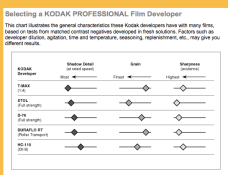
When I started developing film again I did some research and found this.
attachment.php

at http://www.kodak.com/global/en/prof...wFilmProcessing/selecting.jhtml?pq-path=14053

I selected XTOL. After using it a while and seeing what others said about it I tried replenished XTOL. Replenished XTOL is my main developer. At the recommendation of Per Volquartz I use Rollo Pyro for some of my MF and LF processing in the Jobo processor. Rollo Pyro is better for the larger formats.
 

Attachments

  • Screen Shot 2016-01-25 at 10.50.56 AM.png
    Screen Shot 2016-01-25 at 10.50.56 AM.png
    43.8 KB · Views: 156

KidA

Member
Allowing Ads
Joined
Dec 30, 2014
Messages
217
Format
Multi Format
At the recommendation of Per Volquartz I use Rollo Pyro for some of my MF and LF processing in the Jobo processor. Rollo Pyro is better for the larger formats.

Why the larger formats only? What words would you use to describe the print feel compared to something like XTOL? You mentioned 'some of [your] MF and LF...' what is it that makes you decide between the two?
 

Sirius Glass

Subscriber
Joined
Jan 18, 2007
Messages
50,814
Location
Southern California
Format
Multi Format
I am still experimenting with Rollo Pyro. I think it give better tonality, but for 35mm the grain is finer with replenished XTOL.
 

markbarendt

Member
Allowing Ads
Joined
May 18, 2008
Messages
9,422
Location
Beaverton, OR
Format
Multi Format
I am still experimenting with Rollo Pyro. I think it give better tonality, but for 35mm the grain is finer with replenished XTOL.

Lately I've been using RolloPyro for all my B&W and quite happy, my impression is that you are right Sirius. (No objective test.)

It is also my impression that RolloPyro gives a slightly sharper result than Xtol or DD-X.

KidA, please note that while I agree with Sirius, I also think that we are fiddling about around the margins. The difference in sharpness between a replenished Xtol negative and a RolloPyro negative is a small thing, not make or break. The difference in tonality is a subjective measure, not an objectively better or worse thing, just an "I prefer this or that" thing.
 

Sirius Glass

Subscriber
Joined
Jan 18, 2007
Messages
50,814
Location
Southern California
Format
Multi Format
Thanks Mark, I agree that there is not a whole lot of difference, however the grain in 35mm, I was told is larger with Rollo Pyro. The Rollo Pyro has an advantage in processing using Per Volquartz's development process.

This development process in not sensitive to temperature.

Presoak in solution A for 5 minutes. Pour off solution A and save it.
Develop in solution B for 6 to 7½ minutes. Dump solution B
Wash with water: two baths of 30 seconds each
Use TF4 or TF5 hypo for 5 minutes
Wash with water: two baths of 30 seconds each
Soak in solution A for 2 minutes; this is the stain part. Dump solution A
Wash for 15 to 20 minutes.
 

markbarendt

Member
Allowing Ads
Joined
May 18, 2008
Messages
9,422
Location
Beaverton, OR
Format
Multi Format
Thanks Mark, I agree that there is not a whole lot of difference, however the grain in 35mm, I was told is larger with Rollo Pyro.

Maybe. Pure opinion here, but I haven't noticed enough difference to matter.

I use the process listed here less the after bath of "C", losing the after bath eliminates the general stain. The image itself still has a nice stain though. I've done it both ways and got good results so IDK if one or the other is better.

http://stores.photoformulary.com/content/01-5070.pdf
 
OP
OP
John Bragg

John Bragg

Member
Allowing Ads
Joined
Nov 29, 2005
Messages
1,039
Location
Cornwall, UK
Format
35mm
I'd like to ask all of those who are strict one film, one dev users (or at least have been down that path), HOW or WHY they came to choose that combination. Was it a direct influence from where you learned (and fell in love with) photography for the first time? Was it dabbling and re-falling in love again? Or was it 10 rolls each of films a, b, and c and same for developers? This combination would take me years, maybe decades to actually decide!

In my case it was a result of being dissatisfied with the unpredictability of chopping and changing so I used Tri-X and HC-110 for years but became concerned that Kodak may go under when they were in trouble. It was then a case of looking for a credible alternative just in case. I tried Ilford Delta 400 and HP5+ and decided that the HP5+ was more me and more suited to my tastes even than the familiar Tri-X. I now have a combination that is hard to better and I can substitute Tri-X if needed. There are subtle differences but I find that HP5+ holds shadow details better and is grainy enough without being over the top. In fact it looks more like the "Old" Tri-X that I loved more than the "New" Tri-X..
 

Sirius Glass

Subscriber
Joined
Jan 18, 2007
Messages
50,814
Location
Southern California
Format
Multi Format
I did not realize that the solution C reduces the staining at the end. Thank you.
 

markbarendt

Member
Allowing Ads
Joined
May 18, 2008
Messages
9,422
Location
Beaverton, OR
Format
Multi Format
I did not realize that the solution C reduces the staining at the end. Thank you.

No not a reduction.

The solution C after bath "provides" a general stain, on rebate, between frames, everywhere.

Without the after bath the rebate is just as clear as with Xtol, DD-X, D-76, etc... The stain without the after bath, is only in the image area.
 

Sirius Glass

Subscriber
Joined
Jan 18, 2007
Messages
50,814
Location
Southern California
Format
Multi Format
Does the solution C provide uniform or proportional staining?
 

removed account4

Subscriber
Allowing Ads
Joined
Jun 21, 2003
Messages
29,832
Format
Hybrid
I'd like to ask all of those who are strict one film, one dev users (or at least have been down that path), HOW or WHY they came to choose that combination. Was it a direct influence from where you learned (and fell in love with) photography for the first time? Was it dabbling and re-falling in love again? Or was it 10 rolls each of films a, b, and c and same for developers? This combination would take me years, maybe decades to actually decide! (I go thru only a few rolls a month...)

P.S. All this talk about pyro I hear... can't help but be tempted. Anyone have thoughts, experiences with this developer?

hi kidA

when i was living in a cheap loft
i ran out of money. i was film and paper rich
and barely had enough money for my rent and food.
i found a red and white can of " gaf universal developer" that
had been sitting on a drafty windowsill for probably 25 years. i had
never heard of gaf universal, and i mixed it up. it was 5 gallons, and i
processed all my film and paper in it continuously for a summer before
it went bad. ... i ran out of developer and money and eventually found
work and used a few other developers that didn't really cut the mustard,
so a couple of years later i got a photo lab index and had a conversation
with a guy names jc welch who owns equinox photographic. he knew of
gaf universal and didn't really know what it was but suggested i use ansco130
and it might have been the same stuff, so i did. that was around 1999-2003
i don't remember exactly but it began a long long relationship
i had with ansco 130. i used about 6 or 8 gallons of it a year, i'd buy it all at once
and mix it all at once and just use it until i ran out ( it has a mixed stock shelf life of a year )
and i'd buy some more .. i used it as a print developer and used it as a film developer. i put every film i could find in it.
it ended up being armloads ( thousands of sheets of tri x, tmx(100) and tmy(400) (4x5 and 5x7, and some 8x10 )
as well as every kodak, and ilford, sometimes foma and forte 35mm and 120 roll i cold find ( again thousands of them ).
the directions on the gaf-can said 1:1. 1:2paper, and 1:6 film and something like 6mins@68ºF so that is what i did with 130.
eventually i changed the dilutions to see what would happen if it was more or less dilute, if it was replenished,
exhausted, done in deep tanks or trays, or hand tanks, stand, semi stand, with hangers, rotary processors ..
i used this developer every way i could so i knew it backwards and forwards with every film i could find, expired,
fresh, papers expired fresh, and liquid emulsions too. about 5-6 years into this love affair
i met up with caffenol c .. and used that the same way too, and decided to break rank, and add 10-20 drams ( about 1-2oz )
of ansco 130 into the coffee and it worked great.
they were the perfect compliments for each other- easy to mix, easy to use, and PREDICTABLE ...
i used this developer like this for about 10 years. about 4 of those 10 years i sourced my own coffee
and roasted it myself for this coffee developer i eventually decided to use the ansco130 split processing so the A130 as a 1st bath developer
for 1/2 the development time and the coffee developer ( with a little ansco130 mixed in ) for the other half.
i did this for a couple of years too for both sheets and rolls until i ran out of ansco130 and didnt' want to pony up the cash for a few more gallons of it.
eventually after a bunch of tests i decided dektol would work just as well as ansco 130 and i could use up the few gallon packets i have on hand,
and lately i have scratch-mixed D72 ( pretty much the same thing as dektol ) and i have been using dektol and caffenol c
as my main print and film developer for about a year maybe more. i can't really complain.
a little bit of dektol ( or ansco 130 ) in 3-4 L of caffenol gives it an enormous shelf life
( i have procesed hundreds of sheets of paper and film ( rolls and sheets ) without replenishment ...

as for the reason why ... i like to know my chemistry and film backwards and forwards and not have any surprises
i like to know how it will work in any situation, so i use a developer and film until ... i know.

as with everything YMMV ...

good luck with your developer search !

 

markbarendt

Member
Allowing Ads
Joined
May 18, 2008
Messages
9,422
Location
Beaverton, OR
Format
Multi Format
Does the solution C provide uniform or proportional staining?

The process I use starts with C as prewash, this bath does not seem to add a uniform stain. IDK if it contributes to the proportional staining.

The C after bath that is suggested in the directions seems to add uniform stain.

I have no idea why, this is simply my observation.
 

MattKing

Moderator
Moderator
Allowing Ads
Joined
Apr 24, 2005
Messages
55,191
Location
Delta, BC Canada
Format
Medium Format
OP...I generally stuck with plain Jane D-76 and sometime Microdol X. But, I just did down and dirty doc and street work...

nsfw

http://danielteolijr.tumblr.com/

...maybe someone else needs a special developer for their film needs.

For paper, it was Dektol. It worked fine for me with Kodak, DuPont and Agfa Brovira papers.

https://danielteolijr.wordpress.com/2015/03/27/a-silver-gelatin-print-versus-an-inkjet-print/

You go to understand, a lot of the current film devotees like it for the chemistry and not for making great photos. I hated the chemistry...all I wanted was the photos.
Why are you here?
 

Gerald C Koch

Member
Allowing Ads
Joined
Jul 12, 2010
Messages
8,131
Location
Southern USA
Format
Multi Format
No not a reduction.

The solution C after bath "provides" a general stain, on rebate, between frames, everywhere.

Without the after bath the rebate is just as clear as with Xtol, DD-X, D-76, etc... The stain without the after bath, is only in the image area.

Yes. Re-immersing the film in an alkaline solution or used developer only creates an overall stain and does not contribute to the image. At the point where bath/solution C is used all the silver halide has been removed from the film. Using C only makes the negative harder to print. Think of it as just adding fog to the negative. One of the reasons that I dislike staining development is all the mythology that has grown up around it. Most of it is bad science.
 
Last edited by a moderator:
Photrio.com contains affiliate links to products. We may receive a commission for purchases made through these links.
To read our full affiliate disclosure statement please click Here.

PHOTRIO PARTNERS EQUALLY FUNDING OUR COMMUNITY:


Ilford ADOX Freestyle Photographic Stearman Press Weldon Color Lab Blue Moon Camera & Machine
Top Bottom