
So people claim you can push and pull your film and even develop different films together with Stand and still get the full tonal range. That just didn't make sense to me so I sacrificed a roll and tried it.
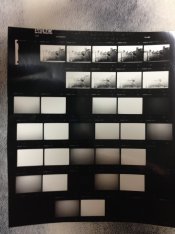
Tri-X in Rodinal 1:100 (500ml distilled water) for one hour semi-Stand.
Meter settings as follows:
Scene:
400, 500, 640, 800;
320, 250, 200, 160;
Grey wall (N, +3, -4):
400, 320;
250, 200;
160, 500;
640, 800;
1250;
Results are hard to judge without looking at the actual proof.
The proof sheet was exposed for minimum time for maximum black.
I can see a difference in shades all the way down to ISO500. At a filter setting of 2.5 on my diffusion LPL the print of the scene also looks best at 500ISO.
So it seems that Stand indeed increases emulsion speed but as you can see it clearly still matters how you expose the film. 800ISO and above is clearly underexposed and I haven't even tried 1600.
The grain is obviously more noticeable than what I get with Xtol.
Tri-X in Rodinal 1:100 (500ml distilled water) for one hour semi-Stand.
Meter settings as follows:
Scene:
400, 500, 640, 800;
320, 250, 200, 160;
Grey wall (N, +3, -4):
400, 320;
250, 200;
160, 500;
640, 800;
1250;
Results are hard to judge without looking at the actual proof.
The proof sheet was exposed for minimum time for maximum black.
I can see a difference in shades all the way down to ISO500. At a filter setting of 2.5 on my diffusion LPL the print of the scene also looks best at 500ISO.
So it seems that Stand indeed increases emulsion speed but as you can see it clearly still matters how you expose the film. 800ISO and above is clearly underexposed and I haven't even tried 1600.
The grain is obviously more noticeable than what I get with Xtol.