

• Welcome to Photrio!
    Registration is fast and free. Join today to unlock search, see fewer ads, and access all forum features.
    Click here to sign up

Not so Magical Powers of Stand Development

feeling grey

A
feeling grey

  • 0
  • 0
  • 16
Inconsequential

H
Inconsequential

  • 2
  • 0
  • 31

Recent Classifieds

Forum statistics

Threads
201,798
Messages
2,830,384
Members
100,961
Latest member
pisimimail
Recent bookmarks
0

ericdan

Member
Allowing Ads
Joined
Feb 28, 2014
Messages
1,359
Location
Tokyo
Format
35mm RF
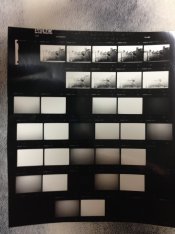
So people claim you can push and pull your film and even develop different films together with Stand and still get the full tonal range. That just didn't make sense to me so I sacrificed a roll and tried it.

Tri-X in Rodinal 1:100 (500ml distilled water) for one hour semi-Stand.
Meter settings as follows:
Scene:
400, 500, 640, 800;
320, 250, 200, 160;

Grey wall (N, +3, -4):
400, 320;
250, 200;
160, 500;
640, 800;
1250;

Results are hard to judge without looking at the actual proof.
The proof sheet was exposed for minimum time for maximum black.
I can see a difference in shades all the way down to ISO500. At a filter setting of 2.5 on my diffusion LPL the print of the scene also looks best at 500ISO.

So it seems that Stand indeed increases emulsion speed but as you can see it clearly still matters how you expose the film. 800ISO and above is clearly underexposed and I haven't even tried 1600.
The grain is obviously more noticeable than what I get with Xtol.
 

Attachments

  • IMG_1165.JPG
    IMG_1165.JPG
    583.5 KB · Views: 248

markbarendt

Member
Allowing Ads
Joined
May 18, 2008
Messages
9,422
Location
Beaverton, OR
Format
Multi Format
So, by different films they are suggesting developing a roll of Tri-X, a roll of HP5, a roll of Delta 400, and a roll of Acros, all in the same tank. That wasn't tested here.

As to various EI settings across a given roll, that's normal with a 'normal' developing schemes too.

As to push (plus development) and pull (minus development) with stand development well not really. They are all developed the same way, everything on your test roll has the same shape of film curve only the exposure changed.
 
OP
OP
ericdan

ericdan

Member
Allowing Ads
Joined
Feb 28, 2014
Messages
1,359
Location
Tokyo
Format
35mm RF
couldn't test it with two different rolls as I use a three reel tank and sandwich my roll in the middle.
I was more interested in what I get out of this speed wise.
Getting a usable 400-500ISO out of Tri-X is nice. I doubt that letting it sit for another hour would change much.
 

Leigh B

Member
Allowing Ads
Joined
Jan 17, 2011
Messages
2,059
Location
Maryland, USA
Format
Multi Format
couldn't test it with two different rolls as I use a three reel tank and sandwich my roll in the middle.
? ? ?
Put one roll at the bottom and one in the middle... voila...

Getting a usable 400-500ISO out of Tri-X is nice.
But Tri-X is rated at 400 ISO.

I've always shot it at that speed with no issues.

- Leigh
 
OP
OP
ericdan

ericdan

Member
Allowing Ads
Joined
Feb 28, 2014
Messages
1,359
Location
Tokyo
Format
35mm RF
Over an hour the developer settles at the bottom. Due to the infrequent agitation in Stand dev Your reel at the bottom will have a gradient from the developer accumulating there.
 

Leigh B

Member
Allowing Ads
Joined
Jan 17, 2011
Messages
2,059
Location
Maryland, USA
Format
Multi Format
Due to the infrequent agitation in Stand dev Your reel at the bottom will have a gradient from the developer accumulating there.
Another good reason not to use "stand".

If you want consistent developer activity across the entire film surface, you must agitate.

- Leigh
 

markbarendt

Member
Allowing Ads
Joined
May 18, 2008
Messages
9,422
Location
Beaverton, OR
Format
Multi Format
I don't think the developer separates from the water...
 

Leigh B

Member
Allowing Ads
Joined
Jan 17, 2011
Messages
2,059
Location
Maryland, USA
Format
Multi Format
I don't think the developer separates from the water...
Of course not.

But you do get a buildup of reaction products generated by developer action accumulating in the emulsion.

If you don't move those out and replace with fresh developer, development slows in that area.

That's the whole mechanism that's commonly called "compensation".

- Leigh
 

markbarendt

Member
Allowing Ads
Joined
May 18, 2008
Messages
9,422
Location
Beaverton, OR
Format
Multi Format
Well the bromides do leave traces (bromide drag) of separating out and moving across the emulsion, the theories I've heard have all been about localized developer exhaustion causing the compensation.

I can't remember ever seeing a single proper test, with plotted film curves, that has demonstrated compensation as real or that it affects a print.
 

TheFlyingCamera

Membership Council
Advertiser
Allowing Ads
Joined
May 24, 2005
Messages
11,599
Location
Washington DC
Format
Multi Format
I've seen it work - it really does. But it is a technique best used on single sheets of large format film. Working with roll film presents challenges. For smaller formats, it is best done not as pure "Stand" but rather "semi-stand" or "extreme minimal agitation" - once every 15 minutes or so, give the tank a single, rapid inversion. Your negatives will come out looking as if they were etched, and they'll appear super sharp when printed because of the micro-contrast achieved at the edges between highlights and shadows. Steve Sherman is the guru (http://www.steve-sherman.com/workshops.cfm) of stand/semi-stand/EMA development - give him a shout, he's here on APUG. You need to see some of his prints to really understand how well it works. But he will also be one to tell you it is not a perfect process, and that it is not the be-all, end-all solution for every image (you wouldn't want to do portraits using stand development!).
 

markbarendt

Member
Allowing Ads
Joined
May 18, 2008
Messages
9,422
Location
Beaverton, OR
Format
Multi Format
Compensation is real and can happen when the developer is formulated to do it. Rodinal doesn't appear to be one of those developers though. I plotted curves for a careful Rodinal stand test but people didn't like them :smile:
Giggle.
 

pdeeh

Member
Allowing Ads
Joined
Jun 8, 2012
Messages
4,770
Location
UK
Format
Multi Format
Never, ever, let the facts get in the way of a good story ...
 
Joined
Jan 21, 2003
Messages
15,715
Location
Switzerland
Format
Multi Format
I think agitation in general is a tool that can be used to varying effect. It's not like there's 'normal agitation' and 'standing development' only. One can vary agitation to be 5 minute intervals, or 10 minutes. It's a scale of varying results, and should be viewed as such. 5 minute intervals is about as far as I dare to stretch agitation, and it gives most of the benefits of standing development, and avoiding most of the risk of uneven development.

I used to dabble with developing times a lot, and agitation, but have settled mostly for agitating every 30 seconds, unless I'm shooting really high contrast stuff, in which case I might dial agitation back to every 2 minutes or 3 minutes, and then keeping dev time the same. Usually turns out well enough for me to work with.
 

Wallendo

Subscriber
Allowing Ads
Joined
Mar 23, 2013
Messages
1,419
Location
North Carolina
Format
35mm
With an range of ISO's from 160 to 800, all but one of the tested images are within one stop of the films published ISO, and well within the latitude of Tri-X. I wonder if the results would have been similar if regular development had been used.
 
Joined
Jan 21, 2003
Messages
15,715
Location
Switzerland
Format
Multi Format
With an range of ISO's from 160 to 800, all but one of the tested images are within one stop of the films published ISO, and well within the latitude of Tri-X. I wonder if the results would have been similar if regular development had been used.

Not likely they would be exactly the same. I would wager that the results would show greater difference between the extremes because the increased agitation would force shorter development time and yield less shadow density, and the highlights would get more density due to the increased agitation (fresh developer in contact with the emulsion).
 

Gerald C Koch

Member
Allowing Ads
Joined
Jul 12, 2010
Messages
8,131
Location
Southern USA
Format
Multi Format
I don't think the developer separates from the water...

You're right. However development by-products like bromide as they are released will settle to the bottom where they will cause bromide drag and other problems. Stand development is a bit like the forward pass in football. Several outcomes are possible but all but one are undesirable.
 

pdeeh

Member
Allowing Ads
Joined
Jun 8, 2012
Messages
4,770
Location
UK
Format
Multi Format
Every time somebody says something horrid about stand development, a fairy dies.
You know that, right?
 
OP
OP
ericdan

ericdan

Member
Allowing Ads
Joined
Feb 28, 2014
Messages
1,359
Location
Tokyo
Format
35mm RF
With an range of ISO's from 160 to 800, all but one of the tested images are within one stop of the films published ISO, and well within the latitude of Tri-X. I wonder if the results would have been similar if regular development had been used.
Nope, not the same. Tried the same in Xtol 1:1 at recommended starting time and 15% increases. Will add that picture when I get a chance.
Highlights nowhere close to where they should be and shadows are only starting to appear at EI 250/320.
 
Joined
Mar 3, 2011
Messages
1,571
Location
Maine!
Format
Medium Format
After years of trying all the chatted about techniques (and basically chasing magic bullets), I'm back to some pretty basic techniques. Different off the shelf developers, some zone techniques, but no alternative development methods. Just good solid process with the same materials and consistency above all else yields the best results IMO.
 

Leigh B

Member
Allowing Ads
Joined
Jan 17, 2011
Messages
2,059
Location
Maryland, USA
Format
Multi Format
After years of trying all the chatted about techniques (and basically chasing magic bullets), I'm back to some pretty basic techniques. Different off the shelf developers, some zone techniques, but no alternative development methods. Just good solid process with the same materials and consistency above all else yields the best results IMO.
+1000

Leigh
 
Photrio.com contains affiliate links to products. We may receive a commission for purchases made through these links.
To read our full affiliate disclosure statement please click Here.

PHOTRIO PARTNERS EQUALLY FUNDING OUR COMMUNITY:


Ilford ADOX Freestyle Photographic Stearman Press Weldon Color Lab Blue Moon Camera & Machine
Top Bottom
