• Welcome to Photrio!
    Registration is fast and free. Join today to unlock search, see fewer ads, and access all forum features.
    Click here to sign up

Nikon F2 hankering

Flooded woodland

Flooded woodland

  • 13
  • 0
  • 84
Babylon

D
Babylon

  • 3
  • 1
  • 77

Recent Classifieds

Forum statistics

Threads
202,840
Messages
2,846,300
Members
101,559
Latest member
gnafin61
Recent bookmarks
1
Meh, as an owner I follow the M645 community quite closely. The first Mamiya body I bought had this problem, and all M645 "for parts" bodies on eBay have this part stripped off. There are also opens-sourced 3D models for downloads, and printed parts on eBay and repair videos on Youtube. These don't happen for myths. Finding RF alignment instructions for certain rangefinders is harder! :smile:
Oh it happens - just quite infrequently.
They were designed to be replaced after a certain very high amount of usage - a regular maintenance step for a camera designed for heavy professional use.
And then, of course, Mamiya left the business, and stopped producing the regular maintenance parts.
 
So nothing's left of them after they got bought by Phase One? I looked at Wikipedia and it doesn't appear that there's anything Mamiya-branded for sale currently, analog or digital.
I think there are golf club shafts branded as Mamiya.
But nothing photographic.
There used to be a really useful Mamiya medium format user forum maintained by Mamiya America. It had all sorts of really useful information in it. All gone.
 
I think there are golf club shafts branded as Mamiya.


How do you go from manufacturing cameras, to manufacturing golf club shafts? Wouldn't that be a significant change in equipment? Or can a shutter maker machine just roll out a shaft with a different combination of buttons pushed?

I wonder what happened to all their manufacturing files and what it would take for another company to acquire them and start making parts again.

I wonder if Nikon still has their files from things like the F2, and if, theoretically, they could start manufacturing them again to the same standard as the original was.
 
How do you go from manufacturing cameras, to manufacturing golf club shafts?.

Same way you go from the F2 to golf equipment, corporate brand ownership and manufacturing diversification - topic drift, where one dimension of one thing spins off analogies that float on down their own meandering creeks, divers respondents putting in the odd uncoordinated paddle. As is their wont.
 
There may be no continuity at all between well-known manufacturers of the last century and the people who are using their brand names today. I see there is the Nikon brand on x-ray equipment and that makes sense: it's another application of optics and imaging expertise and there may well be some continuity there. But somebody is selling cheap sunglasses and using the Bell and Howell brand. Surely this has nothing to do with the people who made the toughest movie cameras anyone ever saw! I suspect that they bought the rights to the name and nothing more. It's likely that somewhere in Japan is a warehouse with all the specs for the F2 and probably some old guy who remembers where they were filed away. But not for much longer...
 
If you want a metered one I would look at an A or an AS. The ring resistor in the A's DP-11 as well as late DP-1's was redesigned & more durable.

The AS is more sensitive & more expensive, as a result..it also has LED's for exposure information & is better in lower light. I prefer the needle in the A most of the time.

The A & AS are also AI finders, not that it will make much difference as long as the lenses you use with your F3 have the bunny ears as any of the F2's meters will meter OK.

As for meter accuracy. I have 5 F2's & 4 of the meters are still pretty accurate. One of my DP-11's is a couple of stops out though. Will be sending it off at some point to see if I can get it calibrated.

I have a couple of F3's as well, bought before I got an F2 but I tend to grab an F2 over them most often now.
 
In these modern times, a large proportion of manufacturing is done by entities whose name is different from the name on the products they make.
Used any Ilford branded film recently?
It isn't the plans that matter. A modern F2 would most likely be made on different machines, using different materials and techniques. Outside considerations of economics, the same or better performance could be achieved.
 
Well... that's sad. I fully expect film camera manufacturing to resume at some point (with Henning's enthusiastic endorsement of this hope) and it looks like we won't see Mamiya coming back.
Anything that "comes back" isn't going to be made using the same machines in the same factories.
But if the entity that undertakes this has the ability to use a name with real value attached to it, along with some sort of customer service, marketing and distribution infrastructure that it can access, it might have a good chance.
Konica/Minolta comes to mind.
 
Well... that's sad. I fully expect film camera manufacturing to resume at some point (with Henning's enthusiastic endorsement of this hope) and it looks like we won't see Mamiya coming back.
I believe part of the appeal of film cameras to younger users is that they represent a different age--kind of like the steampunk phenomenon of the recent past. There is a romantic, nostalgic attraction to film for them. They would seem more apt to buy an older film camera rather than something new and most probably far more expensive. The exception might be novelty and disposable cameras.

Look at how many photographers go to great lengths to simulate Polaroid Type 55 borders, fake colloidion looks, add scratches and grain to digital images. They don't want the fuss of film, just the veneer of past processes.
 
Polaroid did. :D:wink:
That was an example similar to Ferrania - someone rescued an existing plant, with the intention of re-instating or continuing operation. Does Impossible/Polaroid use old equipment to manufacture cameras?
I have doubts that any of the film camera factories still exist, although there may be ways to make some use of parts of the digital camera manufacturing equipment.
 
Dammit Matt, you always slap the "smartass" right off me. :wink:
 
Anything that "comes back" isn't going to be made using the same machines in the same factories.
But if the entity that undertakes this has the ability to use a name with real value attached to it, along with some sort of customer service, marketing and distribution infrastructure that it can access, it might have a good chance.
Konica/Minolta comes to mind.
I recently watched a video about The Saturn-5 Rocket Engines.
"Things", procedures, machines and materials have changed so much since then, that it would be virtually impossible to build a "Replica"
A rocket can be made that would provide similar power, but the video said it would be comprised of (whatever the actual numbers were) about 100 parts instead of 1000 :smile:
 
I once had a Nikon F2 Photomic I had bought new that was burgled from my house when I was at work about 35 years ago together with several Nikon lenses, after the insurance company paid my claim I replaced the camera with a Canon New F1 that I consider a better camera, I have since then bought two more and two Canon F1n's , they were all second hand acquired at various times over the intervening years, they have all proven to be utterly reliable, they have never been serviced since I have owned them. I honestly think that they are better cameras than the F2 because the build quality of the F1( in all its three versions) is easily as good as the F2, and the F1is better designed because unlike the F2 it has no carbon ring resister to wear out in the metering prism because the meter isn't in the prism it's in the front of the camera body, and it uses a beam splitter in the focusing screen to split the light coming through the lens that reflects off the mirror into the viewfinder between the prism and the TTL meter. because the Canon engineers thought it was a better way to do it.

I have had all these cameras for many years and have used them a lot especially since I retired about twenty years ago almost every day. During the recent lockdown when I unable to go out in an idle moment I tested the meter accuracy in all my F1's against each other using a Kodak Grey Card and a digital spot meter and was surprised to find they all agreed with each other within less than a quarter of a stop.
I
 
Last edited:
Remember the Nikon F series cameras were intended for professional, mostly journalism, use. They most likely will have seen heavy use and possible abuse, but will also have been maintained. Caveat emptor.
Any camera used by a professional is going to look like it was used by a professional. Heavy brassing, lots of dings and dents. Stay away from those and you'll be OK. Remember (me included back in the day) serious amateurs bought top of the line cameras like the F2 because that's what the pros used. Almost all manufactures made a top of the line camera even if they lost money on the sale of each one because it was a marketing ploy. Go to Savor's web site to find which meters to avoid (meters have their own serial number). I've had mine overhauled by a semi-local fix anything camera store for about $125 2 years ago and it works like a champ. I prefer the DP1 meter because every non AF lens works with it, and it's cheaper than the other meters. Hand cramp??? Yes, only from carrying it, it's a solid heavy camera.
 
I have just bought an F2 and I have to say that I am impressed rather than gushing, but then I've not had it for long. I have tended to buy the FM series in the past, but I also have an FE, FE2 and F3. An F2 body is the F2, the prism is what makes the variant. I picked up an F2a (which is an F2 with the DP-11 finder) because I like match-needle metering rather than LED of the F2as (DP-12 finder) and the F2a has a wire-wound resistor which should be more robust than the carbon ring resistors in the DP-1 and the FRE in the DP-12. I also have a few third-party lenses without the bunny-ears meaning I would be limited to stop-down metering with the DP-1 or DP-2 finder. The F2 is heavy, and looks bulky but is not really that much bigger to hold than say an FM2n. To be honest, it is an old camera and the ergonomics are good but not awe-inspiring. The aperture and shutter readouts in the viewfinder are small, the metering is a bit slow and a bit primitive but I am expecting this camera to work long after I am gone. Keep in mind though that these cameras are old. The latest model will now be 40+ years old and it will need a service. If you sent it to the best (Sover Wong) there is an 18 month waiting list and it will cost you the same for the service as you probably paid for the camera in the first place. While they are legendary, they do have weak-points. The resistors in the meters is one of them, the plastic battery box can crack (common to many Nikons and you have to go in the front after taking out the mirror box to fix it properly), and you shouldn't leave the shutter cocked for more than a few hours to keep the speeds accurate (info from Sover Wong). They are very nice cameras, just be wary that even picking up a good one, you are likely to need to pay for a good CLA, after that though it should last you for as long as you want.

 
Go to Savor's web site to find which meters to avoid (meters have their own serial number). .


I didn't realize that Sover had that much information on his website. Never stopped long enough to read it.

Turns out my black '72 has a correct, matching DP-1 series 2.
The silver '76 I just picked up however, has a slightly later DP-11 on it. The camera was made October '75 to January '76, the meter was made November '76 to March of '78.


I can't find the page for which meters to avoid though. Am I missing something?
 
A couple notes.

1. I believe Sover Wong does custom built ring resistors for F2 heads. That’s the only available option for this repair

2. With regards to electronics, the issues are component availability, not being inherently less reliable. Replication of mechanical parts is an art, but a well practiced one today. Replacement of custom electronics is a different story, especially if a custom or long-discontinued component failed. This is even more difficult once you start dealing with cameras with processors & firmware (FA and onwards) and you are in a position where duplicating unavailable firmware is a need. It’s not impossible, but the first one to do the repair has a lot to do. Note the older the camera, the more likely it is to be using discrete components which are easier to replace

note that if it’s a generic component failure, it’s probably easier to fix than a mechanical failure
 
Last edited:
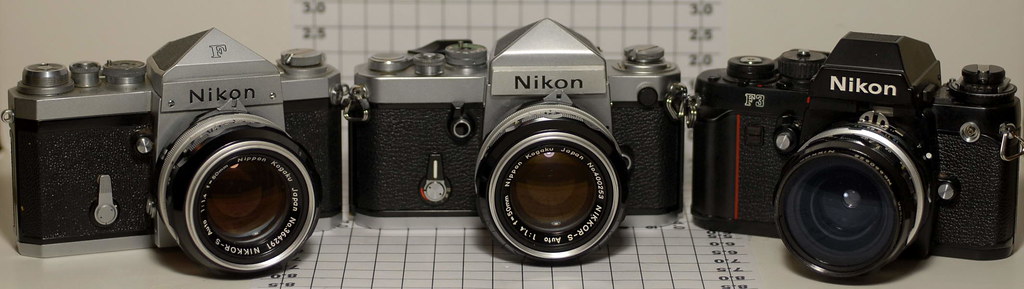
There are two problems on the F3, first is that there is no pointy headed viewfinder available for it . . .

F_F2_F31 by Les DMess, on Flickr

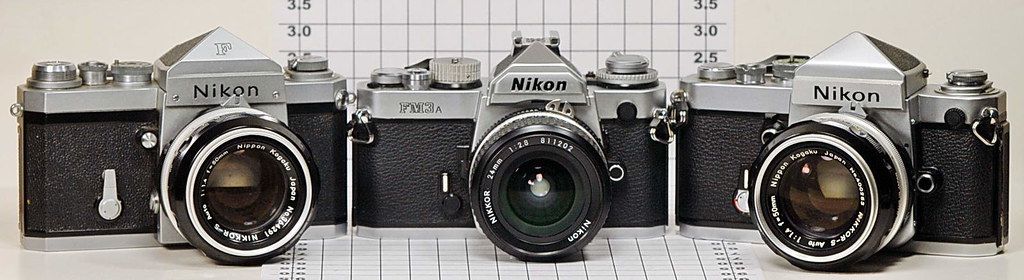
The other is that Nikon overstepped by disabling shutter pseed control until the frame counter gets to 1 which they fortunately corrected in the FM3A . . .

F-FM3A-F2 by Les DMess, on Flickr

BTW, if you shoot mostly in daylight conditions using color negatives or b&w, you might start consider using no meter at all. This is really easy since these films have so much latitude that it is near impossible not to get the right exposure.
 
I wonder if I would like the F3 series as much as I like the F2.

The F looks too fiddly for me. I know I wouldn't like having to take the back off and keep track of it while loading film etc. The F4 is just bafugly and I wouldn't be caught dead using one. The F5 is extremely nice, but it's kinda like taking a Ferrari to the grocery store., I own an F5 but I guess it's going to be one of those garaged Ferrari's that only gets driven in good weather once or twice a year. Haven't shot the F6, and the only reason I would ever consider owning one is because of its CLS capabilities, since I like a lot of OCF lighting. But even then if I use flash with film, I'm usually using studio strobes where I can manually control everything.

The F3 doesn't have any aesthetic appeal to me, and as of late neither does its electronics. I supposed AP mode might be a nice thing, but other than that, there's just much that the F3 offers that flips my dress up.
 
1. Really, the "pointy" pentaprism is a make-or-break feature? Get real. It doesn't affect function or the quality of the images.

2. If you're talking Ferraris, the F3 is the first Ferrari of Nikons. Well, more like the Maserati. It was the first Nikon designed by Giorgio Giugiaro's Italdesign Studios, designers of many Italian super cars--Maseratis, Ferraris, Lamborghinis. He followed that with the F4 (in my opinion, his best) and pretty much every pro model Nikon after that.
 
The resistor ring failed on my F2AS (DP12?) so they wear out just like the others. Sover Wong repaired it by replacing it with a new piece that he mfgs.

My F2A's meter (DP1?) is random and off which is disappointing . Sometimes it seems accurate, other times it is obviously way off.

So my advice if buying an F2 with a metered head is to test it thoroughly before committing to the purchase. Bring along a separate hand held meter, or even a metering app on your phone.
No issues with the plain unmetered prism!
 
Photrio.com contains affiliate links to products. We may receive a commission for purchases made through these links.
To read our full affiliate disclosure statement please click Here.

PHOTRIO PARTNERS EQUALLY FUNDING OUR COMMUNITY:


Ilford ADOX Freestyle Photographic Stearman Press Weldon Color Lab Blue Moon Camera & Machine
Top Bottom