
• Welcome to Photrio!
    Registration is fast and free. Join today to unlock search, see fewer ads, and access all forum features.
    Click here to sign up

Negative Handling (Failure Thereof)

Junk it

A
Junk it

  • 0
  • 0
  • 0
Dawes 2

A
Dawes 2

  • 0
  • 0
  • 0

Recent Classifieds

Forum statistics

Threads
204,341
Messages
2,867,298
Members
102,229
Latest member
chicanorico
Recent bookmarks
0

Richas

Member
Joined
Mar 16, 2023
Messages
22
Location
Usa
Format
35mm
Hi,
I am new to developing negatives at home (C-41). I have Cinestill kit. I have done three rolls and they all came out great. The problem is what happens next.

First, I can't seem to cut the negatives without straying and destroying frames. Perhaps I just need to slow down and be more careful but is there a technique?

The negatives all had deposits after drying.
I am using Photo-Flo 200 and mixed according to the instructions. This seemed awfully soapy. Here in Portland OR the water has very low mineral content, maybe next time I will skip the Photo-Flo.

I am scanning with a DSLR, I am still optimizing this new setup also.

My scans have been failures due to:
Dust on the light diffuser I am using. It took a while for me to figure this out.
The aforementioned deposits.
Dust - Need to pay more attention to this
Light leaks - room light was bleeding in so I turn off the lights now.

I tried rewashing the negatives in a bowl of warm water, to which I added a few drops of Photo-Flo. This sorta worked but deposits remained. Then I got real ham-handed and wiped at the negatives with lens cloths. This was probably "ok" on the non-emulsion side, though I see micro scratches, but I am sure I did damage on some of them on the emulsion side.
I think there are still salvageable frames but I need to take a break and come back with a better plan!

Perhaps another wash, for longer, under running water?

What a hack, right? ;-)

Thanks
Rich
 
35mm or 120 film? Others here can recommend cutters. I use a scissors over a light table.
 
For cutting film I use one of these on top of a light pad: https://www.ebay.ca/itm/19532117888...=2047675&ssuid=&widget_ver=artemis&media=COPY
1686851913334.png


The film advance wheel isn't effective any more (after several years of use) but that isn't really necessary, and all the rest of it works really well.
 
My water is also fairly low in minerals. I just add a partial dropper full of photoflo to the rinse water, which works fine. The dropper is probably 1ml, so maybe .5ml in 500ml of water.

As far as cutting goes, practice makes perfect. Find some scrap film and practice cutting from one sprocket hole, or lack there of, to the other. Or use some paper strips and cut from one dot to another without a line to follow.
 
If there are deposits on the film after drying, take the cut strips and bathe them in lukewarm - distilled! - water with just the smallest drop of dish soap, and rehang to dry. Works for me with deposits or dust. I don't use Photo-Flo, I use a distilled rinse with the aforementioned teeny tiny bit of soap.

For cutting strips with scissors, I've had trouble as well but what I've learned is to eye up where the sprocket holes should be in relation to the cut and make sure to match them up as you're slowly making the cut. I'm horrible with cutting paper evenly so it makes sense that this would be an unreasonably hard challenge for me, but it comes with time. Don't be too precious with the edges of your frames, this process is all subject to minor imperfections and if you have to crop, you have to crop.
 
Are you using distilled water with Photo-Flo? After a water rinse under the tap I do 2ml Photo-Flo into 400ml distilled water and never get spots. Are you rinsing the negatives for the prescribed amount of time after the fix?

After the negatives dry for 24 hours I give them a gentle wipe with an Ilford Antistatic Cloth, that takes care of most of the dust. If you're picking up a lot of dust when the negatives are still wet it will be glued to the negative. Good to dry them in a location that is dust free, like the shower after running the water.

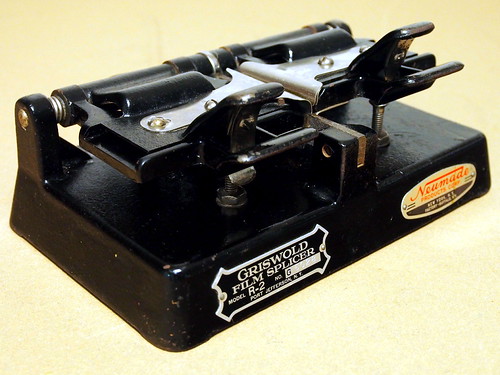
I use an old 35mm film splicer to cut the negatives.
Griswold Film Splicer R-2 by Bryan Chernick, on Flickr
 
FWIW, those developing C-41 negative film should employ some sort of version of Final Rinse as the final bath for the film. In addition to including a surfactant (similar to Photoflo) to aid even drying, Final Rinse provides anti-bacterial properties which help protect the longevity of the negatives. If your final bath is Photoflo or dish soap in water, your negatives will be nice and tasty for any bacteria that may desire them.
 
I've cut with scissors. You just have to be very careful and make sure you have a good light on it. Get close, and keep in mind there is an "offset" on how the scissors cut relative to how it looks like they'll cut. You can run out to a discount store and get a cheap pair of strong reading glasses to help make it easier.

I do prefer using the cutters others have posted - I have the plastic one.

When mixing final rinse/stabilizer/photoflo I use distilled water. I also put in less photoflo than recommended. There are many threads on this site regarding the issue (you can use the search function), but one by the late Photo Engineer is good - though it can be confusing. You'll have to get into the thread a distance to find tips:

I also leave the film on my stainless reels when I dip in the final solution. Then I shake the reels and lay them horizontally on a towel for 10-15 minutes. That way the liquid has a shorter distance to travel to the edge of the film. Finally, I remove it from the reel and hang to dry.
 
I cut with scissors over a light pad and don't care that much if I occasionally cut into the image a bit. It's all part of life's rich pageant.

Try using no photoflo. If not good, use
maybe .5ml in 500ml of water

because that works.

And never wipe a negative with anything other than your tongue.
 
FWIW, those developing C-41 negative film should employ some sort of version of Final Rinse as the final bath for the film. In addition to including a surfactant (similar to Photoflo) to aid even drying, Final Rinse provides anti-bacterial properties which help protect the longevity of the negatives. If your final bath is Photoflo or dish soap in water, your negatives will be nice and tasty for any bacteria that may desire them.

Is the final rinse included with the kits different than what's typically used for B&W film, such as PhotoFlo? I didn't realize that.
 
For cutting film I use one of these on top of a light pad: https://www.ebay.ca/itm/19532117888...=2047675&ssuid=&widget_ver=artemis&media=COPY
View attachment 341385

The film advance wheel isn't effective any more (after several years of use) but that isn't really necessary, and all the rest of it works really well.

Is there a line of mark on this cutter that allows an exact same cut each time Matt? I have a very similar slide film cutter but even then I find that the gap between 35mm negs is so narrow that getting every cut exactly in the middle of the gap is difficult

Extreme care and patience is required.

pentaxuser
 
Is the final rinse included with the kits different than what's typically used for B&W film, such as PhotoFlo? I didn't realize that.

If there is a Final Rinse or something similar in the C-41 kit you have, it should be a combination of a surfactant - similar to Photoflo - and an anti-bacterial agent.
Black and White films don't have need for the anti-bacterial agent, because the silver in the developed negative is an excellent anti-bacterial agent in itself.
At the top of this sub-forum where the "Sticky" threads are there is a long thread from the late Photo Engineer about the "definitive word" on stabilizers for C-41 film - you can find it on here: https://www.photrio.com/forum/forums/color-film-paper-and-chemistry.86/
(I should probably fix the typo in that thread title)
 
Is there a line of mark on this cutter that allows an exact same cut each time Matt? I have a very similar slide film cutter but even then I find that the gap between 35mm negs is so narrow that getting every cut exactly in the middle of the gap is difficult

Extreme care and patience is required.

pentaxuser

For particularly narrow gaps, I mark by eye the edge of one, then the edge of the other, then move the film half of the distance.
For most negatives, that isn't necessary.
The biggest challenge is identifying the gap between two dark transparencies.
 
I tried rewashing the negatives in a bowl of warm water, to which I added a few drops of Photo-Flo. This sorta worked but deposits remained. Then I got real ham-handed and wiped at the negatives with lens cloths. This was probably "ok" on the non-emulsion side, though I see micro scratches, but I am sure I did damage on some of them on the emulsion side.

The 'good' thing about hard water deposits is that they usually only manifest themselves on the shiny side of 35mm film. In my experience, once they're there, they require at least some form of mechanical removal to really get rid of them. Just re-soaking (even in distilled water) may alleviate the problem, but there will be traces left, at least every time I tried it. What helps against calcium scale (since that's what it is, mostly) is to use some water (tap is OK, demineralized/'distilled' is better) and add a little bit of vinegar or citric acid to it. This will act as a mild descaling agent and won't damage the emulsion. Soak the film, and gently brush underwater with a decent quality brush or a soft-fibered cloth. Then rinse to get rid of the acid, and give a brief soak in demineralized water with some surfactant added to it.

Preventing water spots is kind of a personal thing and you'll run into sometimes wildly conflicting practices. For instance:
And never wipe a negative with anything other than your tongue.

While this apparently works great for Don (can't argue about culinary preferences, btw), for me, the most reliable way to prevent water spots has been to hang 35mm when it comes out of the final bath and wipe off the adhering droplets with a soft tissue or cloth. Even if I use demineralized water with a little Adoflo, I'll get some deposits/spots where the droplets were if I don't remove those. On the other hand, I'm very skeptical/wary of film squeegees due to the risk of (severe) scratching, but you'll find a few people also here on Photrio who swear by them instead of at them, and can explain very clearly how they're best used for problem-free results (more power to them!) So YMMV. Try to figure out what best works for you, personally.

Alternatively, shoot 120 roll film or sheet film - drying spots are virtually no problem with those formats, and dust tends to be less of an issue as well since it's relatively smaller to the surface area of the image. If you shoot sheet film, particularly color, your wallet will also take up much less space in your pocket.
 
Photrio.com contains affiliate links to products. We may receive a commission for purchases made through these links.
To read our full affiliate disclosure statement please click Here.

PHOTRIO PARTNERS EQUALLY FUNDING OUR COMMUNITY:


Ilford ADOX Freestyle Photographic Stearman Press Weldon Color Lab Blue Moon Camera & Machine
Top Bottom