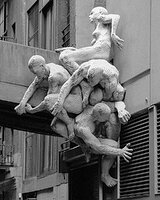
Virtually guaranteed that's shot on digital. Not that it matters.
What you're looking at is setting & pose, lighting and a heck of a lot of post processing to get the tonality where they wanted it. Btw, the editing is rather crude and heavy-handed ; it's clear they just snapped a shot and then went to town with the layers and the big brushes. Note the weird light latch left to the woman's leg and the lack of definition along the edges of the kid's back and the lady's belly. I personally find the vertical bar in the background an unfortunate choice and a weird oversight on a shot like this, but OK. The weird color patch in the center is also...well, weird, but maybe that's just an artifact of how this is presented here? IDK.
I suppose what you might find attractive to it is the high-key/backlit concept. This is mostly down to lighting setup, but also about what happens (or doesn't) in the background. A lot of the time you see this done with a featureless white background, which is fairly easy to do but you quickly end up needing a LOT of light or fast film (high ISO). Use a reflector or a second light source to fill in the foreground, but make sure it's fairly large and diffuse so as to not create obvious specular highlights on skin etc. Shot on digital, what you'd typically do (and what happened here) is forget about the reflectors etc. and just expose so as to maintain just enough differentiation in the highlights and then lift the shadows in the foreground as desired.
Nothing about this screams of particular choices w.r.t. camera gear. As
@Paul Howell remarked earlier, this just really isn't about gear. It's about visualizing the image that you want to produce and then set up for it. Try to get as close as possible. Having said that, I'd shoot digital so you can go back & forth quickly. Doing it on film isn't wrong or impossible, but if you're stumbling in the dark on what you're doing, it's more of a liability than an asset.
Start with the concept, i.e. the image(s) as you want them to materialize at the end of the process, then work your way backwards in terms of the technical choices you need to make to realize it. Right now you seem to be starting at the wrong side of the process by thinking about cameras & film, but those are pretty far down on the list of priorities and you have decent flexibility there. Much, much more relevant choices are what kind of space you're going to use and what kind of lighting setup(s) you have access to & how much light there is to begin with. You'll have to think about clothing/apparel and of course spend a lot of time basically looking at your partner to figure out which views on her you want to work you. See if you can decide beforehand on 3-5 angles/compositions you want to work out, decide what should/shouldn't be part of the frame, think about what the background should look like and how & where the light is going to hit. Try to marry that to the practical means you have access to; i.e. do you have available light only, or will you have access to a well-equipped studio setup? You'll probably need to compromise at this point already.
The only thing that comes to mind in terms of lens choice, apart from field of view which is dictated by the framing you're looking for and the space you have available, is the proneness to flare if you're going to be working with strongly backlit scenes or bright light sources just outside the image frame, which is often the case if you're working in a studio environment. Ensure you have proper lens hoods and avoid lenses that have uncontrollable flare unless it's something you're going to deliberately exploit.