• Welcome to Photrio!
    Registration is fast and free. Join today to unlock search, see fewer ads, and access all forum features.
    Click here to sign up

Need help to make "timeless" portrait photo's

Recent Classifieds

Forum statistics

Threads
203,297
Messages
2,852,586
Members
101,769
Latest member
josejavier
Recent bookmarks
0

Analogski

Member
Allowing Ads
Joined
Mar 29, 2025
Messages
97
Location
Holland
Format
Multi Format
Hi,

I want to make some nice, "timeless" portraits of my pragnent wife.

I'm thinking about using my ARAX/Kiev-60 camera with a monstrous Carl Zeiss Jena Sonnar 180mm lens with 400TMAX film and Porta 160.

I'm also thinking about taking my Pentax 35mm camera with me for the shoot with the 85mm lens and the same film stock.

What lens is "better" fot the job? Or is it purely personal?

Also, all tips are welcome!

Thanks in advance
 
Yes, you do need timeless portraits! Been there; done that; Have the T-shirt to prove it (and a few great portraits). Those both sound like good choices. Reccomend that you use both and especially whichever you jave the most exerience with. If shooting outside in natural light, you may want to re-think the 400-speed B&W and consider something a bit slower to allow use of shallower DoF.
 
Both options are very good choices for portraits, although you may need to be pretty far away if you want a hips-up photo (which is normal for pregnancy photos - you'll want to get the baby in the picture). So maybe bring a "normal" lens as well (80mm for 120 and 50mm for 135).
 
Congrats on the family expansion!

I'm sorry, I don't know anything about timeless photos. All the photos we have that involve important family events are the polar opposite of timeless, and I wouldn't have it any other way.
 
Carl Zeiss Jena Sonnar 180mm

It's a great lens for portraits when you nail focus. Very shallow depth of field so you may want to practice with it for a while. The helicoid can be pretty stiff to turn if it's old. I've taken some portraits I've loved with it, but I've messed up more than I've gotten right. The Volna-3 80mm f/2.8 lens also works great for portraits and is easier. It has a nice glow wide open.

A 35mm lens is smaller and easier to use. Sometimes people want less detail in a portrait so the smaller format can be an advantage. It will also have more depth of field, making errors in focus less critical. Plus, you get more tries to take a good picture. This can go a long way. I don't find 85mm a very long focal length, I think it would be fine for including more of the body. 135mm would be more of a problem.

For B&W, if outdoor, I would shoot under the shade of trees (but not deep forest shade) and use a 100 speed film with not too high contrast. Green or yellow filters can help with skin tones. Acros would be a good choice, many others would work too including Kentmere 100. You ideally want some mix of directional and softbox light, a sunny f/11 with clouds only partially blocking the sun can be ideal. If full f/16 sun, go in the shade. If completely overcast, you might look into ways to add a little bit of directional light, but not too much.

For color, don't be afraid to overexpose Portra 160 to 100 or even 50 if necessary. A cross screen filter will lower contrast a little, as will many other kinds of filters.

Sonnar 180mm on a Kiev 6C (cropped to 6x4.5) and Provia 100F, shade under tree lighting

54527824004_0eec2da43b_k(1).jpg


Volna-3 on a Mamiya 645 with yellow filter and Shanghai GP3, shade under tree again

53751326968_a7f19b9719_k.jpg


Canon FD 135mm f/2.5 on Canon F-1 with Delta 100 (had to shout at this distance, not recommended) overcast conditions

52765372699_0679d0752d_k.jpg


Canon T90 with Jupiter-9 85mm f/2 on Kodak Ektachrome E100 (sunny conditions but made sure sun was behind her)

52836183090_277fef126b_k.jpg


All of these were shot wide open.
 
What have you used in the past that gave you results that you were happy with?
That is what I would use.
 
I think it is less about gear and more about your vision. You have great lens, great film, now it's about how you put it all together.
 
In terms of timeless, whatever lens and camera you use, I would use black & white film and sepia tone the image. Such aphotograph will last a hundred years or more.
 
What really matters for me in a portrait is the presence of the subject. I prefer people to not be 'posing' exactly. Most people will put on the expected photo face, but that's not the real person. Break through that. Make her pose, then don't snap the shutter for long periods. Yes, not fair but necessary. Ask her to think about looking in to the lens and having your child looking at this photo.

Well, as you can see, I am not that interested in the lens or camera. The photographer needs to be comfortable, so use he camera that you like more. And recognize the difference in 12 versus 36 frames at a time- each shot is a little more 'precious' in medium format, while each shot is a little more relaxed in 35mm (huge generalization).

Take your time. If the first shoot doesn't give you what you want, there's time for another try (I think- you didn't say how far along she is. Congrats to both of you!).
 
It's a great lens for portraits when you nail focus. Very shallow depth of field so you may want to practice with it for a while. The helicoid can be pretty stiff to turn if it's old. I've taken some portraits I've loved with it, but I've messed up more than I've gotten right. The Volna-3 80mm f/2.8 lens also works great for portraits and is easier. It has a nice glow wide open.

A 35mm lens is smaller and easier to use. Sometimes people want less detail in a portrait so the smaller format can be an advantage. It will also have more depth of field, making errors in focus less critical. Plus, you get more tries to take a good picture. This can go a long way. I don't find 85mm a very long focal length, I think it would be fine for including more of the body. 135mm would be more of a problem.

For B&W, if outdoor, I would shoot under the shade of trees (but not deep forest shade) and use a 100 speed film with not too high contrast. Green or yellow filters can help with skin tones. Acros would be a good choice, many others would work too including Kentmere 100. You ideally want some mix of directional and softbox light, a sunny f/11 with clouds only partially blocking the sun can be ideal. If full f/16 sun, go in the shade. If completely overcast, you might look into ways to add a little bit of directional light, but not too much.

For color, don't be afraid to overexpose Portra 160 to 100 or even 50 if necessary. A cross screen filter will lower contrast a little, as will many other kinds of filters.

Sonnar 180mm on a Kiev 6C (cropped to 6x4.5) and Provia 100F, shade under tree lighting

View attachment 419098

Volna-3 on a Mamiya 645 with yellow filter and Shanghai GP3, shade under tree again

View attachment 419099

Canon FD 135mm f/2.5 on Canon F-1 with Delta 100 (had to shout at this distance, not recommended) overcast conditions

View attachment 419100

Canon T90 with Jupiter-9 85mm f/2 on Kodak Ektachrome E100 (sunny conditions but made sure sun was behind her)

View attachment 419103

All of these were shot wide open.

Nicely done!
 
My best portraits of my family members I shot with Telear 250mm using Ilford HP5+.

By the way, with the special 10mm extension tube for Pentacon Six you can shoot close-up portraits with your Sonnar 180. I would also recommend to always use a tripod or at least a monopod.

 
Last edited:
Thanks for the tips guys! I'll try to upload some pictures as example of what I'm going to want to try
 
It's a great lens for portraits when you nail focus. Very shallow depth of field so you may want to practice with it for a while. The helicoid can be pretty stiff to turn if it's old. I've taken some portraits I've loved with it, but I've messed up more than I've gotten right. The Volna-3 80mm f/2.8 lens also works great for portraits and is easier. It has a nice glow wide open.

A 35mm lens is smaller and easier to use. Sometimes people want less detail in a portrait so the smaller format can be an advantage. It will also have more depth of field, making errors in focus less critical. Plus, you get more tries to take a good picture. This can go a long way. I don't find 85mm a very long focal length, I think it would be fine for including more of the body. 135mm would be more of a problem.

For B&W, if outdoor, I would shoot under the shade of trees (but not deep forest shade) and use a 100 speed film with not too high contrast. Green or yellow filters can help with skin tones. Acros would be a good choice, many others would work too including Kentmere 100. You ideally want some mix of directional and softbox light, a sunny f/11 with clouds only partially blocking the sun can be ideal. If full f/16 sun, go in the shade. If completely overcast, you might look into ways to add a little bit of directional light, but not too much.

For color, don't be afraid to overexpose Portra 160 to 100 or even 50 if necessary. A cross screen filter will lower contrast a little, as will many other kinds of filters.

Sonnar 180mm on a Kiev 6C (cropped to 6x4.5) and Provia 100F, shade under tree lighting

View attachment 419098

Volna-3 on a Mamiya 645 with yellow filter and Shanghai GP3, shade under tree again

View attachment 419099

Canon FD 135mm f/2.5 on Canon F-1 with Delta 100 (had to shout at this distance, not recommended) overcast conditions

View attachment 419100

Canon T90 with Jupiter-9 85mm f/2 on Kodak Ektachrome E100 (sunny conditions but made sure sun was behind her)

View attachment 419103

All of these were shot wide open.

Thanks for the great advice! And showing your beautiful pictures
 
What really matters for me in a portrait is the presence of the subject. I prefer people to not be 'posing' exactly. Most people will put on the expected photo face, but that's not the real person. Break through that. Make her pose, then don't snap the shutter for long periods. Yes, not fair but necessary. Ask her to think about looking in to the lens and having your child looking at this photo.

Well, as you can see, I am not that interested in the lens or camera. The photographer needs to be comfortable, so use he camera that you like more. And recognize the difference in 12 versus 36 frames at a time- each shot is a little more 'precious' in medium format, while each shot is a little more relaxed in 35mm (huge generalization).

Take your time. If the first shoot doesn't give you what you want, there's time for another try (I think- you didn't say how far along she is. Congrats to both of you!).

Didn't thought about that. Great advice, thanks! My wife is 26 weeks now...

I just bought for a 100 euro's of film.... Let's hope there will be a couple of beautiful portraits to print.
 
This may be a little off beat, but if you happen to have a pet try including it in the portrait. They tend to relax people and present a distraction allowing for a natural look as opposed to a pose. Somewhat of an environmental portrait. Most of the time the pet reacts to the camera better than the person. It’s worked well for me when photographing my family members especially the younger ones.
 
I want to go for something like this. Surely out of my league, but still...I want to try to make something like this. Any tips of settings/focal length are welcome
 

Attachments

  • IMG-20260226-WA0004.jpg
    IMG-20260226-WA0004.jpg
    112.5 KB · Views: 91
That example photo might very well be done with a cel phone.
The element that makes it is the lighting, and the posing, not the camera work.
 
I want to go for something like this.
Virtually guaranteed that's shot on digital. Not that it matters.
What you're looking at is setting & pose, lighting and a heck of a lot of post processing to get the tonality where they wanted it. Btw, the editing is rather crude and heavy-handed ; it's clear they just snapped a shot and then went to town with the layers and the big brushes. Note the weird light latch left to the woman's leg and the lack of definition along the edges of the kid's back and the lady's belly. I personally find the vertical bar in the background an unfortunate choice and a weird oversight on a shot like this, but OK. The weird color patch in the center is also...well, weird, but maybe that's just an artifact of how this is presented here? IDK.
I suppose what you might find attractive to it is the high-key/backlit concept. This is mostly down to lighting setup, but also about what happens (or doesn't) in the background. A lot of the time you see this done with a featureless white background, which is fairly easy to do but you quickly end up needing a LOT of light or fast film (high ISO). Use a reflector or a second light source to fill in the foreground, but make sure it's fairly large and diffuse so as to not create obvious specular highlights on skin etc. Shot on digital, what you'd typically do (and what happened here) is forget about the reflectors etc. and just expose so as to maintain just enough differentiation in the highlights and then lift the shadows in the foreground as desired.

Nothing about this screams of particular choices w.r.t. camera gear. As @Paul Howell remarked earlier, this just really isn't about gear. It's about visualizing the image that you want to produce and then set up for it. Try to get as close as possible. Having said that, I'd shoot digital so you can go back & forth quickly. Doing it on film isn't wrong or impossible, but if you're stumbling in the dark on what you're doing, it's more of a liability than an asset.

Start with the concept, i.e. the image(s) as you want them to materialize at the end of the process, then work your way backwards in terms of the technical choices you need to make to realize it. Right now you seem to be starting at the wrong side of the process by thinking about cameras & film, but those are pretty far down on the list of priorities and you have decent flexibility there. Much, much more relevant choices are what kind of space you're going to use and what kind of lighting setup(s) you have access to & how much light there is to begin with. You'll have to think about clothing/apparel and of course spend a lot of time basically looking at your partner to figure out which views on her you want to work you. See if you can decide beforehand on 3-5 angles/compositions you want to work out, decide what should/shouldn't be part of the frame, think about what the background should look like and how & where the light is going to hit. Try to marry that to the practical means you have access to; i.e. do you have available light only, or will you have access to a well-equipped studio setup? You'll probably need to compromise at this point already.

The only thing that comes to mind in terms of lens choice, apart from field of view which is dictated by the framing you're looking for and the space you have available, is the proneness to flare if you're going to be working with strongly backlit scenes or bright light sources just outside the image frame, which is often the case if you're working in a studio environment. Ensure you have proper lens hoods and avoid lenses that have uncontrollable flare unless it's something you're going to deliberately exploit.

 
Woon thanks fo
Virtually guaranteed that's shot on digital. Not that it matters.
What you're looking at is setting & pose, lighting and a heck of a lot of post processing to get the tonality where they wanted it. Btw, the editing is rather crude and heavy-handed ; it's clear they just snapped a shot and then went to town with the layers and the big brushes. Note the weird light latch left to the woman's leg and the lack of definition along the edges of the kid's back and the lady's belly. I personally find the vertical bar in the background an unfortunate choice and a weird oversight on a shot like this, but OK. The weird color patch in the center is also...well, weird, but maybe that's just an artifact of how this is presented here? IDK.
I suppose what you might find attractive to it is the high-key/backlit concept. This is mostly down to lighting setup, but also about what happens (or doesn't) in the background. A lot of the time you see this done with a featureless white background, which is fairly easy to do but you quickly end up needing a LOT of light or fast film (high ISO). Use a reflector or a second light source to fill in the foreground, but make sure it's fairly large and diffuse so as to not create obvious specular highlights on skin etc. Shot on digital, what you'd typically do (and what happened here) is forget about the reflectors etc. and just expose so as to maintain just enough differentiation in the highlights and then lift the shadows in the foreground as desired.

Nothing about this screams of particular choices w.r.t. camera gear. As @Paul Howell remarked earlier, this just really isn't about gear. It's about visualizing the image that you want to produce and then set up for it. Try to get as close as possible. Having said that, I'd shoot digital so you can go back & forth quickly. Doing it on film isn't wrong or impossible, but if you're stumbling in the dark on what you're doing, it's more of a liability than an asset.

Start with the concept, i.e. the image(s) as you want them to materialize at the end of the process, then work your way backwards in terms of the technical choices you need to make to realize it. Right now you seem to be starting at the wrong side of the process by thinking about cameras & film, but those are pretty far down on the list of priorities and you have decent flexibility there. Much, much more relevant choices are what kind of space you're going to use and what kind of lighting setup(s) you have access to & how much light there is to begin with. You'll have to think about clothing/apparel and of course spend a lot of time basically looking at your partner to figure out which views on her you want to work you. See if you can decide beforehand on 3-5 angles/compositions you want to work out, decide what should/shouldn't be part of the frame, think about what the background should look like and how & where the light is going to hit. Try to marry that to the practical means you have access to; i.e. do you have available light only, or will you have access to a well-equipped studio setup? You'll probably need to compromise at this point already.

The only thing that comes to mind in terms of lens choice, apart from field of view which is dictated by the framing you're looking for and the space you have available, is the proneness to flare if you're going to be working with strongly backlit scenes or bright light sources just outside the image frame, which is often the case if you're working in a studio environment. Ensure you have proper lens hoods and avoid lenses that have uncontrollable flare unless it's something you're going to deliberately exploit.

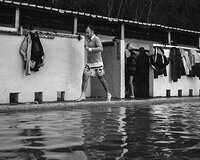
Wow, thanks for the explanation! Maybe in b/w this kind of picture will be also appealing. I don't want to copy this exact foto, but it's something I would like to try. Maybe it's purist of me, but I hope to take one picture that is good enough without having to post process it. I like the raw look of analoge pictures without making them look like a clean digital picture.

Thanks for the tip on flairing. I'll keep that in mind.

I also have a digital DSLR camera. Maybe I'll take some pictures with it to see what the best composition and settings will be.
 
Photrio.com contains affiliate links to products. We may receive a commission for purchases made through these links.
To read our full affiliate disclosure statement please click Here.

PHOTRIO PARTNERS EQUALLY FUNDING OUR COMMUNITY:


Ilford ADOX Freestyle Photographic Stearman Press Weldon Color Lab Blue Moon Camera & Machine
Top Bottom