• Welcome to Photrio!
    Registration is fast and free. Join today to unlock search, see fewer ads, and access all forum features.
    Click here to sign up

Mystery Tiger Striping

Spring break

H
Spring break

  • 6
  • 4
  • 75

Recent Classifieds

Forum statistics

Threads
202,854
Messages
2,846,620
Members
101,572
Latest member
apltd
Recent bookmarks
0
A colleague of mine consulted a former Kodak tech :


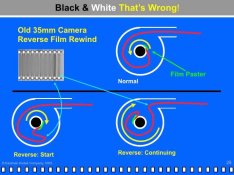
"We saw this, not very frequently, when I was in Kodak Customer Technical Service, and later I put together a slide program of the various things that could happen to film after it was exposed. This appears, to me, as being a classic example of the reverse wind phenomena. Some older camera can rewind film in both directions of the rewind lever. This causes the film to be tightly wound over a very small radius causing physical "exposure." Since the film is weaker (less film area cross-section) in the longitudinal direction across the perforations. the extra exposure appears more visible between the perfs.
Usually, over agitation shows a dark area AROUND each perf because of the extra velocity and agitation of the developer being forced into the perfs. This is not the case here!" unnamed.jpg


What O-N-F is saying is making sense
 
Imagine that... the old guy who does nothing anymore being right about something.
 
ONF, I hope I have made it clear that I agree with your explanation as one possible answer.

The fog I refer to is along the edges of the film, and what I think appears to be a slightly high Dmin.

PE
 
IF PE says it's Bromide drag, you can be sure that Bromide drag is "a thing". He doesn't deal in "internet myth"

I can remember only once did PE make an error, he had thought that he might have been wrong one time, but it turned out that he was right all the time.
 
example of bromide drag
Dead Link Removed Dead Link Removed
 
Looking at the negatives again there is greater density around the four corners of each sprocket hole. Now pressure on an emulsion can cause this to occur. I wonder if there was something wrong with the sprocket hole cutting die.

The following article illustrates the effect of over agitation which causes streak in the image area. It is also a very handy article to keep on hand.

http://micro.magnet.fsu.edu/primer/photomicrography/bwprocessingerrors.html
 
Last edited:
Looking at the negatives again there is greater density around the four corners of each sprocket hole. Now pressure on an emulsion can cause this to occur. I wonder if there was something wrong the the sprocket cutting die.

The following article illustrates the effect of over agitation which causes streak in the image area. It is also a very handy article to keep on hand.

http://micro.magnet.fsu.edu/primer/photomicrography/bwprocessingerrors.html
thats a great read will have to print out
 
It is not bromide drag, but film being kinked, with stress induced imaging as result.

Kinking can have several causes. As wrong winding orientation in the cassette, film being pushed within the cassette, film being pushed onto the processing reel.

Artefacts exactly as the one of the OP are known in the industry.


-) Bromide drag: less density in regions during processing located under parts with high density (and thus strong processing activity) and low agitation

Obviously here are no such points of activity in first place.
For the rest see arguments below.


-) Developer Flow: fresh developer streaming through perforations during low agitation. Resulting in overdevelopment in parts located under the perforations

This would form a broad path of overdevelopment over the width of the perforation.
There would not be streaks from the lower perforation up to film center.
There would not be streaks on the rebate area.
The lower film would have the same artefact
The lines between the sprockets could not be explained by developer flow either.
 
Last edited:
I understand why many here have no respect for my opinions. After all, I've not dealt with analog processes for a very long time due to family, and then professional, and then health issues. This doesn't make me completely ignorant. However, long ago I was very good at this. Processes have not changed that much and this condition is obvious to me. I find it difficult to believe others don't see it. Sorry... but as with other times I've posted, I don't understand the confusion.

While you still have a heart beat O-F-N I agree with you, or better put agree it's something else.

Ian
 
Looking at the negatives again there is greater density around the four corners of each sprocket hole. Now pressure on an emulsion can cause this to occur. I wonder if there was something wrong the the sprocket cutting die.

The following article illustrates the effect of over agitation which causes streak in the image area. It is also a very handy article to keep on hand.

http://micro.magnet.fsu.edu/primer/photomicrography/bwprocessingerrors.html

The problem with this is that part of the image is negative and part positive. This can be most clearly seen in the "partially fogged" image I believe, in which the image that is fogged is clear, but should be black. The rest of the image is negative.

PE
 
example of bromide drag
Dead Link Removed Dead Link Removed

And, interestingly enough, the positive images here show the bromide drag manifested itself as a dark streak on the negative.

I have to agree with ONF, but I also somehow feel that there is something else going on here.

PE
 
Having had a look over this thread I also believe the strange "striping" to be related to stress that was put on the film and developed out as density where one would not expect to see density.

I also believe that the stress was related to the transport of the film within the camera. I'm not sure I could say how it actually happened with any certainty but I feel there is some assurance that the teeth on the sprockets were, at least, one of the stressors in combination with excessive tension or distortion of the film as the film was transported and rewound.

Sometimes a stupid question is not a bad thing...

Do students use their own cameras exclusively? Are cameras shared by students? Could this issue be related to a specific camera?
 
Last edited:
All my 35mm cameras can. All it takes is a free-wheeling rewind crank.

A single photographer, would not likely have this issue because, well... you get used to doing it right.

But a teacher with classroom of students who may have never handled a camera before... Now you're talking about something that can happen every now and then.

O-N-F, you were right all along! You didn't say "don't ask me how I know"... so... How did you know?
 
The extra density around the edges of the sprocket holes could indicate a problem with the film transport. As I mentioned previously pressure on an emulsion can cause dark marks. There is a scientific term for this effect but I can't remember it.
 
Last edited:
Bill... From post #5, "I did that once..." :smile:
 
Any plastic will "stress whiten " when flexed excessively. Take a clear Tic Tac candy box and flex the material back and forth. The material will become white and opaque. However these marks were formed, they appear very uniform. It either happened during manufacturing or in the camera. For a lot of kids this may be the first time they have ever used anything other than a phone for photography .
Best Regards Mike
 
What we have to determine is if the camera used can reverse wind.

PE

But why then the first three frames are unaffected?
Even with a sudden start of the artefact.

From the 3 possible causes I named above thus to me pushing onto the reel seems more likely: film being blocked after the first frames.
But would that cause such a regular kinking?
That regularity rather made me think in first instance of wrong winding of film onto the cassette spool during cassette loading. But that would necessitate self-loading (here we seemingly got an industrially loaded cassette) and would not explain why the first frames are unaffected either.
 
Last edited:
Darkroom faults possibly explaining this artefact, including the first frames being unaffected:

-) Pulling a short lenght of film straight out of the cassette, then (emulsion in) in a sharp angle over the cassette mouth.

Maybe after correctly inserting the film into a Paterson-type of reel, but then holding the cassette in such position to the reel whilst winding the rest of the film to it.


-) Inserting correctly the film into a Paterson-type of reel, but then flipping it (emulsion in) sharply over the mouth parts of the reel and thus winding it over a sharp edge.
(Though that maybe resulting in alternating marks side by side.)


I got no Paterson type of reel at hand and thus cannot say whether such manipulatinon actually is feasable with two hands.
 
Darkroom faults possibly explaining this artefact, including the first frames being unaffected:

-) Pulling a short lenght of film straight out of the cassette, then (emulsion in) in a sharp angle over the cassette mouth.

Maybe after correctly inserting the film into a Paterson-type of reel, but then holding the cassette in such position to the reel whilst winding the rest of the film to it.


-) Inserting correctly the film into a Paterson-type of reel, but then flipping it (emulsion in) sharply over the mouth parts of the reel and thus winding it over a sharp edge.
(Though that maybe resulting in alternating marks side by side.)


I got no Paterson type of reel at hand and thus cannot say whether such manipulatinon actually is feasable with two hands.

film can be loaded upside down and be unaffected in paterson tanks. Did that the other day and was fine!
 
Photrio.com contains affiliate links to products. We may receive a commission for purchases made through these links.
To read our full affiliate disclosure statement please click Here.

PHOTRIO PARTNERS EQUALLY FUNDING OUR COMMUNITY:



Ilford ADOX Freestyle Photographic Stearman Press Weldon Color Lab Blue Moon Camera & Machine
Top Bottom