
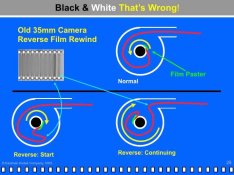
Easy... by turning the rewind crank backwards.
thank you for your insight ! I'm just trying to wrap my head around this! But this is starting to make sense!

Easy... by turning the rewind crank backwards.


IF PE says it's Bromide drag, you can be sure that Bromide drag is "a thing". He doesn't deal in "internet myth"

Imagine that... the old guy who does nothing anymore being right about something.

thats a great read will have to print outLooking at the negatives again there is greater density around the four corners of each sprocket hole. Now pressure on an emulsion can cause this to occur. I wonder if there was something wrong the the sprocket cutting die.
The following article illustrates the effect of over agitation which causes streak in the image area. It is also a very handy article to keep on hand.
http://micro.magnet.fsu.edu/primer/photomicrography/bwprocessingerrors.html

I understand why many here have no respect for my opinions. After all, I've not dealt with analog processes for a very long time due to family, and then professional, and then health issues. This doesn't make me completely ignorant. However, long ago I was very good at this. Processes have not changed that much and this condition is obvious to me. I find it difficult to believe others don't see it. Sorry... but as with other times I've posted, I don't understand the confusion.
Looking at the negatives again there is greater density around the four corners of each sprocket hole. Now pressure on an emulsion can cause this to occur. I wonder if there was something wrong the the sprocket cutting die.
The following article illustrates the effect of over agitation which causes streak in the image area. It is also a very handy article to keep on hand.
http://micro.magnet.fsu.edu/primer/photomicrography/bwprocessingerrors.html
example of bromide drag
Dead Link Removed Dead Link Removed


What we have to determine is if the camera used can reverse wind.
PE
Darkroom faults possibly explaining this artefact, including the first frames being unaffected:
-) Pulling a short lenght of film straight out of the cassette, then (emulsion in) in a sharp angle over the cassette mouth.
Maybe after correctly inserting the film into a Paterson-type of reel, but then holding the cassette in such position to the reel whilst winding the rest of the film to it.
-) Inserting correctly the film into a Paterson-type of reel, but then flipping it (emulsion in) sharply over the mouth parts of the reel and thus winding it over a sharp edge.
(Though that maybe resulting in alternating marks side by side.)
I got no Paterson type of reel at hand and thus cannot say whether such manipulatinon actually is feasable with two hands.
What we have to determine is if the camera used can reverse wind.
PE
yes other film was perfectly fineIt's quite simple it's a film transport problem theres no process issue as the other film is fine.
Ian
| Photrio.com contains affiliate links to products. We may receive a commission for purchases made through these links. To read our full affiliate disclosure statement please click Here. |
PHOTRIO PARTNERS EQUALLY FUNDING OUR COMMUNITY:  |