• Welcome to Photrio!
    Registration is fast and free. Join today to unlock search, see fewer ads, and access all forum features.
    Click here to sign up

Mystery Film - How would you develop?

Do Not Come Here

A
Do Not Come Here

  • 6
  • 3
  • 57
Heavy

H
Heavy

  • 12
  • 5
  • 114

Recent Classifieds

Forum statistics

Threads
201,923
Messages
2,832,114
Members
101,019
Latest member
ferbert72
Recent bookmarks
0

Kirks518

Member
Allowing Ads
Joined
Oct 5, 2013
Messages
1,494
Location
Flori-DUH
Format
Multi Format
I was given a box of stuff, and in it was some old film, both exposed and 'fresh'. The exposed film looks like it was home-loaded by the original owner. The film cartridges are all black with a small bit of masking tape with the number of exposures on them (36/36/10+). There are 3 rolls of this stuff. There are also 2 rolls of exposed color slide film (E-4 Ektachrome).

Included were some bulk film tins (empty) that are Kodak Plus-X Pan Film, and Kodak Tri-X Pan Film. An educated guess tells me that the mystery film is one of these two. However, I don't know ASA of them. Also, I have HC-110 which is in good condition, and I have an unopened bottle of TriX developer of unknown age.

So which developer would you use, and what method of processing would you use? My tap runs at about 78°F or higher (Florida in the summer).

Any help is appreciated.
 
OP
OP
Kirks518

Kirks518

Member
Allowing Ads
Joined
Oct 5, 2013
Messages
1,494
Location
Flori-DUH
Format
Multi Format
Oh, and an estimated expiration date of the film is 1974-1975, based on the 3 unopened boxes of film included in the box.
 

pentaxuser

Member
Joined
May 9, 2005
Messages
20,348
Location
Daventry, No
Format
35mm
I'd clip test a few frames based on what you think the film is + 15% time. This will hopefully give you a good idea how much time the rest of the film needs and wastes one frame - maybe if your lucky only a small part of that frame.

pentaxuser
 
OP
OP
Kirks518

Kirks518

Member
Allowing Ads
Joined
Oct 5, 2013
Messages
1,494
Location
Flori-DUH
Format
Multi Format
If I were to do a clip test, what is the likelihood that the edge of the film will tell me what type of film it is?
 
OP
OP
Kirks518

Kirks518

Member
Allowing Ads
Joined
Oct 5, 2013
Messages
1,494
Location
Flori-DUH
Format
Multi Format
Well, I looked at developing times for both the Pan-X and the Tri-X, and decided on trying 5.25 mins with HC-110 dilution B. Using the massive developing chart on digitaltruth, it seemed that most developing times for those fall in the range of 5 minutes, and seeing how my water is warmer then 68°F, which would shorten the times, I figured I'd give it a go.

Nope.

Now as I'm a novice, I'm trying to figure out if I went too long or too short. There are a couple of discernable areas that say there are images on the film, but they are really 'washed out' (thin??), and are barely visible. The film is drying right now, but I'll see if I can scan a frame or two tomorrow. Ihave one or two more rolls from this batch, and it would be cool if I could get one/two of them developed somewhat properly.

One thing I noticed it that the areas that have an 'image' are near the first frames from the roll, probably frames 1-4, after that there is nothing. Any idea what would cause that?

There are no markings on the film edges of any kind. Does that help with identifying the film?
 
Last edited by a moderator:

pentaxuser

Member
Joined
May 9, 2005
Messages
20,348
Location
Daventry, No
Format
35mm
If I were to do a clip test, what is the likelihood that the edge of the film will tell me what type of film it is?

I was going to add this as one of the additional benefits but then I had a vague feeling that I had read somewhere that some film as old as mid 70s didn't have edge markings although I wonder why not. You shouldn't have to go too far into the film to get to edge markings and anyway developing a few frames as opposed to, say, one frame only will give you a better idea for changes to time

pentaxuser
 

dehk

Member
Allowing Ads
Joined
Aug 4, 2010
Messages
881
Location
W Michigan
Format
Multi Format
I did a roll of old verichrome pan the other day with XTOL 1+7 lowered to 18C 2 Hours Stand came out decent.

I also had decent results with D76 with a pushed time before.
 
OP
OP
Kirks518

Kirks518

Member
Allowing Ads
Joined
Oct 5, 2013
Messages
1,494
Location
Flori-DUH
Format
Multi Format
Can you stand develop with HC-110? If so, how long would you try?
 

pentaxuser

Member
Joined
May 9, 2005
Messages
20,348
Location
Daventry, No
Format
35mm
I did a roll of old verichrome pan the other day with XTOL 1+7 lowered to 18C 2 Hours Stand came out decent.

I also had decent results with D76 with a pushed time before.

Interesting. Unless you used at least 800cc of liquid(100Xtol + 700 water) you managed to successfully break the so -called rule quoted in the Covington site which says that all films require a 100cc of Stock Xtol.

pentaxuser
 
OP
OP
Kirks518

Kirks518

Member
Allowing Ads
Joined
Oct 5, 2013
Messages
1,494
Location
Flori-DUH
Format
Multi Format
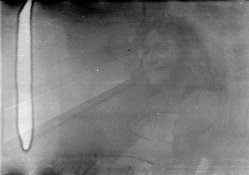
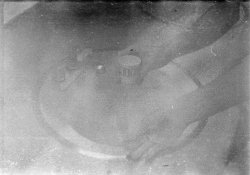
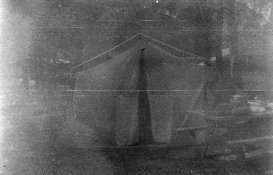
Ok, here are a couple of scans. There actually a lot of 'visible' images through the scanner, about 24. Seeing these, what direction would you give me for the next roll? Remember, I'm a novice, and my only developers are HC-110 and TMax (HC110 preferred). These were done at 69°F (+/- 1°) for 5 minutes 10 seconds in HC-110, water stop bath, and 5 min fixer. What would be the next experimental step?

On a side note, there are 'splotches' throughout the negatives (like in the first pic). Is that something I did during developing, or could it have to do with storage and age of the film? I did notice when I was loading the reel that it felt like the film was kind of sticking to itself as it was coming off the roll.

Thanks.

image0220.jpgimage0225.jpgimage0233.jpgimage0234.jpgimage0244.jpg
 

ic-racer

Member
Joined
Feb 25, 2007
Messages
16,735
Location
USA
Format
Multi Format
Why not just use the same exposure index and development test you would use on any 'known' film.
 

MattKing

Moderator
Moderator
Joined
Apr 24, 2005
Messages
55,260
Location
Delta, BC Canada
Format
Medium Format
Can anyone tell me if these are over developed, or under developed? I honestly don't know.

I'm going to try another roll in a stand develop, and I'm trying to figure out the time to stand for.

Over-developed negatives are quite dense.

Unfortunately, as exposed film ages, the images fade, and the fog gets thicker, so increasing development may not solve the problem.

It is clear, however, that reducing development won't solve it either.

A clip test would be really a good idea with stand.
 
OP
OP
Kirks518

Kirks518

Member
Allowing Ads
Joined
Oct 5, 2013
Messages
1,494
Location
Flori-DUH
Format
Multi Format
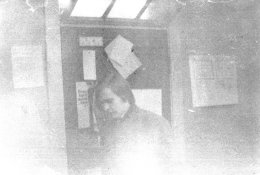
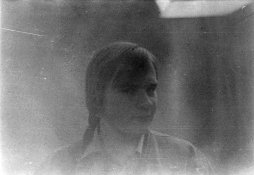
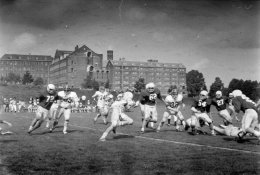
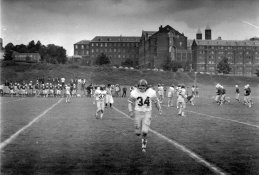
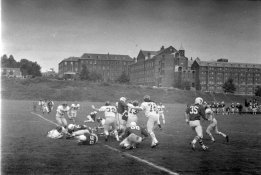
I just developed the third roll of this stuff (still don't know with any certainty what the film is). I did an HC-110 stand developing of 44 minutes with mild agitation and mild inversion only for the first min (30 sec each), followed by a tap water stop for 5 mins, fix for 5 min, and rinse for 5 min with a wetting agent added in the last 30 seconds. Temp was 74°F.

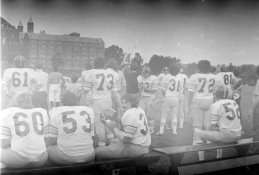
Same film and age as the stuff in the first post, but much better processing. A little bit of bromide drag, but not too bad. Some showed evidence of light leakage or fogging like the last one.


If anyone has any idea what school that is, it would be cool to know. I think it's a cool building. It would be even cooler to track down player number 34, as I'm pretty sure his dad shot these. Camera I believe was a Cavalier STL-1 with (possibly) a Meyer Optik Gorlitz 50mm 1.8.

image0252.JPGimage0255.JPGimage0262.JPGimage0265.JPG
 

aremesal

Member
Allowing Ads
Joined
Jul 6, 2014
Messages
7
Location
Valladolid -
Format
Multi Format
What about a "drop test"?

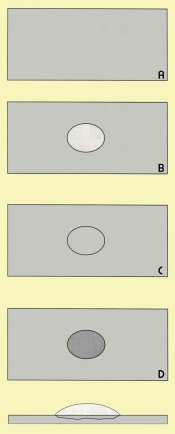
(see the picture below, click for enlarge)

Take a chronometer and a little piece of the film (A) and pour a little drop of your developer, at same temperature and dilution (just mix and place at temp. and use a drop from it), onto the emulsion side of the film. At the very instant that the drop touches the film it'll change its color to a very clearer one, start the time and look at the film (B). The drop will get darker slowly until it's totally black. You must carefully look at this colour change, at certain moment the colour of the drop is exactly the same that the colour of the surrounding area (C), you must stop the time at this precise instant, or just before the colour gets darker (D).

Now, simply divide that time in seconds by 4, and it's the correct development time in minutes for that developer, at that dilution and temperature, for that film :wink:

pruebagota.jpg

Example: you pour a drop of developer onto the emulsion and start counting time. It clears and then starts to darken, when you see the colour matchs the surround colour you stop the time at 28 seconds. 28 / 4 = 7 -> you must develop for 7 minutes.
 
OP
OP
Kirks518

Kirks518

Member
Allowing Ads
Joined
Oct 5, 2013
Messages
1,494
Location
Flori-DUH
Format
Multi Format
@aremesal - That's really cool! But I already went ahead and processes the third roll (see post above yours). Came out good enough.
 

cliveh

Subscriber
Allowing Ads
Joined
Oct 9, 2010
Messages
7,804
Format
35mm RF
What about a "drop test"?

(see the picture below, click for enlarge)

Take a chronometer and a little piece of the film (A) and pour a little drop of your developer, at same temperature and dilution (just mix and place at temp. and use a drop from it), onto the emulsion side of the film. At the very instant that the drop touches the film it'll change its color to a very clearer one, start the time and look at the film (B). The drop will get darker slowly until it's totally black. You must carefully look at this colour change, at certain moment the colour of the drop is exactly the same that the colour of the surrounding area (C), you must stop the time at this precise instant, or just before the colour gets darker (D).

Now, simply divide that time in seconds by 4, and it's the correct development time in minutes for that developer, at that dilution and temperature, for that film :wink:

View attachment 91166

Example: you pour a drop of developer onto the emulsion and start counting time. It clears and then starts to darken, when you see the colour matchs the surround colour you stop the time at 28 seconds. 28 / 4 = 7 -> you must develop for 7 minutes.

What lighting conditions do you suggest for this method?
 

aremesal

Member
Allowing Ads
Joined
Jul 6, 2014
Messages
7
Location
Valladolid -
Format
Multi Format
What lighting conditions do you suggest for this method?

Sorry, it can be done at full light because it's just a small cut from the film, not the whole film :wink: It's just a small, exposed to the light piece cut from the film; I use the very first part of the 135 film, the part which is exposed to the sun when you put it into the camera. When you're going to load the spiral in absolute darkness cut a small piece of film and leave it out of the tank, charge the spiral as usual, close the tank and do the "drop test" with the light switched on.

It's similar to what you do to check the fixing time (immerse a piece of exposed film into the fixing bath, count the time for the piece to get transparent and the double of this time is the perfect fixing time).
 
Photrio.com contains affiliate links to products. We may receive a commission for purchases made through these links.
To read our full affiliate disclosure statement please click Here.

PHOTRIO PARTNERS EQUALLY FUNDING OUR COMMUNITY:


Ilford ADOX Freestyle Photographic Stearman Press Weldon Color Lab Blue Moon Camera & Machine
Top Bottom