• Welcome to Photrio!
    Registration is fast and free. Join today to unlock search, see fewer ads, and access all forum features.
    Click here to sign up

My love/hate relationship with negative contrast and density

Inconsequential

H
Inconsequential

  • 0
  • 0
  • 13
Emi on Fomapan 400

A
Emi on Fomapan 400

  • 5
  • 3
  • 79

Recent Classifieds

Forum statistics

Threads
201,797
Messages
2,830,359
Members
100,957
Latest member
Tante Greet
Recent bookmarks
1

LAG

Member
Allowing Ads
Joined
Aug 8, 2016
Messages
1,006
Location
The moon
Format
Multi Format
... When an individual chooses to avoid certain techniques, like burn and dodge or bleaching, they limit their options, they force compromises.

<< to avoid? >> No Sir, is not avoiding, the individual decision is "to use" (or not) certain techniques (before & after), got nothing to do with "stay away / scape / evade / duck or elude doing ...", no Sir, nothing

<< They limit their options?, They force compromises? >> Once again, absolutely no Sir, by doing so (choose to use, or not to) they just decide what they need as the final result, and that could be with or without adding further frills.

The most common problems I hear of from people who avoid burn and dodge are of blocked up shadows and blown highlights. Sure they can still "fix" the offending problem with say n-1 development or softer paper, but that forces a compromise with the rest of the photo and then they typically complain about flat, lackluster mid tones.

The laws of nature aren't optional.

I'm sorry for that people Mark, but to my way of thinking, they should "fix" those common problems trying to get a new fresh better negative (having fun with the laws of nature) and not by tinkering around with a lacklustre material.

We normally use paper as the final display medium, right?

But that being so (normally) can never justify a poor negative, never. I insist, the negative is not a intermediate step, and the print is not always the final, although both can be licit and perfectly adopted for many people the other way around.
 
Joined
Sep 10, 2002
Messages
3,675
Location
Eugene, Oregon
Format
4x5 Format
LAG,

You are missing the point: Dodging and burning are basic printmaking techniques (as are bleaching and spotting). People wouldn't use them if they didn't yield better prints than they could get from a "perfect" negative printed straight. They are not compromises nor triage for poor negatives. Avoiding their use is like a painter refusing to use a brush or palette knife... I get better prints from negatives I have to dodge and burn in many cases than I could ever get from one that would "straight print" without "blown highlights" or "empty shadows." Local contrast is better. You are more than welcome to strive for negatives that print straight without any manipulations if that's what you want, just be aware that expert photographers and printmakers embrace and take full advantage of a number of manipulation techniques as a matter of course; not because they are trying to save "poor" negatives, but because they expand their creative possibilities and extend the limits of the medium.

Best,

Doremus
 

Bob Carnie

Subscriber
Allowing Ads
Joined
Apr 18, 2004
Messages
7,735
Location
toronto
Format
Med. Format RF
LAG,

You are missing the point: Dodging and burning are basic printmaking techniques (as are bleaching and spotting). People wouldn't use them if they didn't yield better prints than they could get from a "perfect" negative printed straight. They are not compromises nor triage for poor negatives. Avoiding their use is like a painter refusing to use a brush or palette knife... I get better prints from negatives I have to dodge and burn in many cases than I could ever get from one that would "straight print" without "blown highlights" or "empty shadows." Local contrast is better. You are more than welcome to strive for negatives that print straight without any manipulations if that's what you want, just be aware that expert photographers and printmakers embrace and take full advantage of a number of manipulation techniques as a matter of course; not because they are trying to save "poor" negatives, but because they expand their creative possibilities and extend the limits of the medium.

Best,

Doremus
Plus one

I do not think I have ever made a print without dodge and burn, ok I lie contact prints of freshly processed film.
 

Bill Burk

Subscriber
Allowing Ads
Joined
Feb 9, 2010
Messages
9,464
Format
4x5 Format
... wanted, with this thread, instead to express my dismay with finding a continuing merit with BOTH approaches to negative exposure. There are claims to be made for both negative 'scores'. Neither approach is 'wrong', but neither is definitively 'correct'. I want, intuitively, an approach towards negative exposure that is always correct,... - David Lyga

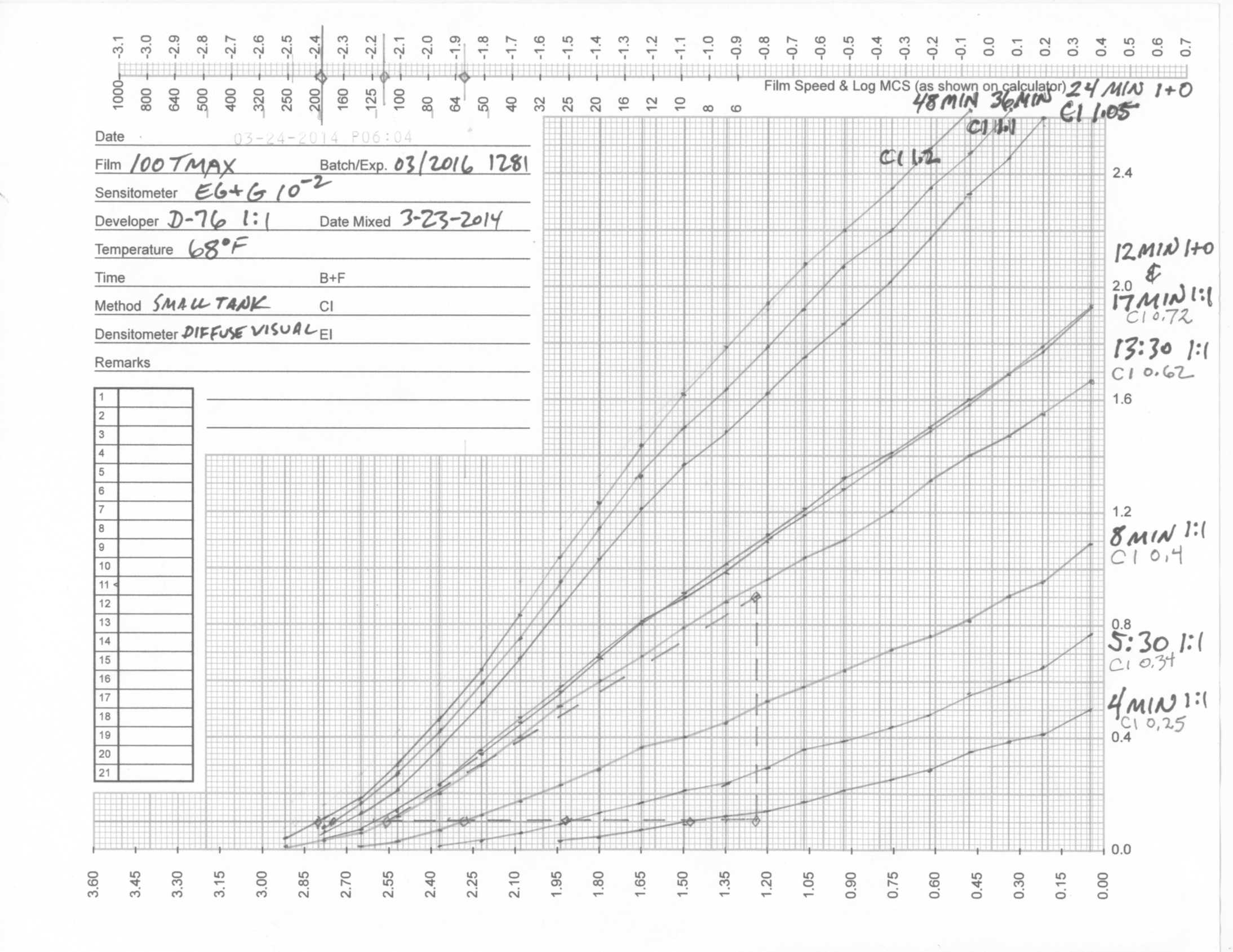
Maybe my approach would work for you.

I start with a curve family... which gives you an idea where all possible combinations of exposure and development will arrive on film density...

tmxfamily.jpg


No matter what, for D-76 this film will respond to light and development according to the curve family...

So it becomes a playground where you can mentally play out different ideas... always working with the same understanding...

For example, consider the idea of "pushing" which I hate to consider, especially for a 100 speed film. But suppose you wanted the stark look that comes with it...

I can see that on the absolute logarithmic scale, any film exposure less than about -2.5 log mcs will always result in density indistinguishable above base+fog. So if I want any detail, I have to make sure the film gets more light than that. So for TMAX 100, if I wanted to push, I might expose a highlight such that it arrives at -1.8 log mcs and develop the film 48 minutes in D-76 stock. (That might mean choosing an EI of 200 for my light meter).

The film doesn't change its speed, it's still 100... but what changes is the setting on your meter that will probably give you an acceptable picture on average...
 
Last edited:

markbarendt

Member
Allowing Ads
Joined
May 18, 2008
Messages
9,422
Location
Beaverton, OR
Format
Multi Format
Plus one

I do not think I have ever made a print without dodge and burn, ok I lie contact prints of freshly processed film.
Plus two
 

MattKing

Moderator
Moderator
Allowing Ads
Joined
Apr 24, 2005
Messages
55,167
Location
Delta, BC Canada
Format
Medium Format
I do not think I have ever made a print without dodge and burn, ok I lie contact prints of freshly processed film
I often choose the negative for the APUG Postcard Exchange with a goal of minimizing the amount of burning and dodging necessary.

Small prints + multiple copies + complex printing = less fun
 

LAG

Member
Allowing Ads
Joined
Aug 8, 2016
Messages
1,006
Location
The moon
Format
Multi Format
LAG,

You are missing the point: Dodging and burning are basic printmaking techniques (as are bleaching and spotting). People wouldn't use them if they didn't yield better prints than they could get from a "perfect" negative printed straight. They are not compromises nor triage for poor negatives. Avoiding their use is like a painter refusing to use a brush or palette knife... I get better prints from negatives I have to dodge and burn in many cases than I could ever get from one that would "straight print" without "blown highlights" or "empty shadows." Local contrast is better. You are more than welcome to strive for negatives that print straight without any manipulations if that's what you want, just be aware that expert photographers and printmakers embrace and take full advantage of a number of manipulation techniques as a matter of course; not because they are trying to save "poor" negatives, but because they expand their creative possibilities and extend the limits of the medium.

Best,

Doremus

No Sir. Not missing point, chosen.

Excuse me Doremus Scudder

There are lots of basic (others not so much) technics, inside as well as outside the print process, but all of them are optional, I insist and sorry to emphasized OPTIONAL. I am not avoiding, nor refusing, because Is not obligatory, is it? (I cannot believe that such a simple word in capital letters does not makes sense to you, must be a joke). One painter can use a simple set of pencils, and can also decide to tear up his/her canvas and start again.

If you get better prints, if your local contrast is better that way, (good for you) Good to know! And also is good to know what others "experts" EMBRACE (at last, free to choose!) but I am more interested in what they see rather than what they use. Anyway, Thanks for the advise.

Let me add, that I have worked 16 years in an Advertising and Media Center Agency as Art Director (never liked those words, together or separately) and during those years I used (obligue/exonerated) all kind of photographic (film/d.g.t.l) manipulation. I know first hand the media, and pretty well the creative/destructive possibilities part. Lots of learning, both ways.

All the Best, to you
 
Last edited:

LAG

Member
Allowing Ads
Joined
Aug 8, 2016
Messages
1,006
Location
The moon
Format
Multi Format
... which gives you an idea where all possible combinations of exposure and development will arrive on film density...

Excuse me Bill Burk, the combinations are better reflected in the "Nine states of the Negative"

The film doesn't change its speed, it's still 100... but what changes is the ...

Latitude
 

Bill Burk

Subscriber
Allowing Ads
Joined
Feb 9, 2010
Messages
9,464
Format
4x5 Format
Excuse me Bill Burk, the combinations are better reflected in the "Nine states of the Negative"

The ring-around is a valuable exercise to illustrate examples of what will happen if you go different directions in developing and exposing, absolutely worthwhile. I know Bob Carnie occasionally does that.

But I get closer to seeing all that is possible when I look at a family of curves like I presented... I'd be happy to spend time exploring this with you if you like. I think you might enjoy it.


Yes latitude is greater with less development, but it is much more than that, I think you'll agree with my examples...

For example even if you don't change development time, you get more latitude when the light is flatter. This will happen on a foggy day (I live near the California coast so I have some experience with that.), dusk, or in a studio when you deliberately make the subject illumination flatter with fill light.
 

LAG

Member
Allowing Ads
Joined
Aug 8, 2016
Messages
1,006
Location
The moon
Format
Multi Format
Excuse me Bill

I was trying to say that the presented family curve is “Your” playground, but not “The” playground, while the (years-ago) ring-around is a wider and complete starting point, to my way of thinking of course. I was not trying to compare both test (bracketing exp/dev), but trying to make you see that I believe that “those combinations” in your examples can not covered the “all” thing. In conclusion (my conclusion) that curve is not valid (for me, I can't vouch for the rest) as a reference.

Anyway, thanks for sharing your tests! I’ll be glad to hear and learn more from you, no doubt about it! Much more if you say it could be enjoyable ...

I’m sorry I was very concise in my post to you. It takes me a lot of time to write in another language (it means to me a great effort - even more when writing down out of a desktop –) and same thing happens with the reading as well, sometimes it’s very hard to find out some expressions when R/W. (so you all may think “that’s your problem!”, right!), and the previous answer took me too long, for which I apologize for any inconvenience to you.

Regards
 

Bob Carnie

Subscriber
Allowing Ads
Joined
Apr 18, 2004
Messages
7,735
Location
toronto
Format
Med. Format RF
Bill - I have stopped doing ring arounds as I have reached level 13 enlightenment .

I encourage all grasshoppers to give a bw and colour ring around a go.
 

chris77

Member
Allowing Ads
Joined
Jan 11, 2015
Messages
708
Location
Paris
Format
Medium Format
very good thread, i find. no fouls and very informative
thanks to you all!
 

cliveh

Subscriber
Allowing Ads
Joined
Oct 9, 2010
Messages
7,792
Format
35mm RF
Easy answer to the OP is that lack of shadow detail is always more acceptable than lack of highlight detail. There are shadows that we can't see into, but if you have a white blob in your picture our eye is drawn to it.
 

NJH

Member
Allowing Ads
Joined
Dec 30, 2013
Messages
702
Location
Dorset
Format
Multi Format
I think I know what the OP is getting at but perhaps its more about compressing the midtones than highlights and shadow. I have some of my negatives I am printing at the moment, unfortunately they were massively overdeveloped by a lab and are requiring grade 1 or less to get most of it onto the paper. All the cloud detail is still in there despite the neg looking really dark but the details that use a lot of midtones definitely lack bite to my eyes, but then again grade 0 or 00 is pretty extreme surely and wouldn't be normal I guess. All my own developed negatives are printing OK at between 2 and 3. Long print times at nigh on full yellow on the enlarger is a bit of a pain. One doesn't have to print like that though, maybe I am going on the wrong path where I am trying to get a good base print then use dodging/burning to emphasise/de-emphasise elements of the picture for artistic effect rather than printing at a more normal grade and using the dodging/burning to bring them back into visual range? Maybe this is the issue the OP is grappling with? Its effecting me but as I said earlier I wouldn't ever set out to create a negative that wants an extreme print grade anyway.
 
Photrio.com contains affiliate links to products. We may receive a commission for purchases made through these links.
To read our full affiliate disclosure statement please click Here.

PHOTRIO PARTNERS EQUALLY FUNDING OUR COMMUNITY:


Ilford ADOX Freestyle Photographic Stearman Press Weldon Color Lab Blue Moon Camera & Machine
Top Bottom