• Welcome to Photrio!
    Registration is fast and free. Join today to unlock search, see fewer ads, and access all forum features.
    Click here to sign up

My love/hate relationship with negative contrast and density

Inconsequential

H
Inconsequential

  • 0
  • 0
  • 7
Emi on Fomapan 400

A
Emi on Fomapan 400

  • 5
  • 3
  • 72

Recent Classifieds

Forum statistics

Threads
201,796
Messages
2,830,355
Members
100,957
Latest member
Tante Greet
Recent bookmarks
0

LAG

Member
Allowing Ads
Joined
Aug 8, 2016
Messages
1,006
Location
The moon
Format
Multi Format
Excuse me David Lyga

Perhaps, the dilemma is not spending 52 years in a darkroom, but having one repeated fifty times ... In my opinion, I believe that a more than right answer to this thread is far from Adams', but too much close to the markbarendt's (Anïs) signature.


Excuse me Jonasfj

Everyone is free to act as he wishes, but I wonder why some (of that "every") spend so much time writting those kind of long articles (thanks for sharing, and thanks to Mr. Halfhill anyway), searching much of the answers that are summend up in a simple graphic (C. C.) I think that sometimes we make things even more complicated than they really are
 
OP
OP
David Lyga

David Lyga

Member
Allowing Ads
Joined
Nov 25, 2007
Messages
3,445
Location
Philadelphia
Format
35mm
First, even in Adams time it wasn't normally about negatives not having some enough room for extra highlight detail, instead the real limit has always been the paper.
.

Mark: It is not entirely up to the paper. What I was trying to impart with this thread is that, even if you capture it all in the negative, you STILL might not have the proper separation that you are looking for. Paper can adjust the WHOLE panoply of tones, but it cannot separate, for example, ONLY the highlights, or ONLY the shadows, or ONLY the midtones. With some subjects that might matter, in that we might wish to differentiate only one of those three areas of the tonal continuum. Only through a combination of proper exposure, judged solely upon what you wish to capture and emphasize (within the subjective scene), and proper development time/temp, again, judged solely upon that same criteria, can a truly exacting print manifest. Now, there are scenes, maybe MOST scenes, which do not need all this fine tuning, but, if one is aware that sometimes it just might be necessary, tailored exposure/development (for what you wish to impart) is another weapon in your arsenal. (And I don't even own a gun!)

As good as he was, I do think that AA was overkill with regard to the Zone System. I mean, why say 'Dev - 1' when you could more precisely say '90% Dev Time' (and it would also make more sense)? Also, the cumbersome Roman numerals used to simply divide a tonal system into ten parts did not have to be stated so 'theoretically'. - David Lyga
 
Last edited:

markbarendt

Member
Allowing Ads
Joined
May 18, 2008
Messages
9,422
Location
Beaverton, OR
Format
Multi Format
Hey David,

Sure, the tools like the paper and the film can be a bit rigid in their global characteristics; that's only a problem for a "straight printer".

What's missing from your comments are the humans doing the work and all the fun stuff like burn and dodge and bleach and split-toning that we bring into the printing process.

We have local control. We can print well separated shadow detail in one area and well separated highlights in another and snappy mid-tones ta-boot; Adams did this regularly. Clearing Winter Storm and Moonrise are two standouts here.

The reason for saying N, N-1, or N+1 is that these weren't meant as absolute numbers. Your N, N-1, or N+1 was expected to be different than his N, N-1, or N+1. You were expected to find your numbers for yourself by printing and testing for yourself.
 

LAG

Member
Allowing Ads
Joined
Aug 8, 2016
Messages
1,006
Location
The moon
Format
Multi Format
You were expected to find your numbers for yourself by printing and testing for yourself.

Exactly! Just like the number "ten?" (parts), who was/is another number for others. Just like the printing and testing numbers who others did/do with other numbers as well.
 

ic-racer

Member
Joined
Feb 25, 2007
Messages
16,728
Location
USA
Format
Multi Format
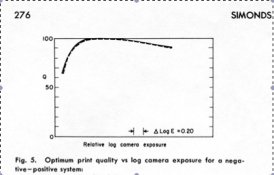
Unless one is using vintage or outdated film, or including light sources in the image area, one can always render the entire scene on the film. If one is using a film with mostly straight line characteristics, then additional exposure (over that needed to render the shadows) results in loss of resolution, not tonal separation. Using sheetfilm can minimize these effects.
 

Attachments

  • Simonds.jpg
    Simonds.jpg
    30.2 KB · Views: 102
OP
OP
David Lyga

David Lyga

Member
Allowing Ads
Joined
Nov 25, 2007
Messages
3,445
Location
Philadelphia
Format
35mm
Hey David,


What's missing from your comments are the humans doing the work and all the fun stuff like burn and dodge and bleach and split-toning that we bring into the printing process.

But, Mark, I want this process to be lacking a need to do all that 'fun stuff'. I want my negative to be the perfect score that performs itself! - David Lyga
 
OP
OP
David Lyga

David Lyga

Member
Allowing Ads
Joined
Nov 25, 2007
Messages
3,445
Location
Philadelphia
Format
35mm
If one is using a film with mostly straight line characteristics, then additional exposure (over that needed to render the shadows) results in loss of resolution, not tonal separation.

True, no loss in tonal separation, but the excess exposure DOES result in tonal COMPACTION. That could be a problem. - David Lyga
 

LAG

Member
Allowing Ads
Joined
Aug 8, 2016
Messages
1,006
Location
The moon
Format
Multi Format
... I want my negative to be the perfect score that performs itself! - David Lyga

Now that I am invisible and nobody can hear me ...

After 52 years ... “If you don't know where you are going, any road can take you there”, Alice in Wonderland
 

markbarendt

Member
Allowing Ads
Joined
May 18, 2008
Messages
9,422
Location
Beaverton, OR
Format
Multi Format
After 52 years in the darkroom I still cannot decide whether I like more fully exposed negatives (which grant more shadow detail but less highlight separation) or less exposed negatives (which skimp on shadow detail but allow for more brilliant highlight separation). Do any of you face the same dilemma?
The exact placement of camera exposure is almost irrelevant if one can adjust their enlarger exposure, f-stop and or time for print exposure. Most any reasonably exposed negative is fully capable of printing any tone, high or low, with good separation.

Given that, this isn't really a technical dilemma, instead it's an artistic dilemma.

The only reason both might not happen at the same time on the same print is because of the choices made by the person printing. For example:
But, Mark, I want this process to be lacking a need to do all that 'fun stuff'. I want my negative to be the perfect score that performs itself! - David Lyga
 

markbarendt

Member
Allowing Ads
Joined
May 18, 2008
Messages
9,422
Location
Beaverton, OR
Format
Multi Format
When the tones are too close together. - David Lyga
What we are getting at David is that with modern films compaction on the film is rare to non-existent.

The compaction happens in the print/on the toe and shoulder of the paper, not on the negative.
 
Joined
Sep 10, 2002
Messages
3,675
Location
Eugene, Oregon
Format
4x5 Format
What we are getting at David is that with modern films compaction on the film is rare to non-existent.

The compaction happens in the print/on the toe and shoulder of the paper, not on the negative.

This is the crux of the matter. Finding a paper that has a different toe curve may be an answer to your dilemma, David. FWIW, I spend quite a lot of time on getting the separation in the highlight values just right when I print. Small changes in exposure (or tweaking development time in 15-second intervals) as well as changing paper brands is how I go about getting what I need (along with burning with higher-contrast filtration when I'm using VC papers).

Best,

Doremus
 

nworth

Member
Allowing Ads
Joined
Aug 27, 2005
Messages
2,228
Location
Los Alamos,
Format
Multi Format
There are a lot of things happening here, as is usually the case with discussions of exposure. Film will only record a limited range of brightness, and some films are better than others. That may be one of the reasons I like Tri-X; it has an excellent dynamic range. Pan-F+ is one of the more limited range films, although it has other compensations. Pan-F+ will handle about 7-1/2 stops of brightness range. That is enough for all but the most difficult situations. Tri-X will handle about 8-1/2 stops. XP-2+ has a huge range, and it is generally an excellent film. But sometimes you just can't get everything. You just need to work around that. You also need a developer that will bring out the full range. Not all developers perform well in this way. Pyrocat-HD seems to do well, and the old standards D-76 and D-23 are well known full range developers.

The Zone system really does work, and it can help a lot in evaluating a scene, even if you are using roll film. Roll film presents a problem because you usually have many exposures of varying subjects on the roll, and you can only develop for the average on the roll. I generally just use the normal recommended development for roll film. That means I can not adjust the contrast in development, and I must depend on the contrast range of the paper to compensate. It usually works. A spot meter is very useful, even with roll film. One method of exposure that I found somewhere is to meter the most important area of the scene (maybe a medium shadow with important detail), assign it to the appropriate zone (4?), and base your exposure on that reading. It works pretty well. You can also check the brightest and darkest areas of the scene that have important detail and see if you will capture them. This will also give you an idea of the contrast grade you will need in printing.

Re-reading some of the standard texts, dull as they may be, can help. Adams, "The Negative" and Davis "Beyond the Zone System" come to mind. White, Zakia, and Lorenz "The New Zone System Manual" is also quite useful.
 
  • jonasfj
  • Deleted
  • Reason: im posting again

jonasfj

Member
Allowing Ads
Joined
Dec 14, 2013
Messages
198
Format
35mm
There are a lot of things happening here, as is usually the case with discussions of exposure. Film will only record a limited range of brightness, and some films are better than others. That may be one of the reasons I like Tri-X; it has an excellent dynamic range. Pan-F+ is one of the more limited range films, although it has other compensations. Pan-F+ will handle about 7-1/2 stops of brightness range. That is enough for all but the most difficult situations. Tri-X will handle about 8-1/2 stops. XP-2+ has a huge range, and it is generally an excellent film. But sometimes you just can't get everything. You just need to work around that. You also need a developer that will bring out the full range. Not all developers perform well in this way. Pyrocat-HD seems to do well, and the old standards D-76 and D-23 are well known full range developers.

What you say here is just not correct. All state-of-the-art black and white films can record at least 14 stops of dynamic range, probably 16. You can tailor the characteristic curve in any way you desire.

If you do this:
http://www.halfhill.com/speed1.html

then all your films will show the same contrast.
 

jonasfj

Member
Allowing Ads
Joined
Dec 14, 2013
Messages
198
Format
35mm
Excuse me David Lyga

Perhaps, the dilemma is not spending 52 years in a darkroom, but having one repeated fifty times ... In my opinion, I believe that a more than right answer to this thread is far from Adams', but too much close to the markbarendt's (Anïs) signature.


Excuse me Jonasfj

Everyone is free to act as he wishes, but I wonder why some (of that "every") spend so much time writting those kind of long articles (thanks for sharing, and thanks to Mr. Halfhill anyway), searching much of the answers that are summend up in a simple graphic (C. C.) I think that sometimes we make things even more complicated than they really are

It seems that you do get my point. The characteristic curve can look anyway you want it to look. In practice it can vary a lot between your workflow and my workflow. By workflow I include such elements as calibration of your light meter, the way you use your light meter, your ISO rating of the film, the way you develop, temperature, agitation, time, the way you print, diffuser/condenser and many other variables.

It is just not a useful concept to state that one film has different contrast than another film. You can only state that one film with a specific workflow has a different contrast from another film with a specific workflow.

If you follow Mr. Halfhill's method, all your films will show the same contrast.
 

Peter Schrager

Subscriber
Allowing Ads
Joined
Jul 19, 2004
Messages
4,317
Location
fairfield co
Format
Large Format
interesting discussion..with roll film my Zone system is to meter for the high values and place it as high as possible...like zone 7.5
of course I'm out in California so it's all about the light!!...I'm agreeing about TRI-X it's a great film; very hard to beat
but there are many nice other flavors of film...get to know one well and your pictures will sing...just learn the materials and make your OWN system!!
Best, peter
 

LAG

Member
Allowing Ads
Joined
Aug 8, 2016
Messages
1,006
Location
The moon
Format
Multi Format
There are a lot of things happening here, as is usually the case with discussions of exposure. Film will only record a limited range of brightness, and some films are better than others. That may be one of the reasons I like Tri-X; it has an excellent dynamic range. Pan-F+ is one of the more limited range films, although it has other compensations. Pan-F+ will handle about 7-1/2 stops of brightness range. That is enough for all but the most difficult situations. Tri-X will handle about 8-1/2 stops. XP-2+ has a huge range, and it is generally an excellent film. But sometimes you just can't get everything. You just need to work around that. You also need a developer that will bring out the full range. Not all developers perform well in this way. Pyrocat-HD seems to do well, and the old standards D-76 and D-23 are well known full range developers.

The Zone system really does work, and it can help a lot in evaluating a scene, even if you are using roll film. Roll film presents a problem because you usually have many exposures of varying subjects on the roll, and you can only develop for the average on the roll. I generally just use the normal recommended development for roll film. That means I can not adjust the contrast in development, and I must depend on the contrast range of the paper to compensate. It usually works. A spot meter is very useful, even with roll film. One method of exposure that I found somewhere is to meter the most important area of the scene (maybe a medium shadow with important detail), assign it to the appropriate zone (4?), and base your exposure on that reading. It works pretty well. You can also check the brightest and darkest areas of the scene that have important detail and see if you will capture them. This will also give you an idea of the contrast grade you will need in printing.

Re-reading some of the standard texts, dull as they may be, can help. Adams, "The Negative" and Davis "Beyond the Zone System" come to mind. White, Zakia, and Lorenz "The New Zone System Manual" is also quite useful.

Excuse me nworth

Excessive amount of priority on conventional attitudes or "found somewhere". In practice, sometimes (most of the times) is not a good idea to do the things "by the book" (from your personal shelf, or others)

Excuse me jonasfj

The characteristic curve can look anyway you want it to look

Look anyway? Absolutely not Sir ... another thing is that you are free to make your own reading (as I told you before) and do whatever you want with your personal "look-anyway-interpretation" of it.

In practice it can vary a lot between your workflow and my workflow...

Mr example worflow

...and many other variables... Mr. Halfhill's method ...

You've answered for yourself.
 
OP
OP
David Lyga

David Lyga

Member
Allowing Ads
Joined
Nov 25, 2007
Messages
3,445
Location
Philadelphia
Format
35mm
The compaction happens in the print/on the toe and shoulder of the paper, not on the negative.

THIS is what I have a problem with: Depending how you expose the negative, the BEST separation is found in the mid-range of the characteristic curve, and that mid-range does not have to be the mid-TONES of the negative. Thus, if you expose so that the highlights are compressed into the negative's shoulder (yes, there still is toe and shoulder in modern films, albeit not as much) you compact those hightlights. On the other hand, if you underexpose considerably, your highlights are going to be golden: lush separation and beautiful tonality. The REST of the scene just might be, tonally, severely compromised (or even nonexistent).

Look at it this way: the highlights of a daylight scene are usually subjectively interpreted as being 'glaring', 'bright', thus not 'having the right' to be visually interpreted as internally separated as much as mid-tones are. Thus, we WANT those highlights to be somewhat compressed, tonally. However, there might be situations, whereby ONLY the highlights are to be presented: there, we might wish to re-interpret those highlights as NOT the exception, NOT the glare, NOT brighter than a normal mid-tone. So we underexpose so that the highlights will not be too compacted.

Perhaps easier to understand: when we photograph a scene that is WHOLLY in the shade, and NOT with competing highlights to set things into perspective, we WANT that shade to appear brighter in the photograph. Thus we would opt to place those shadow details more into the mid-range, or as Ansel Adams would say, place onto Zone 5 instead of Zone 2. That is what I (WE!) love so much about monochrome photography: we get to play with perception.

This topic is not definitive; instead it is fluid, rather subjective, warranting much thought and discussion in areas that many considered non-existent. It is not good enough to posit that today's films do not have the problems of old. They might be better in many aspects, but the old film, with an extended toe and shoulder, perhaps 'left more room' for mid-tone separation. Some situations could actually benefit from that. After all, there is only so much room between density and translucence. - David Lyga
 
Last edited:
OP
OP
David Lyga

David Lyga

Member
Allowing Ads
Joined
Nov 25, 2007
Messages
3,445
Location
Philadelphia
Format
35mm
Even with modern films, there is a compaction at the top and bottom. Not as much, but it is still there. - David Lyga
 

markbarendt

Member
Allowing Ads
Joined
May 18, 2008
Messages
9,422
Location
Beaverton, OR
Format
Multi Format
You are right David, in that there are still limits to the film's range. It is worth finding those limits.

I honestly don't think the films limits are what you're struggling with here though.

I think you are stuck between scenes, where the tones in nature aren't falling where you want them, and not wanting to burn and dodge.
 
OP
OP
David Lyga

David Lyga

Member
Allowing Ads
Joined
Nov 25, 2007
Messages
3,445
Location
Philadelphia
Format
35mm
When we see a particular 'scene' (and that might be as simple as the shaded area within a larger, sunlit scene), we need to know how we want that tonality expressed in a (tonally truncated) reflectance print. We can express this either as a less important, subordinate 'shade' (usual case), giving wide berth to the more important sunlit portions, or, if, instead, that shaded portion is deemed to be considered the main topic of the scene, we might wish to express it as portraying, indeed heralding, more luxurious mid-tones and let the sunlit portion NOW retain a subordinate (and, thus, less important) glare with far less tonal differentiation. That becomes the subjective determination. We do this, theoretically simply, with Zone System 'placement' and proper development timing. However, finding the correct combination, swaying from the 'good enough' syndrome, becomes a formidable task.

We are SO spoiled by manufacturers striving to let us 'have it all' with better and better films and papers, but the truth is that there are only so many tonalities within a negative, and far less, even, within a reflectance print. What we see, thus, must, by necessity, become visually compressed, (usually, other than with the case of low contrast scenes), and it is up to us to decide just WHAT is most able to be compromised (without constricted artistic results). This is why monochrome photography (as opposed to the more straightforward color) is really the final test as to one's artistic merit.

I claim no such merit, but am, by this time, qualified to state that this dilemma does, in fact, exist. And this 'dilemma' just might be reason enough to state that that is what gives inventiveness and ingenuity to this hobby, craft, and artistic endeavor. I wanted to bring this up to stymie you because, after 52 years in the darkroom, I have shown that nobody out there 'knows it all'. We become humbled by the panoply of choices.

And the fact that the moderators let me make about 20 - 30 edits to an extant post, in order to 'get it right', is reason enough for me to keep my APUG subscription. - David Lyga
 
Last edited:

Craig75

Member
Allowing Ads
Joined
May 9, 2016
Messages
1,234
Location
Uk
Format
35mm
Is this the search for negative so exquisite that it needs no test print but just the minimum time in the enlarger - all contrast work has been done within the camera and development to execute a print you could swim in?
 

jonasfj

Member
Allowing Ads
Joined
Dec 14, 2013
Messages
198
Format
35mm
The straight line portion of the characteristic curve (ie the exposure range with maximum contrast for a given overall gradient, which is what David is referring to) is considerably shorter than the total exposure range. As for tailoring the characteristic curve in any way you desire, I disagree with that premise.

I guess that was a sloppy way of expressing it, but I do think you know what I mean, which is:

You can tailor the characteristic curve in a way so that the starting point and end point will show detail in the final print (or scan), i.e. you can shift the curve up/down and you can adjust the slope of the curve.

One way to do this, in a fairly accurate way, is by following the method of Mr. Hill (which actually is a better written and easier to understand version of Kodak's recommendations in one of their tech publications). By doing this, you will find the optimum characteristic curve and it will look similar for any given modern film.

Note, I only talk about the useful part of the characteristic curve. Film can record a larger dynamic range than the printing paper (or the scanner for that matter). The latent image can record up to 14-16 stops, the developed negative can contain 10+ stops, but the paper only has 10 stops and many scanners significantly less.

On top of this you can manage the subject dynamic range by using the zone system.

Einstein stated that everything is relative. I still maintain that discussing a negative contrast without referencing the workflow is like trying to tell the speed you travel in space.

I tell you guys, if you pick any 100 ISO film and any 400 ISO film and a developer, spend half a day optimising your ISO and development time, then you will get easy to print negatives with as much detail in shadows and highlights possible. Every time!

The best book (I read) on the subject is: The Art of Photography by Bruce Barnbaum

Cheers,

Jonas
 

jonasfj

Member
Allowing Ads
Joined
Dec 14, 2013
Messages
198
Format
35mm
Excuse me nworth

Excessive amount of priority on conventional attitudes or "found somewhere". In practice, sometimes (most of the times) is not a good idea to do the things "by the book" (from your personal shelf, or others)

Excuse me jonasfj


Look anyway? Absolutely not Sir ... another thing is that you are free to make your own reading (as I told you before) and do whatever you want with your personal "look-anyway-interpretation" of it.


Mr example worflow


You've answered for yourself.


What do you mean?
 
Photrio.com contains affiliate links to products. We may receive a commission for purchases made through these links.
To read our full affiliate disclosure statement please click Here.

PHOTRIO PARTNERS EQUALLY FUNDING OUR COMMUNITY:


Ilford ADOX Freestyle Photographic Stearman Press Weldon Color Lab Blue Moon Camera & Machine
Top Bottom