• Welcome to Photrio!
    Registration is fast and free. Join today to unlock search, see fewer ads, and access all forum features.
    Click here to sign up

MR-9 adapter voltage question

Somewhere...

D
Somewhere...

  • 5
  • 2
  • 88
Iriana

H
Iriana

  • 7
  • 1
  • 149

Recent Classifieds

Forum statistics

Threads
202,750
Messages
2,845,032
Members
101,498
Latest member
Hansue
Recent bookmarks
0

Bwbuff

Member
Allowing Ads
Joined
Jan 6, 2023
Messages
114
Location
Canada
Format
35mm
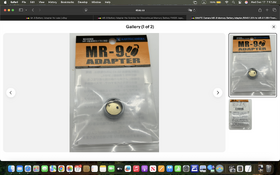
Is the MR-9 adapter only accept SR43 battery according to the description from the packaging ? I don't have any SR43 to test, I had tried the LR44 and SR44w without the adapter the voltage shows 1.56v and 1.59v. With the adapter , the voltage did not drop to 1.35v as expected, it shows 1.51v and 1.52v respectively. I tried both adapters , the results are the same . These are the Kanto camera MR-9 from Japan. Also I tried the Zinc air 1.35 V with/without the adapter, the voltage remains 1.35 volt.
Any idea why ? thank you.
 
You can try adding a 10K resistor to the output of MR-9 and measure again. The alkaline battery and MR-9 might behave differently with or without load. You were measuring open-circuit voltage, and the values seem correct.
 
After reading the description of the adapter, it seems it is designed to work just with the specified SR43 battery.
 
These adapters contain a diode (probably a Schottky diode), whose voltage drop depends on the current draw (like all diodes). At nearly zero load, they'll have nearly zero drop. So as blee1996 suggested, you are likely to get misleading results testing it without a load.

An SR43 battery is a silver oxide battery (equivalent to #386) that is 11.6 x 4.2mm.

An SR44 battery is a silver oxide battery (equivalent to #357) that is 11.6 x 5.4mm.

You can get these specs from any battery maker, like exellbattery.com. I don't have this exact MR-9 adapter, but I am certain that the difference between SR43 and SR44 is about whether the larger battery physically fits in your camera/meter when it's sitting in the adapter. If it fits, just try using the camera.
 
I found that with an MR-9 adapter and an MS-76 (or equivalent size battery), with some cameras, the battery cover would stick out and the bottom of the camera would not sit flush on a flat surface. With these cameras I used the slimmer 386 battery instead. The 386, being smaller, may be exhausted slightly sooner but is sometimes a better fit.
 
There are some so-called 'MR-9' adapters sold on the market which are NOT Voltage conversion capable, but rely upon the use of 1.35V air cells...typiically thses have a hole in them to admit air to the cell. Do you have one of these imposter MR-9?
 
There are some so-called 'MR-9' adapters sold on the market which are NOT Voltage conversion capable, but rely upon the use of 1.35V air cells...typiically thses have a hole in them to admit air to the cell. Do you have one of these imposter MR-9?
The ones I have has a tiny diode at the bottom .
 
These adapters contain a diode (probably a Schottky diode), whose voltage drop depends on the current draw (like all diodes). At nearly zero load, they'll have nearly zero drop. So as blee1996 suggested, you are likely to get misleading results testing it without a load.

An SR43 battery is a silver oxide battery (equivalent to #386) that is 11.6 x 4.2mm.

An SR44 battery is a silver oxide battery (equivalent to #357) that is 11.6 x 5.4mm.

You can get these specs from any battery maker, like exellbattery.com. I don't have this exact MR-9 adapter, but I am certain that the difference between SR43 and SR44 is about whether the larger battery physically fits in your camera/meter when it's sitting in the adapter. If it fits, just try using the camera.

Thanks, That's what I think , without any current being drawn, the voltage remains unchanged.
 
Is the MR-9 adapter only accept SR43 battery according to the description from the packaging ? I don't have any SR43 to test, I had tried the LR44 and SR44w without the adapter the voltage shows 1.56v and 1.59v. With the adapter , the voltage did not drop to 1.35v as expected, it shows 1.51v and 1.52v respectively. I tried both adapters , the results are the same . These are the Kanto camera MR-9 from Japan. Also I tried the Zinc air 1.35 V with/without the adapter, the voltage remains 1.35 volt.
Any idea why ? thank you.

The MR9 solution will not drop voltage until it is under load. You're not loading the battery simply by measuring it with the device freestanding.
 
If a Schottky diode drops the voltage in relation to the current draw, then that brings up the question, How much current does a camera meter draw?

In other words, if one wants to check a MR-9 battery adapter to be used in a camera, what resistor value should be chosen to represent a realistic current draw?

In addition to a 20V DC setting, my multimeter has a Battery Test function for 1.5V, 9V, and 12V. Can I assume using the Battery Test mode of my multimeter adds some kind of load? The operating instructions do not say if a load is applied, or how much.
 
Last edited:
If a Schottky diode drops the voltage in relation to the current draw, then that brings up the question, How much current does a camera meter draw?

In other words, if one wants to check a MR-9 battery adapter to be used in a camera, what resistor value should be chosen to represent a realistic current draw?

In addition to a 20V DC setting, my multimeter has a Battery Test function for 1.5V, 9V, and 12V. Can I assume using the Battery Test mode of my multimeter adds some kind of load? The operating instructions do not if a load is applied, or how much.

It's designed for a nominal draw of 200 microamps:

 
It's designed for a nominal draw of 200 microamps
When it comes to electronics, I am a real babe-in-the-wood -- so, someone please help.

If I understand correctly (doubtful), and if I got the decimal in the right place for the amps, then is it true that a 7500 ohm resistor would be an appropriate load for testing the MR-9 voltage converter?

Screenshot 2025-12-16 at 9.29.58 PM.png
 
The ones I have has a tiny diode at the bottom .
What I said earlier about so-called 'MR-9...they use the designation, they look similar, but they work differently -- NOT Voltage converting...

You have one like this...

1fa27631-f7d8-402d-8787-b53feebd5c85.jpg
[/URL]

...and the product description says, "The adapter fits for LR44 or a 1.4v Zinc air battery."
and since the hole is not needed for air to the cell, it probably simply lets air in so that expended cell will more easily drop out of the inset cavity because a vacuum does not form as the cell is withdrawn.

OTOH, this (different) product sold on the same website as an MR-9 is one with Voltage conversion, and costs more...
"US Duty Paid Kanto Camera MR-9 Mercury Battery Adapter SR43 1.55V to 1.35V New"
 
Last edited:
If a Schottky diode drops the voltage in relation to the current draw, then that brings up the question, How much current does a camera meter draw?

In other words, if one wants to check a MR-9 battery adapter to be used in a camera, what resistor value should be chosen to represent a realistic current draw?

In addition to a 20V DC setting, my multimeter has a Battery Test function for 1.5V, 9V, and 12V. Can I assume using the Battery Test mode of my multimeter adds some kind of load? The operating instructions do not say if a load is applied, or how much.

Any type of diode will drop the voltage by some amount that ramps up from zero (it is a knee-like curve) depending on the current draw.

A normal silicon diode (like a 1N4001 rectifier) will drop the voltage by about ~0.7 volts at typical currents like a fraction of an amp. It would probably be about 0.5 volts at the tiny less-than-a-milliamp currents drawn by a light meter. That's too much, so the people who make MR-9 type adapters have to use a different type of diode. Something like a Schottky BAT42 diode would be a good choice. These use a metal-semiconductor junction and have a smaller voltage drop. Here's a datasheet for the BAT42: https://www.vishay.com/docs/85660/bat42.pdf

Figure 2 (see below) shows that at 25 C and a current of 0.2 milliamps, the BAT42 has a forward voltage drop of 0.2 V, which is just about exactly right.

The battery test mode of your multimeter might draw a few milliamps, I think that's what mine draws. This might be close enough to do the test. It would be more controlled to get a resistor and measure the device under a known load - it doesn't have to be exactly a 7.5Kohm resistor, it could be 5K, or 10K, and you'd still get a meaningful result.

But at some level, what are you planning to learn? These Schottky diodes are not exotic complicated parts; you can probably buy a BAT42 for 10 cents and it will last forever at camera voltages. The hard part is packaging the diode into the tiny space of the battery adapter, and that's what the user is paying for.

diode_bat42_voltage_drop.png
 
What I said earlier about so-called 'MR-9...they use the designation, they look similar, but they work differently -- NOT Voltage converting...

You have one like this...

1fa27631-f7d8-402d-8787-b53feebd5c85.jpg
[/URL]

...and the product description says, "The adapter fits for LR44 or a 1.4v Zinc air battery."
and since the hole is not needed for air to the cell, it probably simply lets air in so that expended cell will more easily drop out of the inset cavity because a vacuum does not form as the cell is withdrawn.

OTOH, this (different) product sold on the same website as an MR-9 is one with Voltage conversion, and costs more...
"US Duty Paid Kanto Camera MR-9 Mercury Battery Adapter SR43 1.55V to 1.35V New"

Ebay deceiver
 
In addition to @reddeserts excellent explanation & illustration above: we need to realize that the current draw in a camera is not necessarily constant. Combined with the I/V characteristic of any diode, which is also not constant (see above), we can conclude that a diode-'adapter' will simply not result in a perfectly predictable & constant supply voltage to the camera. The question is whether that's a problem and I'd argue that in many cases, it isn't - otherwise the internet would have long ago exploded from horror stories about gross metering problems. Having said that, if you want to do it right, there are also adapters or guides to build them that use a tiny low-drop voltage regulator to create a truly constant (at least within more than reasonable bounds) supply voltage. See this thread (for instance) for more info: https://www.photrio.com/forum/threa...v-mercury-batteries-voltage-regulator.193257/
 
But at some level, what are you planning to learn?
The only thing I was trying to learn, is how to test a battery using a multimeter. And I thought that might be useful to know for @Bwbuff, as well.
---

I am told, both of the mercury-era Konica cameras I own have been adjusted/recalibrated by camera techs to use modern 1.5V batteries. How exactly that was done, I have no idea. But if I see another mercury-era camera that I am interested in buying, it would be good to know which battery options are available that do not require sending the camera to a technician.

For cameras that use two batteries, I assume it would be necessary to buy two of the Kanto MR-9 adapters? Or do they make one adapter that holds two batteries with an output of 2.7V? Kanto's English website is not working correctly for me, so I can't see a list of what various adapters they may offer.

Gossen makes a two-battery voltage converter (SKU: V207A) for their older meters, which I assume should work in a camera which was designed to use two V625PX batteries
https://www.gossen-photo.de/en/produkt/battery-adapter-set/
B&H Photo in NYC shows the Gossen adapter as in stock for about $30USD

...if you want to do it right, there are also adapters or guides to build them that use a tiny low-drop voltage regulator to create a truly constant (at least within more than reasonable bounds) supply voltage. See this thread (for instance) for more info: https://www.photrio.com/forum/threa...v-mercury-batteries-voltage-regulator.193257/
The tiny voltage regulator does seem like the most elegant solution to me. Not sure I have the skills to install one though. So the MR-9 type adapter appear to be an easy solution for those of us who don't have the inclination to poke around inside a camera with a soldering iron. That is, if they actually work as advertised.

 
The only thing I was trying to learn, is how to test a battery using a multimeter. And I thought that might be useful to know for @Bwbuff, as well.
---

I am told, both of the mercury-era Konica cameras I own have been adjusted/recalibrated by camera techs to use modern 1.5V batteries. How exactly that was done, I have no idea. But if I see another mercury-era camera that I am interested in buying, it would be good to know which battery options are available that do not require sending the camera to a technician.

For cameras that use two batteries, I assume it would be necessary to buy two of the Kanto MR-9 adapters? Or do they make one adapter that holds two batteries with an output of 2.7V? Kanto's English website is not working correctly for me, so I can't see a list of what various adapters they may offer.

Gossen makes a two-battery voltage converter (SKU: V207A) for their older meters, which I assume should work in a camera which was designed to use two V625PX batteries
https://www.gossen-photo.de/en/produkt/battery-adapter-set/
B&H Photo in NYC shows the Gossen adapter as in stock for about $30USD


The tiny voltage regulator does seem like the most elegant solution to me. Not sure I have the skills to install one though. So the MR-9 type adapter appear to be an easy solution for those of us who don't have the inclination to poke around inside a camera with a soldering iron. That is, if they actually work as advertised.

Some cameraas have bridge curcuit, as such not relliant on actual battery voltage, and do not require any adapters nor 1.35 V battery, so it all depends on what camera you woud be considering.
 
I think too much fuss is made around these volatge dropping MR-9 adapters. Unless it simply does not work as advertised, I'd rather use it and see if results are suspect on film, whic is almost impossible to notice especially on B&W film anyways. Could jsut as well use ISO compensation of 1-1.5 stops and be done too. So long as the battery is silver oxide, not alkaline.
 
Some cameraas have bridge curcuit, as such not relliant on actual battery voltage, and do not require any adapters nor 1.35 V battery, so it all depends on what camera you woud be considering.
True, but unfortunately, my Konica cameras lack the bridge circuit and are reliant on a constant 1.35 volt source.

The OP, @Bwbuff, does not say what camera his MR-9 adapters will go in. We probably should have asked sooner, to verify he actually needs the voltage adjustment.
 
True, but unfortunately, my Konica cameras lack the bridge circuit and are reliant on a constant 1.35 volt source.

The OP, @Bwbuff, does not say what camera his MR-9 adapters will go in. We probably should have asked sooner, to verify he actually needs the voltage adjustment.

Voltage adapter won't hurt in any case, just some cameras do not need it. I have 6 of them, bought form 2 sources over last 6 years. One was I think in VIetnam, small shop, recent was direct from AliExpress (where prices vary widely for exact same adapter). All work fine, so I think so long as assembly was done correctly (adapter provides power to camera), there is no need to worry what voltage it drops to (they all use same diode).
 
Difference between SR43 and SR44 is in height only, there is no difference otherwise as far as what adpater does to its voltage. But the height difference is why on some cameras the cover will not screw all the way in (Leica M5 comes to mind, where SR44 makes it near impossible to get the threading even started).

There were adapters from a person in the Netherlands I think (or maybe Belgium) who gouged original battery cell and sold complete adapter or, for less, a kit with all parts for self assembly. Those were giving fewer issues with fit.
 
Photrio.com contains affiliate links to products. We may receive a commission for purchases made through these links.
To read our full affiliate disclosure statement please click Here.

PHOTRIO PARTNERS EQUALLY FUNDING OUR COMMUNITY:


Ilford ADOX Freestyle Photographic Stearman Press Weldon Color Lab Blue Moon Camera & Machine
Top Bottom