
Hello fine people! I have a sudden need to photograph the moon every month in its various stages. I use a Nikon F100 and a Nikon FE. My only long lens is a 300mm f4, certainly too short a lens for lunar photography. I am not concerned with top-drawer image quality, and I am on a limited budget. I wonder if any of you have played around with mirror lenses for moon photography? Or perhaps I'm better off buying a telescope and an adaptor? Anyhow, I will warmly welcome your opinions and suggestions. Thank you truly!
-
Welcome to Photrio!Registration is fast and free. Join today to unlock search, see fewer ads, and access all forum features.Click here to sign up
- Home
- Forums
- Analog Workflow Forums (100% Analog/Traditional)
- Analog Equipment
- 35mm Cameras and Accessories
You are using an out of date browser. It may not display this or other websites correctly.
You should upgrade or use an alternative browser.
You should upgrade or use an alternative browser.
Moon photography on the cheap and easy. Mirror lenses?
-
A
- Thread starter Joseph Bell
- Start date
Recent Classifieds
-
For Sale 612 HolgaPAN modded body
- Started by OAPOli
-
For Sale Rodenstock Apo Sironar N 300mm RARE
- Started by x.rasenas
-
For Sale Leica M9 not working sensor _ for repair
- Started by Manual Camera
-
Want to Buy WTB: 4x4 Resin 81B Filter
- Started by NortheastPhotographic
-
For Sale LINHOF SUPER TECHNIKA III VERSION 5 with Raptar 135, film holders and FP4
- Started by Simon Benton
Forum statistics
pentaxuser
Member
It depends on the cost of a telescope and adaptor, it seems to me. On sheer cost grounds I''d have thought that a 500mm mirror lens with a 2x convertor might be the cheapest way or possibly a 1000mm mirror. If that can be operated with a 2x converter then that is one big magnification
pentaxuser
pentaxuser
Depending on how deep your pockets are the Vivitar 800 Series 1 mirror, designed and made by Perkin-Elmer here in the U.S, one of the best of the breeds, dont recall if there is a matched teleconverter.

High chance that cata lenses are too short for what you want.
What size you want the Moon to be on the negative?
What size you want the Moon to be on the negative?

I wonder if any of you have played around with mirror lenses for moon photography? Or perhaps I'm better off buying a telescope and an adaptor?
I have a 1000mm f/11 Nikkor mirror lens and an Orion 900mm f/9 APO refractor telescope that I use for lunar photography. I prefer to use the Nikkor mirror because it is so much easier to transport due to its smaller size.
Attached is an image of the lens with a Nikon TC300 2x converter.
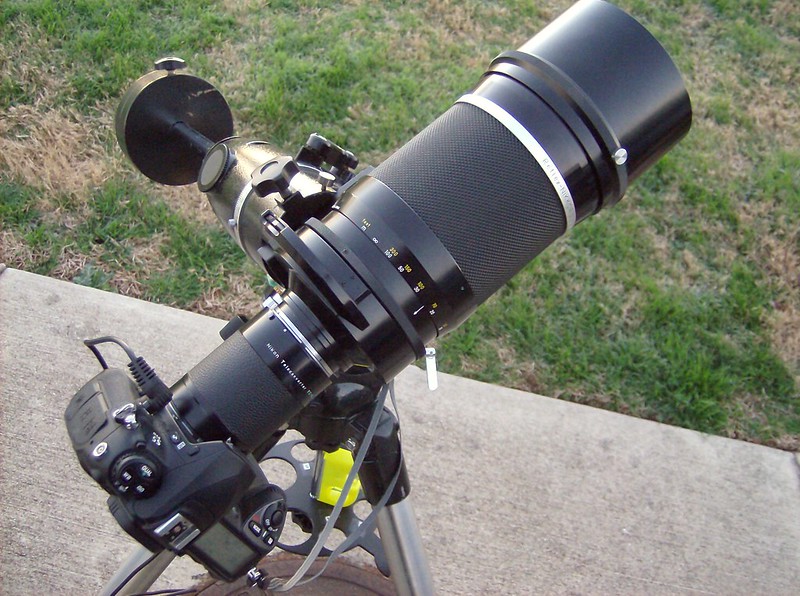
Nikon mirror lens by Narsuitus, on Flickr
The moon is half a degree across, or about 0.0087 radians. This means if you want the moon to be a 10mm diameter image on your film, you need a lens of focal length f = 10mm/0.0087, or about ~1140 mm. So a lens of ~1000 mm is in the ballpark. With any lens or telescope like this you have to start thinking about how you are going to mount it, and point it. You can typically use a moderate shutter speed since the moon is in sunlight, but the moon moves fast so you will keep having to repoint.
The moon is half a degree across, or about 0.0087 radians. This means if you want the moon to be a 10mm diameter image on your film, you need a lens of focal length f = 10mm/0.0087, or about ~1140 mm. So a lens of ~1000 mm is in the ballpark. With any lens or telescope like this you have to start thinking about how you are going to mount it, and point it. You can typically use a moderate shutter speed since the moon is in sunlight, but the moon moves fast so you will keep having to repoint.
That is very helpful, thank you. I did imagine that a focal length of 1000mm would be a good start...
Thank you! The illustrative photo is very helpful.I have a 1000mm f/11 Nikkor mirror lens and an Orion 900mm f/9 APO refractor telescope that I use for lunar photography. I prefer to use the Nikkor mirror because it is so much easier to transport due to its smaller size.
Attached is an image of the lens with a Nikon TC300 2x converter.
Nikon mirror lens by Narsuitus, on Flickr
pentaxuser
Member
So with the 2x convertor you have the equivalent of a 2000mm lens? According to reddesert's calculations you will get a moon that is almost 20mm across on a 36mm frame of film? Now that is getting big. Clearly cost is important to the OP so what's the cost of your equipment i.e. what might it cost to buy nowadays?I have a 1000mm f/11 Nikkor mirror lens and an Orion 900mm f/9 APO refractor telescope that I use for lunar photography. I prefer to use the Nikkor mirror because it is so much easier to transport due to its smaller size.
Attached is an image of the lens with a Nikon TC300 2x converter.
Nikon mirror lens by Narsuitus, on Flickr
Thanks
pentaxuser
So with the 2x convertor you have the equivalent of a 2000mm lens? According to reddesert's calculations you will get a moon that is almost 20mm across on a 36mm frame of film? Now that is getting big.
Sounds reasonable. Here is an image I took of the moon and sun with the tripod mounted Nikon 1000mm f/11 mirror lens and Nikon TC-300 2x teleconverter on April 8, 2005.
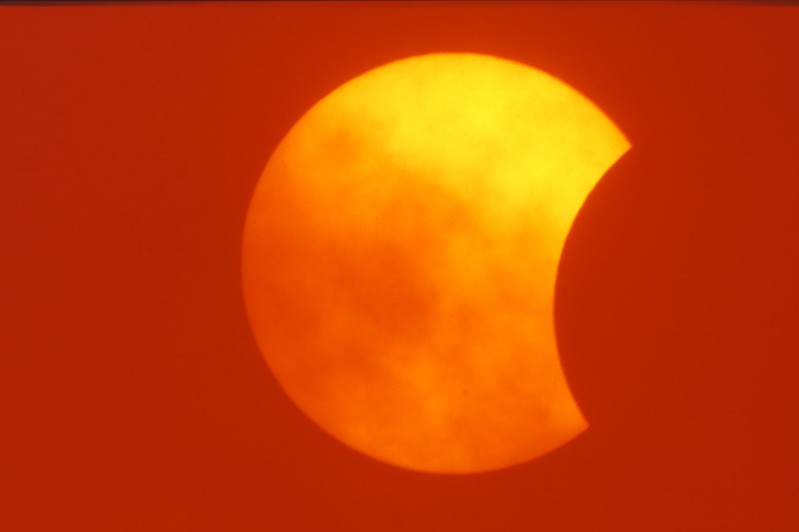
Partial Solar Eclipse (2005) by Narsuitus, on Flickr
Clearly cost is important to the OP so what's the cost of your equipment i.e. what might it cost to buy nowadays?
I have no idea what today's cost would be; but it probably cost less now than when I bought it.
pentaxuser
Member
Thanks for that. Yes it certainly seems big enough. You haven't mentioned cost however . Now strangely enough the OP who did seem very interested in the cost at the start hasn't mentioned it either in his replies but I will assume he is still interested in cost as anyway am I. So can I ask you to reply to costSounds reasonable. Here is an image I took of the moon and sun with the tripod mounted Nikon 1000mm f/11 mirror lens and Nikon TC-300 2x teleconverter on April 8, 2005.
Partial Solar Eclipse (2005) by Narsuitus, on Flickr
Thanks
pentaxuser

I used to photograph the moon all the time when I was set up for astrophotography. You want about an 1800mm schmidt Cassegrain telescope On an equatorial mount to do it justice and fill your 35mm frame. Look for a cheap used 8” Meade or celestron telescope with mount. Good luck

Wise words from pentaxuser which highlight a hidden variable. The moon races across the sky by its own diameter in two minutes. A 20mm moon image given (say) a 1 second exposure will incorporate 1/6 millimetre of lateral motion blur. This might acceptable in a small enlargement but possibly obtrusive in a big one. The ideal answer is an equatorial tracking mount set to the lunar rate. More money.So with the 2x convertor you have the equivalent of a 2000mm lens? According to reddesert's calculations you will get a moon that is almost 20mm across on a 36mm frame of film? Now that is getting big. Clearly cost is important to the OP so what's the cost of your equipment i.e. what might it cost to buy nowadays?
Thanks
pentaxuser
Thanks for that. Yes it certainly seems big enough. You haven't mentioned cost however . Now strangely enough the OP who did seem very interested in the cost at the start hasn't mentioned it either in his replies but I will assume he is still interested in cost as anyway am I. So can I ask you to reply to cost
Thanks
pentaxuser
Yes indeed, and thank you. I have been unable to access the Internet for several hours. My budget for this enterprise is $500 at most. Am I only dreaming? Thanks truly for all the great comments, I certainly appreciate your helpful ideas!
Wise words from pentaxuser which highlight a hidden variable. The moon races across the sky by its own diameter in two minutes. A 20mm moon image given (say) a 1 second exposure will incorporate 1/6 millimetre of lateral motion blur. This might acceptable in a small enlargement but possibly obtrusive in a big one. The ideal answer is an equatorial tracking mount set to the lunar rate. More money.
I mentioned pointing earlier. Tracking is less of an issue. The moon is in full sunlight. Sunny-16 applies, but the moon's albedo is less than 18% grey, so "loony f/11" is also a good starting point for the full moon - f/11 at 1/ISO.
The moon's reflectivity is greater at 180 deg than other angles, meaning the half (quarter) moon is less than half as luminous in total as the full moon (its surface brightness is less than the full moon), and loony-11 can be modified a little. Nevertheless, a 1 second exposure is much too long for a starting point for a novice. Your first need is for a very sturdy mount to minimize camera shake. An equatorial mount can come later.

Mirror lenses have a bad reputation, that's why they are pretty cheap nowadays. The reason for their bad reputation is mainly due to their peculiar bokeh - but you won't care about this for astrophotography.
Here's my feedback from my limited use of one:
Here's my feedback from my limited use of one:
- Mirror lenses are much lighter than "glass" lenses of equivalent focal length
- The limited aperture (a 500mm typically has f/8, a 1000mm as mentioned above has f/11) was, to me, the main source of problems
- Problem #1 is that focusing was a pain, particularly in low-light situations such as lunar eclipse - and I did it with live view at maximum magnification on a digital camera (I know, I know...
 ) It can be more difficult with a film camera, but then you are shooting the un-eclipsed moon which is brighter.
 - When shooting film (lower ISO than digital), the longer exposure time might require tracking. The "600 rule" tells you the max possible exposure time which does not require tracking: t = 600 / f with f = focal length. So with f= 500mm, t= 1.2s; with f=1000mm, f= 0.6s.
Great shot! Did you use a filter?Sounds reasonable. Here is an image I took of the moon and sun with the tripod mounted Nikon 1000mm f/11 mirror lens and Nikon TC-300 2x teleconverter on April 8, 2005.
Partial Solar Eclipse (2005) by Narsuitus, on Flickr
I used this for my solar shots, but the resulting image was almost black & white, nowhere near as colorful as yours:
https://www.baader-planetarium.com/...olar-eco-size-safety-film-5.0-140x155-mm.html
Great shot! Did you use a filter?
Yes I did. I had a Baader Solar Filter but could not find it at the time. Instead, I used a red filter.
The 2-f/stop red filter and the two-stop loss from the teleconverter gave me an effective f/stop of f/45.
I used the slowest speed film I had (ISO 100) and set the Nikon F4 shutter speed to 1/8000 second.


- Joined
- Jul 13, 2015
- Messages
- 2,175
- Format
- Plastic Cameras
Does the work need to be on film? Because I'm thinking the cheapest way to get decent moon pics is with a super-zoom digital camera such as Canon SX50, SX60, Nikon Coolpix P950, P1000 and so on. These are small-sensor cameras, but that allows for whopping magnifications in a relatively compact, image-stabilized package, and they make handheld moon photos a viable option. The Canon SX50 and 60 are discontinued but can be had at modest prices. Most cameras in this category are limited to JPEG output, but the Canon and Nikon cameras listed above also offer raw output.
With film, best you can hope for is a compact and affordable mirror lens, but if you do achieve enough magnification to really fill the frame, you're going to wish you had a really solid equatorial mount for your camera, and that alone will easily break your budget. A "German Equatorial Mount" such as the one in narsuitus's photo would be a good choice.
With film, best you can hope for is a compact and affordable mirror lens, but if you do achieve enough magnification to really fill the frame, you're going to wish you had a really solid equatorial mount for your camera, and that alone will easily break your budget. A "German Equatorial Mount" such as the one in narsuitus's photo would be a good choice.
Thank you for this!
forMirror lenses have a bad reputation, that's why they are pretty cheap nowadays. The reason for their bad reputation is mainly due to their peculiar bokeh - but you won't care about this for astrophotography.
Here's my feedback from my limited use of one:
Funny, I also mentioned my mirror lens a few days ago in this thread: https://www.photrio.com/forum/threa...-lens-for-just-one-photo.175775/#post-2288816
- Mirror lenses are much lighter than "glass" lenses of equivalent focal length
- The limited aperture (a 500mm typically has f/8, a 1000mm as mentioned above has f/11) was, to me, the main source of problems
- Problem #1 is that focusing was a pain, particularly in low-light situations such as lunar eclipse - and I did it with live view at maximum magnification on a digital camera (I know, I know...
- When shooting film (lower ISO than digital), the longer exposure time might require tracking. The "600 rule" tells you the max possible exposure time which does not require tracking: t = 600 / f with f = focal length. So with f= 500mm, t= 1.2s; with f=1000mm, f= 0.6s.
My wish was to execute this project on film, but certainly I see your point. Something to think about, thank you!
Does the work need to be on film? Because I'm thinking the cheapest way to get decent moon pics is with a super-zoom digital camera such as Canon SX50, SX60, Nikon Coolpix P950, P1000 and so on. These are small-sensor cameras, but that allows for whopping magnifications in a relatively compact, image-stabilized package, and they make handheld moon photos a viable option. The Canon SX50 and 60 are discontinued but can be had at modest prices. Most cameras in this category are limited to JPEG output, but the Canon and Nikon cameras listed above also offer raw output.
With film, best you can hope for is a compact and affordable mirror lens, but if you do achieve enough magnification to really fill the frame, you're going to wish you had a really solid equatorial mount for your camera, and that alone will easily break your budget. A "German Equatorial Mount" such as the one in narsuitus's photo would be a good choice.
| Photrio.com contains affiliate links to products. We may receive a commission for purchases made through these links. To read our full affiliate disclosure statement please click Here. |
PHOTRIO PARTNERS EQUALLY FUNDING OUR COMMUNITY:  |