• Welcome to Photrio!
    Registration is fast and free. Join today to unlock search, see fewer ads, and access all forum features.
    Click here to sign up

modern flash for off camera

Recent Classifieds

Forum statistics

Threads
202,921
Messages
2,847,622
Members
101,536
Latest member
takesama2001
Recent bookmarks
0

CMoore

Member
Joined
Aug 23, 2015
Messages
6,349
Location
USA CA
Format
35mm
I was hoping to buy a modern day (new) flash, that i could hand hold.
Can you guys recommend one or two.?
For use with your typical Nikon F2/FM..... Canon A-1 or AE-1P.
I was hoping to run a short (2 feet maybe) PC cable from the camera to the flash unit.
Is there any problem using a new flash unit with these older 35mm cameras.?
Thank You
 
No, there are no problems using newer style flashes with older cameras. It's usually the other way around where one has to be concerned because of potentially dangerously high trigger voltage. But since you're leaning toward newer flashes, this isn't a problem for you in any case.

If you like handle-mount style strobes, which are convenient for off-the-camera work at least, the Metz 45CT4 or 45CL4 are very popular. They support TTL metering and are quite powerful. They run off six "AA" batteries. You want the -CT4 or -CL4 version, though. You can get adapters for A-series Canons and the FM for them. Dunno about the F2 -- I'd probably just use a PC sync cord. The adapter module slides onto the camera's hot shoe and then there's a cable that connects the adapter to the strobe.

The Metz flashes tend to be very pricey when new, but the 45s aren't made anymore and you can pick up clean examples for reasonable prices. A couple of years ago, I bought a very clean 45CT4 with bracket and cords for about $100. And I've seen them go for even less than that on eBay.

I have a couple of electronic flashes -- a Canon 540EZ and a Nikon SB-24 that I picked up for cheap. These are excellent flashes -- quite powerful and full of features. I was able to pick them up for comparatively cheap because these flashes were both designed for use with film cameras. When the manufacturers switched over to digital, they changed the way their flashes operated, so, while these flashes can be used on digital cameras, the cameras won't meter with them. So you have to use trial and error for correct exposure. Which is why they're relatively cheap. But they're both very capable for off-camera work. In fact, I use both for off-camera work when I dupe slides. I make consistent use of their fractional power output when shooting dupes. These were not wasteful purchases for me, though. I own an EOS Elan 2e and a Nikon F4 and N80, so these cameras will operate properly with these two flashes.

Also, you can go with something simple, but powerful, like the old Vivitar 283 or 285. They both have fairly high output and their onboard thyristors will handle exposure chores for you, so they can be used with any of the cameras you mention.
 
Other than having a current production flash already in house I do not see the point in buying a new flash for a decades old camera, when the flashes from the 70s to 90s can be had cheap.


The only benefit I can see would be radio-transferred TTL-metering if possible.
 
Last edited:
off camera flash ( sometimes handheld ) is a great way of exposing film !

john
 
+1 on what cooltouch said about the Metz flash. Older ones, with high flash voltage, should still be fine for mechanical film cameras. Even the lowly (and inexpensive) CT-1 will have auto exposure. And the bounce head allows you to keep sensor pointed at subject. Newer ones will have TTL with module.
 
I think the biggest challenge you will have is finding a new/modern flash that will have a PC socket. You'll have to invest in some triggers that will allow you to use a non-PC flash with a hotshoe or a cord.

Not to mention that modern flashes cost about 3-5x (or more) what a good, strong, reliable 'vintage' flash would cost you. If you plan on using it for both a 'vintage' film camera and a digital with E-TTL (etc.), then I could see wanting a new flash. But IMO, a new flash will not give you any advantage over an older flash, except the advantage of a lighter wallet.

There is a recent thread somewhere (not under the lighting section, where this thread should be as well), but about using triggers and older cameras. I'd find it and read it.
 
Instead of a cable, you could use wireless triggers. The trigger mounts on the hotshoe and there are receivers for each flash you want to use. They can be as cheap as $25. http://www.cowboystudio.com/product_p/npt-04.htm I don't know about that brand, but there are better choices if you don't mind spending a little more. Also, be careful of triggers with extra (ttl) pins for Nikon, they tend to have trouble mounting on non TTL shoes. I did find an adapter from Cowboy Studios to help get them mounted.
 
OK, thanks for all the info.
I did not realize a modern flash might not have a PC connect (or the cost difference).
I also did not realize you could buy a wireless trigger for such an affordable price.
Thanks Again
 
I found the link I was talking about (it was in the lighting section) - (there was a url link here which no longer exists)
 
There are FEW 'speedlight' flashes on the market today that are not 'dedicated' to one of the digital nTTL cameras with multi-connection hotshoes, so very few have a PC connector!

And 'older' (pre-digital) photosensor flash units like the Metz 45 series or 60 series, the Vivitar 285, or something like them, are a good inexpensive flash with both full Manual output or photosensor-regulated light output.

Lots of folks wrongly call the flashes 'Thyristor' as if that is what did the Auto mode...the thyristor merely shunts electricity back to the capacitor (upon command of the photosensor circuit), cutting recycle time!
 
OK...my (ignorance) mistake then.
I will hunt Ebay for a flash or two.
Sorry to ask, but this is All New To Me:
1. Do most flash units of the 1975-1985 time frame fit most cameras, or do you need to find something that is brand specific.?
The camera manuals list some flash units, but that was from 30-40 years ago. Are those still the best units to look for, or did somebody like Vivitar make a flash that was compatible with a lot of brands.?
2. I was going to ask about metering, and sync speeds, and when a connection is TTL, etc etc.
I should probably get a few flash units first, and see what i can figure out on my own with the flash and camera manual.
It is all, kind of, daunting when you have never used a flash before. I realize that some of the flash units have a guide on them also.
Thank You
 
As far as I can tell, none of the cameras you listed offer TTl flash metering, so TTl compatibility issues with flashes won't matter much.

There still are some benefits to be had with dedicated flashes though - things like "flash ready" and "sufficient exposure" signals in the camera viewfinder, and automatic setting of flash synch capable shutter speeds on the camera.

Be careful with the older handle mount flashes. Some of the old ones have high trigger voltages, and with cameras like the A1 and AE1-P you are starting to get into the era when the flash synch circuits involve electronic rather than mechanical switches. I can't remember whether the A1 and the AE1-P are vulnerable or not.
 
Vivitar 283 and 285 are really inexpensive, had many options for off camera, very nice handle, long PC cord, slave, and different diffusion panels for wide angle and a telephoto lens.
 
There are FEW 'speedlight' flashes on the market today that are not 'dedicated' to one of the digital nTTL cameras with multi-connection hotshoes, so very few have a PC connector!

And 'older' (pre-digital) photosensor flash units like the Metz 45 series or 60 series, the Vivitar 285, or something like them, are a good inexpensive flash with both full Manual output or photosensor-regulated light output.

Lots of folks wrongly call the flashes 'Thyristor' as if that is what did the Auto mode...the thyristor merely shunts electricity back to the capacitor (upon command of the photosensor circuit), cutting recycle time!
Maybe few but they do exist
_20160825_205432.JPG
 
I have a PC Sync Cable and i am pretty sure i have a hot-shoe adapter somewhere. With that cable adapter, i should be able to use just about "any" flash unit.?
Thanks
 
One thing to have in mind is how come around changing output on a flash raised up high on its stand or hidden inside a sofbox :wink:
 
For decades, the Vivitar 283 has been my workhorse electronic flash for shooting portraits, action, interior architecture, weddings, still lifes, macro, and candids. I used them mounted on the camera and off the camera. I triggered them remotely with optical slaves, radio slaves, and long synch cords. I used them mounted on light stands with umbrellas, soft boxes, and large diffusion panels.

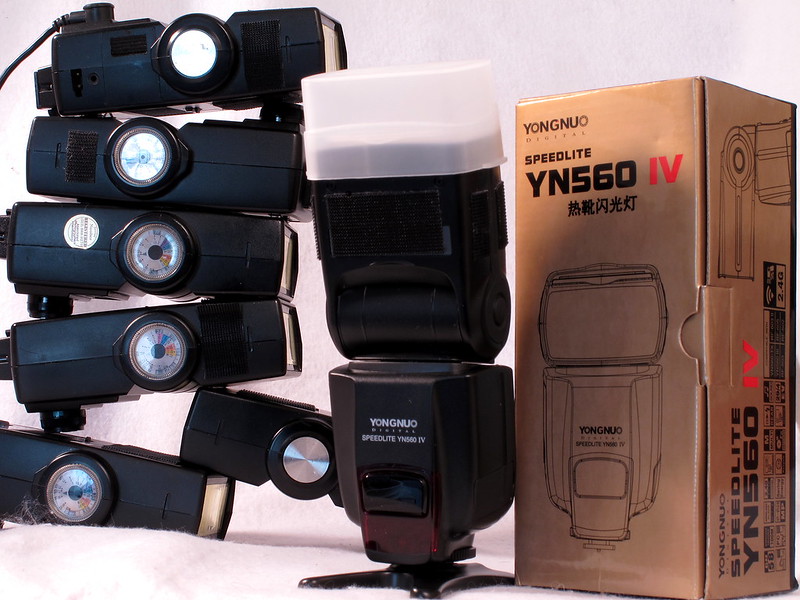
Over the years, I owned and used eight of them. As they aged and stopped working, I repaired or replaced them. Now that I am down to only three working units, I decided it was time to replace them with something newer.

Since I shoot with a variety of cameras (e.g. small format, medium format, large format, film, digital, Canon, Nikon, Fuji, Pentax, Olympus, and a few others), I prefer to not replace them with a dedicated flash unit. The Yongnuo YN 560 IV, like the Vivitar 283, is a flash that is not dedicated to a specific camera brand. One major advantage the Yongnuo has over the Vivitar is that the optical slave, the radio slave, the zooming flash head, the variable angle flash head, and the variable power output are built into the Yongnuo. They were separate and expensive add-ons for the Vivitar.


Yonguo YN 560 IV by Narsuitus, on Flickr
 
OK...my (ignorance) mistake then.
I will hunt Ebay for a flash or two.
Sorry to ask, but this is All New To Me:
1. Do most flash units of the 1975-1985 time frame fit most cameras, or do you need to find something that is brand specific.?
The camera manuals list some flash units, but that was from 30-40 years ago. Are those still the best units to look for, or did somebody like Vivitar make a flash that was compatible with a lot of brands.?
2. I was going to ask about metering, and sync speeds, and when a connection is TTL, etc etc.
I should probably get a few flash units first, and see what i can figure out on my own with the flash and camera manual.
It is all, kind of, daunting when you have never used a flash before. I realize that some of the flash units have a guide on them also.
Thank You

Back in the day, a hotshoe with center pin and edge contact only, was universal in being triggered by any camera. The hotshoe only provides the same functionality (trigger) as a PC cable with two conductors in the insulation.
Then manufacturers started to display 'flash ready' and 'flash exposure OK' lights via additional contacts, and the hotshoes became specific to the manufacturer. But the center pin and edge contact still were universal and you could still trigger via PC cord without any of the 'dedication'
Then manufacturers added TTL to the cameras, and more contacts were added to tell the flash 'no more light' when TTL metering felt it was enough. But the center pin and edge contact still were universal and you could still trigger via PC cord without any of the 'dedication'.
Enter the world of digital, and yet another contact was added to the hotshoe, this time to command the flash to go into HSS or for it to get commands for a certain amount of light, after the pre-flash signal was sent and metered by the camera.

In many cases, manufacturers like Canon made their own flash units back compatible to TTL cameras as well as for eTTL in digital, as well as back compatible for some intermediate (and since abandoned) xTTL versions in between.
The independents like Metz made their customizing modules also compatible, in some cases needed different models of modules for cross-camera compatibility even in the same brand. Brands like Metz are fairly easily switched in compatibility from brand to brand simply with a module...my Metz 45 is compatible with my 1981 Olympus OM-1, my 1984 Olympus OM-4 with TTL, my 1994 Bronica ETRSi with ETTL, and my Canon 40D but not with its eTTL...I have to use a Metz 54 to get Canon 40D eTTL (and support of all the other cameras that I listed).

You are likely to need some insulating material (e.g. mylar 3M Magic Mending tape) to insulate the extra pins from making contact, in order for a Brand X camera to work with Brand Y flash using the center trigger pin and edge contacts only.

 
Last edited:
I just picked up this flash from Lumo Pro, Dead Link Removed.
I love everything about it! Costs $150. It doesn't have ttl which I don't need. I find it difficult to manually control some of the flashes that have ttl. This flash is super easy to manually set, you just choose the power, 1/4, 1/32, 1/2 for example. Also, it has an easy to use light stand mount, easy to connect via pc and other methods. I own pocket wizards so I connect that way. They have another flash has radio built in, you would just need to buy the trigger then have easy off camera flash.

This is seriously my favorite flash that I've ever used!
 
Last edited:
I just picked up this flash from Lumo Pro, Dead Link Removed.
I love everything about it! Costs $150. It doesn't have ttl which I don't need. I find it difficult to manually control some of the flashes that have ttl. This flash is super easy to manually set, you just choose the power, 1/4, 1/32, 1/2 for example. Also, it has an easy to use light stand mount, easy to connect via pc and other methods. I own pocket wizards so I connect that way. They have another flash has radio built in, you would just need to buy the trigger then have easy off camera flash.

This is seriously my favorite flash that I've ever used!

That looks like a really nice flash, and I like that it has the PC port. If I ever have to replace my Quantums, this will be on my shortlist.
 
https://www.amazon.com/YONGNUO-RF-6...1_9?ie=UTF8&psc=1&refRID=VFWYPQ3ACACKE761NBZ2
Do these type of modern, wireless pose any problem.?
Do you have to worry about the pins not lining up, or maybe shorting with our older cameras/flashes.?
Thanks

I use the older version (602), and have had no problem using them with any hotshoe flash (except Minolta/Sony's because of the shoe shape). I will say this though, of 2 TX's, and 5 RX's, only 1 TX and 2 (or 3) RX's are still working after only 3 years.
 
Photrio.com contains affiliate links to products. We may receive a commission for purchases made through these links.
To read our full affiliate disclosure statement please click Here.

PHOTRIO PARTNERS EQUALLY FUNDING OUR COMMUNITY:


Ilford ADOX Freestyle Photographic Stearman Press Weldon Color Lab Blue Moon Camera & Machine
Top Bottom