• Welcome to Photrio!
    Registration is fast and free. Join today to unlock search, see fewer ads, and access all forum features.
    Click here to sign up

Metol in glycol now horrible brown

Recent Classifieds

Forum statistics

Threads
203,213
Messages
2,851,537
Members
101,729
Latest member
Luis Angel Baca
Recent bookmarks
0
Evan! I was making the point that the AA could easily be protecting the metol in pyrocat-MC as Patrick suggested. He even made the comment that it might be able to reverse its oxidation. So, I tried a little of this and that and it lost the brown and went back to clear, prompting my comment that this was an interesting phenomenon. No more. I even extended the idea to the glycol stock but to no avail. It steadfastly stayed horrible brown.
Anyway you use Germain's brew! Glycin forever.:smile: Remember?
Murray
 
Evan! I was making the point that the AA could easily be protecting the metol in pyrocat-MC as Patrick suggested. He even made the comment that it might be able to reverse its oxidation. So, I tried a little of this and that and it lost the brown and went back to clear, prompting my comment that this was an interesting phenomenon. No more. I even extended the idea to the glycol stock but to no avail. It steadfastly stayed horrible brown.
Anyway you use Germain's brew! Glycin forever.:smile: Remember?
Murray

I got excited that it might be the glycol stock which was reversed. I use the Germain but I always expose 2 sheets of the same photo so I have lots of developing options, the chemistry is almost more fun than the photography. And yes, Glycin forever, hopefully. I get the shakes when worrying that PF could quit making it.:D:D:D...Evan
 
Patrick;

While the examples "look" fine, there is no reference. I have nothing to compare your results to. This is my continuing problem with this ad hoc developer design.

At the present time, I face a long arduous walk to design a new HA developer maximizing grain, speed and sharpness. I cannot do it without making a valid comparison to something like D76 and Microdol X as an example, or Xtol. So, I hope you see my point. You prove nothing, but the fact that the developer develops.

Dektol might do as good as what you have shown, but without an exact comparison who would know?

Sorry.

PE
 
I got excited that it might be the glycol stock which was reversed. I use the Germain but I always expose 2 sheets of the same photo so I have lots of developing options, the chemistry is almost more fun than the photography. And yes, Glycin forever, hopefully. I get the shakes when worrying that PF could quit making it.:D:D:D...Evan
It was a little of the stock I used. And I emphasise the 'little'. It cleared as I dropped and watched some go into the AA solution. No more than that. Patrick has said before that one needs something like (IIRC) 40 times the amount of AA to metol to regenerate it predictably in a developer. Or was that phenidone? Sorry to be so vague.
But yes, I repeat, it was the brown stock metol.
Murray
 
Patrick;

While the examples "look" fine, there is no reference. I have nothing to compare your results to. This is my continuing problem with this ad hoc developer design.

At the present time, I face a long arduous walk to design a new HA developer maximizing grain, speed and sharpness. I cannot do it without making a valid comparison to something like D76 and Microdol X as an example, or Xtol. So, I hope you see my point. You prove nothing, but the fact that the developer develops.

Dektol might do as good as what you have shown, but without an exact comparison who would know?

Sorry.

PE

Dektol, purchased or home made, is more expensive. I'm sure it is a close relative to, if not the same as the MQ I used to do my first Verichrome when I was 12.

I don't see any point to your argument. If you don't like the results you get with a particular formula for anything, you can compare it with anything you want and show it to the public. If I didn't like the results I got, I would not have presented it to others to begin with. If I did make a comparison, it would be with one of the variants of D-76, or better yet, to XTOL, but not to Dektol.

So now you have a possible competitor in S(ave)P(hotographers)F(ormulary)-3,is that it? And you call it "ad hoc" because you think there was no theory involved? You really should compare it with your HA developer when it's ready. (I hope the HA means "High Acutance".):D
 
Dektol, purchased or home made, is more expensive. I'm sure it is a close relative to, if not the same as the MQ I used to do my first Verichrome when I was 12.

So now you have a possible competitor in S(ave)P(hotographers)F(ormulary)-3,is that it? And you call it "ad hoc" because you think there was no theory involved? You really should compare it with your HA developer when it's ready. (I hope the HA means "High Acutance".):D
Patrick, mate, it was I who asked what the SPF-3 was all about. Never confuse my ramblings with Ron's incisive repartee.
Me too with the Dektol 60 years ago! Soup plate and my mum calling out the minutes from the kitchen (I was in the pantry).
Murray
 
There has been no resolution of the glycol/metol concentrate conundrum. Apparently it can die. And quite quickly. Enough said? Back off, guys.
Murray
 
Patrick;

I'm sure that you, as an engineer, know the value of running checks with your experiments to prove or disprove the validity of the experiment.

That is the point to my argument.

PE
 
I wasn't confusing you two. I am wondering why the concern in this case but not before, when I presented other formulas like PC-TEA or CatP-TEA for consideration. That, of course, is a two part question. Why? Philosophers through the ages have thought about that and reached no conclusive answer. Is there concern in this case? Yes.

Perhaps I should have called it AH-3 for ad hoc. That, by the way, means "for this (special) purpose", which purpose in my case is developing black & white film.

To all concerned: try it. You'll like it.
 
As an add on here Patrick, I'm not sure what you mean by your SPF reference. As for anything I do for the Formulary, I have to prove my claims to them with concrete examples with checks using current production materials such as Dektol. So, everything I do has checks with it.

I have also aske for checks from you before, but you never reply.

PE
 
PE - you bring up an interesting point.

The Formulary sells Pyrocat-MC, but were studies done to show it's better in any respect to other developers given to the Formulary before they started selling it? (No reason for you to actually know this information, actually.)

I don't know why it would have to be done, as something as simple as market demand should suffice for them wanting to produce and market the product.
 
Kirk;

I know nothing of any other product, but what was asked of me and what I provided. I posted some of that data here on APUG but was censured as it reflected a conflict of interest so I don't wish to discuss it any further.

PE
 
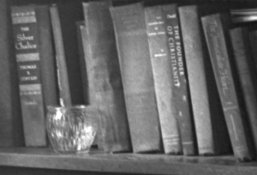
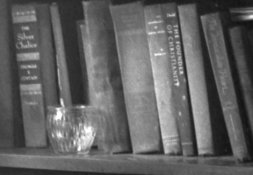
Comparing SPF-3, Rodinal, Microdol X expedient.

Patrick;

I'm sure that you, as an engineer, know the value of running checks with your experiments to prove or disprove the validity of the experiment.

That is the point to my argument.

PE

Just because I didn't show formal tests doesn't mean I just threw something together to see if it would work. That is the last step of the scientific method. One reads pertinent literature, of which I have done much over many years about many things. One thinks about what might be added to the literature. Heck, you know all this.

I knew from my reading that Phenidone is much less affected by bromide concentration, that phenidone and hydroquinone are not synergistic without the presence of sulfite, that Phenidone and ascorbic acid are synergistic without sulfite, and I knew the buffering capabilities of borax. I knew there is widespread belief that fine grain developers must contain sulfite. I wanted to see what qualities a developer without sulfite could have. So I did. You know, surely, that I have experienced the qualities, sometimes under at least semi-pro conditions, of a number of commercial and home-brewed developers. I have published some of my finfings in Photo Techniques and other publications. I know that many others in APUG have covered the same ground in different ways and places.

Anyway, I have made a few more tests. I performed the same test and presentation I showed here, this time on HP5+ developed with the PCBorax, with Rodinal, and with D-23 fortified with 30 g/l of sodium chloride. I shall endeavor to present them now.
 

Attachments

  • RODINAL 25 LO RES.jpg
    RODINAL 25 LO RES.jpg
    89.6 KB · Views: 199
  • RODINAL 25 HI RES.jpg
    RODINAL 25 HI RES.jpg
    104.9 KB · Views: 205
  • SPF-3 LO RES.jpg
    SPF-3 LO RES.jpg
    91.4 KB · Views: 224
  • SPF-3 HI-RES.jpg
    SPF-3 HI-RES.jpg
    163.3 KB · Views: 192
  • MICRODOL Expedient Lo Res.jpg
    MICRODOL Expedient Lo Res.jpg
    87.3 KB · Views: 200
  • MICRODOL Expedient Hi Res.jpg
    MICRODOL Expedient Hi Res.jpg
    87.9 KB · Views: 203
Last edited by a moderator:
Very nice comparison Patrick. Now that is what I was talking about.

Any comments on relative ISO ratings or contrast?

PE
 
As an add on here Patrick, I'm not sure what you mean by your SPF reference. As for anything I do for the Formulary, I have to prove my claims to them with concrete examples with checks using current production materials such as Dektol. So, everything I do has checks with it.

I have also aske for checks from you before, but you never reply.

PE

Well, you must remember that you proposed that I might be putting Photographers Formulary out of business by showing APUG how to purify 20 Mule Team Borax. Bud had a good laugh over that. SPF-3 has about as much borax in it as you can put at 60 F, so I called it SPF for "saving Photographers Formulary" to give him another laugh.
 
Patrick;

I don't believe that I mentioned the Formulary specifically, but if I did it was along with other company names or used as a prominent example. I merely said that buying economy chemistry at swimming pool suppliers or from grocery stores affected all legitimate photochemical suppliers.

PE
 
Very nice comparison Patrick. Now that is what I was talking about.

Any comments on relative ISO ratings or contrast?

PE

Now that you mention it, I treated each one as D-76 for purposes of estimating time vs temperature. The only one that required tweaking of contrast in the printing was the Rodinal, which cannot get HP5+ much above CI= 0.6 anyway. The information is all there. I bracketted + and - 1/2 stop in exposing the film, and took 400 as the median, which is the negative I used for this presentation in each case. HP-5+ is not a high contrast film with any of these developers, so the difference from + to - is not significant for many purposes.

There appear to be differences in gradation that cannot be entirely explained by overall contrast. I do not have at hand all the gear I used to use to get characteristic curves, so can't quite put my finger on it.

I hope there is enough here to make someone who can do the appropriate analyses want to try it. I was struck more by the lack of differencees, considering the wide variations in amount of sulfite among these three, from 0 to lots. Hydroquinone is not a factor here. Actually, I cheated a little on the Microdol expedient. I used only 75 grams. Even so, it is the "mushiest" of the three.
 
There are also differences in grain and sharpness across the series. How that is interrelated to the contrast variations and how it is to be interpreted is yet to be determined. It is a very interesting test.

Lower contrast gives the visual impression of lower sharpness whether true or not. Sometimes it takes a good instrument to get to the fact of the matter.

PE
 
I did an article some years ago using resolution charts to show the effects of several things on resolution. There were two effects that are probable pertinent here. One was the addition of sodium chloride to D-23, which makes spaces in the negatives wider than bars, and the other was infectious development in Rodinal, which does the opposite. A lot has changed in the intervening years, mostly in me. Standing, stooping, squinting, even sitting have become more arduous. Microdensitometer traces of images of sharp edges combined with characteristic curves can tell a lot. At least we can often say "Ah HA! That's why it looks like that."
 
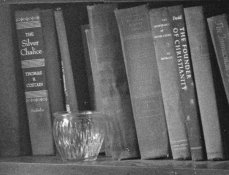
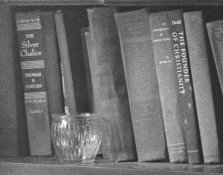
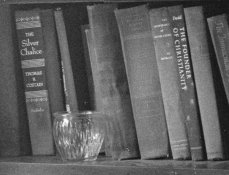
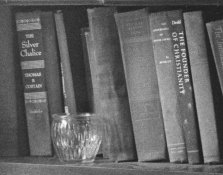
Now I couldn't sleep til I compared the Microdol expedient with the SPF-3 at higher resolution. I made a chemical print with enlarger head high enough to make at least an 11x14 print from the whole negative, made a print of each, adjusting exposure only to make the best match I could without wasting too much paper. I must say it was difficult o see the grain to focus on it. I scanned each at 300 dpi, further cropping as I scanned, o get the results you see attached.
 

Attachments

  • MICRODOL EXPEDIENT VERY HI RES.jpg
    MICRODOL EXPEDIENT VERY HI RES.jpg
    145.9 KB · Views: 219
  • SPF-3 VERY HI-RES.jpg
    SPF-3 VERY HI-RES.jpg
    157 KB · Views: 195
To give some idea of the resolution we're looking at, the space between the bookshelves is about 4.2 mm on the negative. On my viewscreen, it measures about 167. What I see on my screen is about like a portion of a 40x60 inch print from a 35 negative. Two lenses were involved: the commonplace 1.8 Canon on my camera and the 2.8 Rodenstock on the enlarger.
 
Looks good. Maybe a direct negative scan of that area would be better, and then adjust to the same contrast?

PE
 
Looks good. Maybe a direct negative scan of that area would be better, and then adjust to the same contrast?

PE

Not with the scanners I have. I tried it. I'll give it another whirl, but when the size of the grain is close to the size of the pixel you run into Shannon's Law. I figured my best bet would be to get the grain size as large as possible and the pixel size as small as possible.

When your sampling rate is less than twice the bandwidth of the signal being sampled, you get foldover of highs into lows. We can consider grain to be a band limited random signal and the scanner to be a fixed rate sampler, so whatever granularity is beyond the scanning rate will show as a distortion at the low end. You have probably run into these considerations in your carreer, but many APUGers have not. They apply to spacial as well as to audio and radio signals.
 
I understand what PE is getting at and tried with a simple program (Irfanview).
The two images don't have quite the same gamma.
I will try to post my attempt anyway
Murray
 

Attachments

  • MICRODOL EXPEDIENT VERY HI RES.jpg
    MICRODOL EXPEDIENT VERY HI RES.jpg
    145.9 KB · Views: 200
  • SPF-3 VERY HI-RES.jpg
    SPF-3 VERY HI-RES.jpg
    103.1 KB · Views: 197
Looks like I was wrong about my scanners. Oh, well. There's a first time for everything.:D I'm not sure I have resolved the grain, but here are the direct scans with a minute adjustment of contrast.
 

Attachments

  • MICRODOL EXPEDIENT VERY HI RES.jpg
    MICRODOL EXPEDIENT VERY HI RES.jpg
    21.9 KB · Views: 184
  • SPF-3 VERY HI-RES.jpg
    SPF-3 VERY HI-RES.jpg
    22.6 KB · Views: 197
Photrio.com contains affiliate links to products. We may receive a commission for purchases made through these links.
To read our full affiliate disclosure statement please click Here.

PHOTRIO PARTNERS EQUALLY FUNDING OUR COMMUNITY:


Ilford ADOX Freestyle Photographic Stearman Press Weldon Color Lab Blue Moon Camera & Machine
Top Bottom