• Welcome to Photrio!
    Registration is fast and free. Join today to unlock search, see fewer ads, and access all forum features.
    Click here to sign up

Measuring off-axis resolution

Rainy Day Trees

A
Rainy Day Trees

  • 5
  • 1
  • 82
One Way

A
One Way

  • 3
  • 1
  • 79

Recent Classifieds

Forum statistics

Threads
203,154
Messages
2,850,691
Members
101,703
Latest member
arrowactive
Recent bookmarks
0

BetterSense

Member
Allowing Ads
Joined
Aug 16, 2008
Messages
3,151
Location
North Caroli
Format
35mm
When measuring the resolution, by shooting a resolution chart, I think I understand what's needed for straight-on resolution at the optical center of a lens.

However, when shooting a resolution chart far from the optical axis of a lens, at the very edge of the field-of-view, should I place the resolution chart normal to the optical axis, or normal to a line drawn between the resolution chart and the aperture of the lens? The two setups will give results that differ by a factor of the cosine of the angle, which becomes substantial for wide-angle lenses. Either approach seems valid but which is the convention?
 
Discussions on measurement of resolution is one of my pet annoyances. Why? Because they are never done by us amateur and many professionals with any regard to the lighting contrast ratio.

Resolution tests must be done at known lighting contrast ratios othewise they are meaningless. And that means your subject lighting contrast ratio and your measurements from film with known lighting contrast ratio.

Do you know what they are ? I doubt it but I'm here to be told I'm wrong.

I've seen countless claims of this resolution and that resolution and not one of them ever says under what lighting contrast ratio the measurement was taken.

So where does that leave us? Well a good starting point is to use 1000:1 for very brightly lit subjects which is 11 stops of range. And for low contrast subjects 1.6:1 because thats whats Fuji use in their film spec sheets if you look at one.

A landscape subject may have overall contrast ratio of 1000:1 from bright white clouds to dark shadows but the little fiddly bits in the bulk of the image subject will have a very small local contrast ratio which is where we are trying to get maximum detail from. So if your starting contrast ratio is only 1.6:1 it doesn't prove anything about what your lens or film is theoretically capable of under the correct conditions.

But in the real world it is the low contrast ratios of the subject that we should be worried about and YES knowing how good your lens is at those ratios may be useful. BUT if you don't set your test lighting contrast ratio to a typical subject contrast ratio then your results may and probably will be highly misleading.

For example, these tests http://www.hevanet.com/cperez/testing.html don't mention under what lighting contrast ratio they were done so the results shown become next to meaningless.

take a look at at a Fuji film spec sheet. Say Provia 100. At 1000:1 the film will give 160 lp/mm. At 1.6:1 which is more real world local contrast ratio the figure drops to only 80 lp/mm. So tests in above might be wildly over or under representing what we might think they are representing depending on how much light was used to do the test.

So does your test include setting the lighting contrast ratio to a real world value or a value to see what your lens is theoretically capable of if the lighting was really bright or just what it happens to be on the day and place where you made the images. And if its the latter then we are entitled to take the results with a pinch of salt.

Rant over.

 
Last edited by a moderator:
If OP wants to compare two lenses he may not be interested but reasonable test charts have colour and high and low contrast resolution patterns...
 
Standardization in lens resolution testing is necessary for standard results. However, resolution problems can become obvious without attention to such standardization. Any test is better than no test at all. Even the classic newspapers taped to a wall can give the perceptive photographer insight into lens performance.
 
I am shooting resolution charts purely for comparison between two lenses. I will keep as many things the same as possible between the comparison. I agree that shooting resolution charts is a poor proxy for real-world use, but it's the best way I can think to compare. I asked earlier about measuring MTF but it appears to be beyond my means.

Since I am testing on a test setup, not a camera, it's easy to test off-off - axis by tilting the lens. However based on what I am reading here, tilting the lens is not sufficient. I also need to tilt the resolution chart and the film to the same angle, which emulates what happens in a camera, but seems odd.
 
Last edited by a moderator:
I think that you would print a resolution chart with grey, rather than black bars. You could test the contrast ratio with a reflection densitometer.
 
Normal to the optical axis, because the film is also normal to the optical axis (except of course Noblex, Horizon, and the like). In that way you preserve the scaling between the chart and its image.

If the goal is simply to preserve the scaling i.e. make sure that a square resolution chart appears on the film as a square image, then would it make sense to do what I described and tilt the lens without also tilting the film and resolution chart? This would be like tilting a view camera lens. Would comparison of off - axis resolution numbers obtained this way be any more or less meaningful? Mutually tilting the film and resolution chart seems to do nothing except introduce another cos^2 illumination factor across the film image. But maybe this is desirable or necessary for some reason.
 
Care to explain how to set a lighting ratio on a flat black and white resolution chart??

If your target includes a patch of black and a patch of white big enough to meter and which are same colour as your fine lines on target then you can meter with a spot meter and measure the contrast difference.
Turn up or down a strobe (in a darkened room) until its outputting enough light to get the contrast range you want for your test. But be wary of the fact that a very bright flash may influence your reading from the black patch. i.e. its not so simple I think and I have never tried it.
Or if you target is translucent then you illuminate it from behind which might be a better way.
 
If the goal is simply to preserve the scaling i.e. make sure that a square resolution chart appears on the film as a square image, then would it make sense to do what I described and tilt the lens without also tilting the film and resolution chart? This would be like tilting a view camera lens. Would comparison of off - axis resolution numbers obtained this way be any more or less meaningful? Mutually tilting the film and resolution chart seems to do nothing except introduce another cos^2 illumination factor across the film image. But maybe this is desirable or necessary for some reason.

Don't think you can tilt the lens eg for a normal test you focus on axis and measure off axis you are measuring flatness of image and resolution together?
 
Don't think you can tilt the lens eg for a normal test you focus on axis and measure off axis you are measuring flatness of image and resolution together?

I don't even understand what you are trying to say here.
 
. . . Since I am testing on a test setup, not a camera, it's easy to test off-off - axis by tilting the lens. However based on what I am reading here, tilting the lens is not sufficient. I also need to tilt the resolution chart and the film to the same angle, which emulates what happens in a camera, but seems odd.

It is simpler to acquire or improvise a test chart large enough to include the entire field of view at an appropriate distance, and have the optical axis centered on the chart. This is practical for small formats, but can be difficult for large film.
 
The real world is the best test for a lens, or lenses: "no matter" how many line pairs you are getting, so many other qualities of lens contribute to the overall look, and feel of a lens. take my advice, go out and shoot with the two lenses, with a varied light, focusing near and far. and see which images fair better. you will probably see right away which one is better for this or that. . .. which one is slightly better for this or that, or no difference at all.
 
It is simpler to acquire or improvise a test chart large enough to include the entire field of view at an appropriate distance, and have the optical axis centered on the chart. This is practical for small formats, but can be difficult for large film.

Field curvature will mess with your measurements on a setup like this. I had to learn that the hard way about a decade ago.
 
I don't even understand what you are trying to say here.

I apologise you need to test the lenses on camera on a large brick wall without any movements.
Then test same wall with the movements you normally use.

That tells you what the real results on a brick wall will be like.

The test you propose might pick a lens that did not perform as well in 'real world'.

Do you need flat field performance like a process lens?
 
I am actually doing experiments here, not pictorial photography. More like process photography. The results will not be needed in any other environment except my test bench.

I have concluded that keeping the film and resolution chart facing each other, rather than mutually tilting them so as to simulate a camera, is a good way to just reduce uneven exposure from falloff. The scale of the resolution chart on the film will be the same either way.
 
. . . I have concluded that keeping the film and resolution chart facing each other, rather than mutually tilting them so as to simulate a camera, is a good way to just reduce uneven exposure from falloff. The scale of the resolution chart on the film will be the same either way.

The falloff will be the same with both techniques as long as film and resolution chart are parallel.
 
How do you know what curve the focus plane of the lens has. Without knowing that how can you put the test target for center middle and edge a correct distances. I mean you need three test targets. One in center of image on film, one at middle and one at edge all illuminated exactly the same. But if the lens focus plane is not flat field then only the one you focus on will give the correct figures. So I suppose you will need to make 3 images focussing on each in turn very accurately. That should also tell you whether your lens has flat field focus plane.
Do you think you'll be able to see that in the viewfinder?
And of course the distance from camera to target will affect the results. How are you planning to do an infnity test or are you just going to test at close range in the belief that will give the same results as at real world working distances.
 
When measuring the resolution, by shooting a resolution chart, I think I understand what's needed for straight-on resolution at the optical center of a lens.

However, when shooting a resolution chart far from the optical axis of a lens, at the very edge of the field-of-view, should I place the resolution chart normal to the optical axis, or normal to a line drawn between the resolution chart and the aperture of the lens? The two setups will give results that differ by a factor of the cosine of the angle, which becomes substantial for wide-angle lenses. Either approach seems valid but which is the convention?

Edmund Scientific makes a resolution chart ,which can give ou center and corner resolution within the same shot;the cornersare off axis but that's how it will be in the field also.no conversion needed.:smile:
 
I will be testing at up to 5 meters away so there is no way there is a resolution chart big enough to to test both center and edge of the field of view.

I am testing diffraction of pinholes so there is no concern about focus or field curvature.
 
Print several 'resolution' charts on A3 size paper, glue one to the middle of a wall. Glue another in each corner. Surely having one piece of paper instead of several pieces of paper does not affect the resolution of the lens?
 
Print several 'resolution' charts on A3 size paper, glue one to the middle of a wall. Glue another in each corner. Surely having one piece of paper instead of several pieces of paper does not affect the resolution of the lens?

Yes, print several USAF1951 resolution charts and pin them to a wall so one ends up in the center of your image and another in the corner.Don't worry about it being off axis.that happens in real photographs also anyway
:smile:
 
I will be testing at up to 5 meters away so there is no way there is a resolution chart big enough to to test both center and edge of the field of view.

I am testing diffraction of pinholes so there is no concern about focus or field curvature.

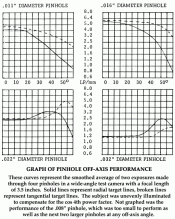
Pinhole testing can be scaled down for convenience, so you may not need the charts to be 5 meters away. Contrary to what some people say, pinhole cameras have an optimum focus distance and field curvature. They also have some chromatic aberration. When shooting an array of resolution charts fixed to a wall, arrange them so some chart lines point to the optical axis instead of arranging them in a rectilinear grid. This lets you analyze both radial and tangential resolution. They can differ considerably near the corners of a wide angle photo.
 

Attachments

  • OffAxis5.gif
    OffAxis5.gif
    83.2 KB · Views: 117
Photrio.com contains affiliate links to products. We may receive a commission for purchases made through these links.
To read our full affiliate disclosure statement please click Here.

PHOTRIO PARTNERS EQUALLY FUNDING OUR COMMUNITY:


Ilford ADOX Freestyle Photographic Stearman Press Weldon Color Lab Blue Moon Camera & Machine
Top Bottom