
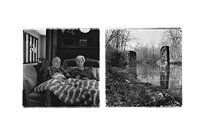

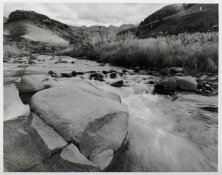
I've just printed some photos I took in the Drakensberg mountains this week. One of them shows a mark on the print. It's as though a small area is slightly lighter than it should be. The increased density is visible on the negative, so it's not a printing problem. I would be most grateful if anyone could identify the reason for this so I can avoid it in future. The mark is visible on the top edge of the print about 1/5 of the way from the right. The boundary is a nearly straight line running down the print at an angle of about 25 degrees from vertical. To be honest, it's also possible that it's just how the light was falling, but I don't think so.
Here's everthing I can think of about process that might be relevant:
The film was Delta 100 (120 format, 6 x 4.5) developed in a Paterson tank for 11 minutes using Ilford ID-11 1:1, IlfoStop and Rapid Fixer as per the datasheet instructions. The ID-11 was from a 5l batch of stock made up from powder immediately before developing this film. The fixer was checked with a clip test the day before, and had a clearing time of 45 seconds. I used a fix time of 3 minutes.
Wash was as per the Ilford method (3 rinses with 5 inversions, 10 inversions and 20 inversions. I did a fourth rinse also with 20 inversions just for safetly). I did not use any wetting agent in the final rinse. It was hung up to dry at an angle from the vertical. Come to think of it, the angle is perhaps similar to the angle of the mark on the print - could this be a drying mark, and if so, can I re-wash the negative to remove it?
The film was loaded into the camera in the field in moderately bright daylight (about 10 am). I attempted to keep the film and back shaded with my body during the film loading. The film was removed in my darkroom, secured with a rubber band and wrapped in aluminium foil until I loaded it into the tank. I left it loaded in the tank overnight (because I prefer to load tanks at night but did not have time to process immediately) and I kept the tank inside a zipped up black camera bag to provide additional protection.
Of course this is about the only photo for which I don't have a duplicate negative. Lesson learned!
Thanks for the help!
Andrew
Here's everthing I can think of about process that might be relevant:
The film was Delta 100 (120 format, 6 x 4.5) developed in a Paterson tank for 11 minutes using Ilford ID-11 1:1, IlfoStop and Rapid Fixer as per the datasheet instructions. The ID-11 was from a 5l batch of stock made up from powder immediately before developing this film. The fixer was checked with a clip test the day before, and had a clearing time of 45 seconds. I used a fix time of 3 minutes.
Wash was as per the Ilford method (3 rinses with 5 inversions, 10 inversions and 20 inversions. I did a fourth rinse also with 20 inversions just for safetly). I did not use any wetting agent in the final rinse. It was hung up to dry at an angle from the vertical. Come to think of it, the angle is perhaps similar to the angle of the mark on the print - could this be a drying mark, and if so, can I re-wash the negative to remove it?
The film was loaded into the camera in the field in moderately bright daylight (about 10 am). I attempted to keep the film and back shaded with my body during the film loading. The film was removed in my darkroom, secured with a rubber band and wrapped in aluminium foil until I loaded it into the tank. I left it loaded in the tank overnight (because I prefer to load tanks at night but did not have time to process immediately) and I kept the tank inside a zipped up black camera bag to provide additional protection.
Of course this is about the only photo for which I don't have a duplicate negative. Lesson learned!
Thanks for the help!
Andrew
Last edited by a moderator:


