
• Welcome to Photrio!
    Registration is fast and free. Join today to unlock search, see fewer ads, and access all forum features.
    Click here to sign up

Making my own D19 developer - advice on how to modify it for my purposes appreciated

Recent Classifieds

Forum statistics

Threads
201,997
Messages
2,833,527
Members
101,059
Latest member
Janeijsden
Recent bookmarks
1

nick mulder

Member
Allowing Ads
Joined
May 15, 2005
Messages
1,212
Format
8x10 Format
Hello,

I shoot two formats mostly nowadays almost at the opposite end of the format spectrum - 16mm cine and 8x10 ...

I do reversal developing in the 16mm and Pt/Pd contact printing with the 8x10.

For both formats I use Kodak D19 - its great for the higher gamma needed for Pd prints and is listed as a good substitute for D94 in the 16mm world - However, as my supply is running low and I dont want to order from overseas any longer I want to mix my own with chems bought here - the mix is as follows:

Water at 50°C (125°F): 500 ml
Elon (Kodak's name for Metol): 2.0g
Sodium sulfite, anhydrous: 90.0g
Hydroquinone: 8.0g
Sodium carbonate, monohydrated: 52.5g
Potassium bromide, anhydrous: 5.0g
Add water to make 1L


Since I am investing some time into make this myself I thought it would be prudent to find out what each component of the mixture does and what the effects on film would be with addition of extra or less of these components... A sort of reverse engineer if you will :wink:

Any knowledge appreciated!

the reversal developing says I good putting in sodium thiocyanate - as I have been doing... what does this do also ?

thanks,
Nick
 

Ian Grant

Subscriber
Allowing Ads
Joined
Aug 2, 2004
Messages
23,417
Location
West Midland
Format
Multi Format
Nick, D-19 has a variant D19b which is the same as Ilford ID-19, the PQ - phenidone variant is ID-72.

I would suggest looking at a comparison of some Ilford developer formulae and their uses would give you a lot of insight into how variations of the proportion of the components produce developers for differering purposes.

I'll add a table later today.

Ian
 
OP
OP
nick mulder

nick mulder

Member
Allowing Ads
Joined
May 15, 2005
Messages
1,212
Format
8x10 Format
I have some phenidone here to play with also - have been meaning to try a POTA developer for a while now, but haven't had a shoot I can experiment with and compare the results easily (telecine of 16mm).

Maybe I will try some 120 in it.

Thanks for the info Ian - I'll look into those developers.

D19 is often specified as an 'aerial/scientific' film developer...

What were 'aerial films' exactly ? I'm guessing they used them for aerial photography (?) but more to the point what were the characteristics that required D19/ID-19 etc... ?

With 24deg (its hot upstairs here) standard solution I'm getting good Pt/Pd negs in 20mins tray dev near on constant agitation with Bergger BPF200 btw ...
 

Ian Grant

Subscriber
Allowing Ads
Joined
Aug 2, 2004
Messages
23,417
Location
West Midland
Format
Multi Format
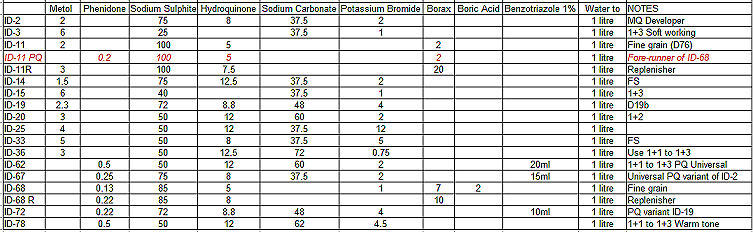
OK Nick, here's the comparison chart as promised, its only a few of the total published.

ilford%20devs%20sm.jpg


Ilford Developers Higher resolution

You will see the main developer types:

ID-2 MQ ID 67 PQ Universal film & paper developers

ID-3 M only Soft working developer for films or papers

ID-20 MQ ID-62 PQ Film & Paper developer (fine grain if used quite dilute).

ID-11 MQ ID-68 PQ (Microphen) Fine grain film developers

ID-19 MQ ID-72 PQ Clean working Industrial, Aerial photography, x-ray developer.

ID-14 Contrast developer, for films and papers.

Of course Ilford have published many other formulae, using other developing agent etc but these give you something to start with, all companies produced a similar range of developers. The commercial version of D19 is more likely to be closer to the D19b variant.
 
OP
OP
nick mulder

nick mulder

Member
Allowing Ads
Joined
May 15, 2005
Messages
1,212
Format
8x10 Format
The comparison between ID-19 and ID-14 is interesting - I'll try some A/B comparisons between the two (once I have compared D19 and D19b)

Maybe the ID-72PQ as I already have phenidone here and can scratch ordering the metol

Again though, just out of interest> what does 'Clean working Industrial' mean in terms of subjective qualities in the final print ? I know I have plenty of examples here as its what I have been using, but I am not very good at reading differences in developed negs with nothing 'standard' to compare them with (like the same neg in D76 for instance)

Thanks for the chart, its a pretty good starting point ! It really shows there are some pretty standard chemicals when it comes to the Metol/Hydroquinone developers - I'll try to find out what each of the components do, like Sodium Sulphite is there in every one, it must do something vital ...
 

pgomena

Member
Allowing Ads
Joined
Jun 25, 2003
Messages
1,391
Location
Portland, Or
As I recall D-19 is a "clean-working industrial developer" because it produces very little fog and is a higher-contrast developer. It probably is paired with aerial films because aerial photographers are always fighting haze, so fog on the film base is counterproductive. I used it in school with Tri-X Ortho film to make shadowgraphs of bullets in flight. It does produce very little fog.

Peter Gomena
 
OP
OP
nick mulder

nick mulder

Member
Allowing Ads
Joined
May 15, 2005
Messages
1,212
Format
8x10 Format
Righto, ok with my understanding of how gamma works I can see how base fog would be an issue if high contrast was desired - As it turns out this is exactly the effect I am after and can see in the neg ...

judgeholm.jpg


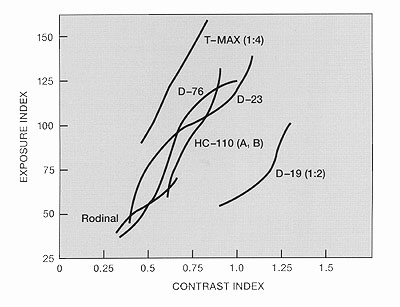
I've read that the similar effect in HC-110 (which is compared to D19) is due to a strong 'restrainer' - which chemical component is the restrainer ?
 

Tom Hoskinson

Member
Allowing Ads
Joined
Mar 7, 2004
Messages
3,867
Location
Southern Cal
Format
Multi Format
PotaIn Kodak Developer D19, the Restrainer is Potassium Bromide

Righto, ok with my understanding of how gamma works I can see how base fog would be an issue if high contrast was desired - As it turns out this is exactly the effect I am after and can see in the neg ...

judgeholm.jpg


I've read that the similar effect in HC-110 (which is compared to D19) is due to a strong 'restrainer' - which chemical component is the restrainer ?

In Kodak Developer D19 recipe, the Restrainer is Potassium Bromide. I don't have the HC110 recipe (it is closely held by Kodak).
 
Last edited by a moderator:

Tom Hoskinson

Member
Allowing Ads
Joined
Mar 7, 2004
Messages
3,867
Location
Southern Cal
Format
Multi Format
Here are the recipes for Kodak D-19, Kodak D-19b and Agfa 80. Sheet 1 and Sheet 2 of the attached Excel File.

You will notice that both Kodak D-19b and Agfa 80 have less Potassium Bromide and less Sodium Sulfite than Kodak D-19. Agfa 80 uses 60 grams/liter of Potassium Carbonate vs 48 grams/liter of Sodium Carbonate in Kodak D-19.

You could add some Benzotriazole solution to any of these developers. Benzotriazole is an organic restrainer and will decrease fog and also decrease Effective Film Speed.
 

Attachments

  • Kodak Developer D-19, D-19b and Agfa 80.xls
    22 KB · Views: 341

Tom Hoskinson

Member
Allowing Ads
Joined
Mar 7, 2004
Messages
3,867
Location
Southern Cal
Format
Multi Format
Potassium Bromide is the Restrainer in D-19

Here are the recipes for Kodak D-19, Kodak D-19b and Agfa 80. Sheet 1 and Sheet 2 of the attached Excel File.

You will notice that both Kodak D-19b and Agfa 80 have less Potassium Bromide and less Sodium Sulfite than Kodak D-19. Agfa 80 uses 60 grams/liter of Potassium Carbonate vs 48 grams/liter of Sodium Carbonate in Kodak D-19.

You could add some Benzotriazole solution to any of these developers. Benzotriazole is an organic restrainer and will decrease fog and also decrease Effective Film Speed.
 

Ian Grant

Subscriber
Allowing Ads
Joined
Aug 2, 2004
Messages
23,417
Location
West Midland
Format
Multi Format
Suprol - Reversal processing

Nick, there is or rather was a very informative technical data sheet for May & Baker Suprol. May & Baker became Champion.

The data sheet was published in the 1970's and gave a lot of extremely useful and detailed information on a wide range of uses for Suprol, and this included reversal processing and adjustments to obtain different gammas etc.

Other uses were as a fine grain developer for commercial processing, and at about 1+29 or higher dilution for tank development, and it did give very fine grained negative.

Suprol is fairly similar, effectively equivalent, to Ifords PQ Universal and so would give you pointers for adjusting and using a developer like ID-62, or even ID-72

My copy of the datasheet is in storage but if you can't find a copy I'll try and dig it out next time I'm in the UK.

Ian
 

HumbleP

Member
Allowing Ads
Joined
Jun 8, 2012
Messages
81
Location
Sydney, Aust
Format
35mm
Sodium Carbonate Vs Poassium Carbonate

Reviving this thread with a related question....

I noticed the recipe attached to this thread includes a "Agfa 80" recipe. The main difference between the D-19 and Agfa 80 is that Potassium Carbonate replaces Sodium Carbonate in the Agfa 80.
I was just wondering what the effect of this may be?

I'm asking as I was about to mix my own D-19 when I realised I was low on Sodium Carbonate but had plenty of Potassium Carbonate.

Regards,
Peter
 

mts

Member
Allowing Ads
Joined
Feb 12, 2004
Messages
372
Location
Los Alamos,
Format
Multi Format
D-19 is the old standby for astronomical imagery primarily due to its high straight-line gamma and short toe (low fog level). It was used with plates from about the early part of the last century up through the 80s when CCD detectors came into wide use. I used it with the standard glass-plate emulsions for astrophotography forty years ago, 103a and the like. It was also used for spectroscopy and for "patrol" cameras that were used primarily to record and discover asteroids.

For consistency you should always measure and set the developer pH to the level (around 10 to 11) that gives you the result you want.
 

Gerald C Koch

Member
Allowing Ads
Joined
Jul 12, 2010
Messages
8,131
Location
Southern USA
Format
Multi Format
You can replace sodium carbonate with potassium carbonate if you correct for the difference in molecular weight. Potassium salts are slightly more active then their sodium analogs in photograpic formulas. The one exception being for use in fixers where the potassium salts retard the fixing process.
 

Ian Grant

Subscriber
Allowing Ads
Joined
Aug 2, 2004
Messages
23,417
Location
West Midland
Format
Multi Format
I noticed the recipe attached to this thread includes a "Agfa 80" recipe. The main difference between the D-19 and Agfa 80 is that Potassium Carbonate replaces Sodium Carbonate in the Agfa 80.
I was just wondering what the effect of this may be?

Peter

Agfa (Orwo) tended to use Potassium Carbonate (& sometimes sulphite) because of the higher solubility compared to Sodium Carbonate (& sulphite), this allows storage of more concentrated solutions.

In commercial liquid concentrates they go a step further and use a smaller amount of Carbonate and a little Hydroxide to achieve the same pH, Ilford & Kodak do the same. This is quite useful when making up your own concentrated stock solutions.

Ian
 
  • Deleted member 2924
  • Deleted

Ian Grant

Subscriber
Allowing Ads
Joined
Aug 2, 2004
Messages
23,417
Location
West Midland
Format
Multi Format
In a developer Potassium salts will give marginally finer grain than Sodium, this is most noticable with warm tone developers where it's the fineness of the grain that alters the warmth.

The differance in solubility between Sodium Carbonate 215 g/L (20 °C) and Potassium Carbonate 112 g/100 mL (20 °C) is quite marked, hence why Potassium Carbonate is used in commercial liquid developers.

Ian
 

Athiril

Subscriber
Allowing Ads
Joined
Feb 6, 2009
Messages
3,062
Location
Tokyo
Format
Medium Format
In a developer Potassium salts will give marginally finer grain than Sodium, this is most noticable with warm tone developers where it's the fineness of the grain that alters the warmth.

The differance in solubility between Sodium Carbonate 215 g/L (20 °C) and Potassium Carbonate 112 g/100 mL (20 °C) is quite marked, hence why Potassium Carbonate is used in commercial liquid developers.

Ian

Did you mix these two up?
 

Gerald C Koch

Member
Allowing Ads
Joined
Jul 12, 2010
Messages
8,131
Location
Southern USA
Format
Multi Format
Isn't the carbonate part only that is active? That is, pH is controlled only by cabonate, not the counter-cation.
I did know K+ salts are only a little soluble than Na+ salts. Maybe is this the difference?

At the strengths usually employed in photo graphic developers the hydrolysis of potassium carbonate (separation into caustic potash and bicarbonate) liberates a much greater amount of caustic alkali than does the hydrolysis of sodium carbonate, so that potassium carbonate gives developing solutions of greater energy.
 
Photrio.com contains affiliate links to products. We may receive a commission for purchases made through these links.
To read our full affiliate disclosure statement please click Here.

PHOTRIO PARTNERS EQUALLY FUNDING OUR COMMUNITY:


Ilford ADOX Freestyle Photographic Stearman Press Weldon Color Lab Blue Moon Camera & Machine
Top Bottom