Vaughn
Subscriber
Vaughn, Joni Mitchell would be proud of you and after 50 years I'm sure you know what you are doing. Please ignore my previous post.
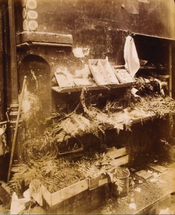
I did find some ferns by Atget...

Vaughn, Joni Mitchell would be proud of you and after 50 years I'm sure you know what you are doing. Please ignore my previous post.


Only photographers on a photo forum can argue that fake pictures are real.

Anyone know what was going on there? Were the ferns for sale, or just packaging for something else?I did find some ferns by Atget...
My guess is a fish shop.
Nobody has argued that. What people are saying is that even "real" not-deliberately-altered photographs aren't literally real. They are a particular version and incomplete recording of whatever actually happened in front of the camera.
That doesn’t follow at all from what @reddesert has said here. Your logic is busted and you’re conflating ideas so you can keep referring to your story about a judge or something.Of course photos can't be the real thing. That's why they call portraits a "likeness" of the subject. Only the original subject is real, unless you're God and can duplicate objects. But if the likeness in the photo is so adulterated it no longer represents the reality, than it's a fake. What you're saying is that since no picture is "real", then fake pictures aren't fake. Tell that to the judge.
That doesn’t follow at all from what @reddesert has said here. Your logic is busted and you’re conflating ideas so you can keep referring to your story about a judge or something.
That's exactly what he's saying. That leaving in telephone lines is just as unreal as cloning them out.
Don't put words in my mouth. Show me anywhere in this thread where I said anything about leaving in or cloning out an object, telephone lines or anything else.

Certainly not here.Just to be clear, then, do we agree that cloning in or out objects from the original view during the edit process is "less real", maybe fake, picture making? If not, where would you draw the line?
It's important to recognize different photos serve different ends. A photo that is to stand as evidence of something needs to be as authoritatively authentically representative as possible. So don't add or remove bits from it - leave it as-is to be interpreted and assessed as-is for its evidentiary value.
Art photos - adding and removing doesn't make them fake. It makes them what they are. They are photos that are ends in themselves.
Family snapshots? Once again, do what you want. A personal photographic record is usually very selective and overly glossy, anyway.

Would a film photograph used as evidence in a court case carry more weight than a digital version?
From limited observation in our courts, there seems to be a difference between Superior Court and Small Claims Court regarding the type/format of photographic evidence. In Superior Court it seems that the judges allow photographs to be admissable whereas in Small Claims Court the judges tend to only allow consideration of "the original source".... "Don't show me a printout, show it to me on your phone." Presumably, the Superior court trust Law Enforcement and lawyers to present images that are unaltered whereas Small Claims does not necessarily trust citizens to do the same. Small Claims Court seems to have a distinct preference for digital/phone photography, which might be to minimize the opportunities for alteration and perhaps because it's just the way most people document things these days.
No matter, the Courts seem oriented toward "Takers" and against "Makers' LOL
Perhaps "fake" is too emotive term, as it has a negative connotation. But if you alter a photo, it's certainly no longer the original scene, so no longer represents physical reality and becomes your interpretation of the scene.
...
But there is always the possibility that an altered image can actually describe reality more fully to the viewer than an unaltered image.
If you shoot 8x10 and use aggressive N- development to record a wide scene with an enormous contrast range and print it massively so that details not noticeable to the naked eye become clearly visible when walking up to the print - isn't all of that the same kind of enhancement as HDR, "super-resolution" etc? But I bet everyone here would label it "straight reality" and it wouldn't raise any eyebrows even among the more conservative crowd. But it someone takes a digital camera and does a HDR merge, focus stacking, stitching...oooh boy, that's a whole different story.Certainly things like adding or removing objects, HDR, "super-resolution", AI night view "enhancement" etc all distort physical reality.
| Photrio.com contains affiliate links to products. We may receive a commission for purchases made through these links. To read our full affiliate disclosure statement please click Here. |
PHOTRIO PARTNERS EQUALLY FUNDING OUR COMMUNITY:  |