
• Welcome to Photrio!
    Registration is fast and free. Join today to unlock search, see fewer ads, and access all forum features.
    Click here to sign up

Low cost process automation for making emulsions

Somewhere...

D
Somewhere...

  • 2
  • 1
  • 59
Iriana

H
Iriana

  • 6
  • 1
  • 119

Recent Classifieds

Forum statistics

Threads
202,739
Messages
2,844,927
Members
101,493
Latest member
aekatz
Recent bookmarks
0

Photo Engineer

Subscriber
Allowing Ads
Joined
Apr 19, 2005
Messages
29,017
Location
Rochester, NY
Format
Multi Format
Well, another day at GEH, and the first day there I could get around without a wheel chair and Nick pushing. I even left my cane behind a few times!

Anyhow, the theme of our work for the last few months has been low cost process automation. By this I mean under $100 for a two pump system.

At this time, we have found suitable pumps for $4.95 (yes, true) and these are now running in my lab and Nick's with batteries (6) or a small model train transformer.

We are using standard tubing and can deliver solution in the range we need for about 100 - 500 ml of emulsion, right where the usual home lab maker wants.

If this all works out, it will improve repeatability by quite a bit and make things easier.

Our next step is to check the pumps for resistance to corrosion after several uses. All too often, we have dissolved our equipment after use, even with good washes.

Of course, we have been up to other things, but they are not ready for discussion yet.

PE
 
It's good to hear your able to get around without a chair, and definitely a good sign to be forgetting your cane. I have the occasional gout attack, and it's always a nice feeling to realize I forgot my cane (so long as I don't turn too fast).

For $5 a pop, the pumps don't have to last forever - as long as there is no contamination. I'm following along; I hope to try my hand at emulsion-making some day (and am budgeting for your book/dvd).
 
Hmm. Waiting patiently to see what you've got!

Glad to hear you are getting around better, Ron!

-- Jason
 
Thanks guys. I had a great time with Nick, Mark and that was just at GEH. Nick and I went to Radio Shack (whats left of them here) and then here for a bit to do some work.

Gettin better every day.

PE
 
It's good to learn of the progress in the lab, and also that you're up and around.
 
This is good news indeed! Didn't know you were needing a chair to get around but glad you are doing better.
 
Great news all around, PE! :smile:

Good to hear that you are getting better too.
 
Thanks all for your concern. It is appreciated.

Just to give more information, I only used the wheelchair to get around at GEH as it is so large and involves sloping corridors. I can do that now with a cane. At home, I pretty much don't need the cane indoors, just outside when I walk. Today, after a visit to the doctor's office, my wife and I took a short walk through the mall nearby and had a small snack at the B&N cafe. Things are looking up.

For those who express doubt about the pump, yes $4.95 each. I bought 8 of them and donated 4 to GEH for testing. I have 4 that I am testing.

Today, Nick is running it at about the right range using a Radio Shack "wall wart" set at 3 V and using a high wattage pot to control the speed. Next comes making an emulsion, probably next week. I'll post pix later if you wish. They are very tiny but very powerful.

PE
 
Sounds like a sweet setup to me if it all works according to plan. Some of the best setups are done with improvised equipment on the cheap. Good luck with the pumps.
 
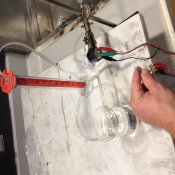
Here is the photo Nick sent me.

Retrieve and rotate at your leisure. See how small it is.

Details to follow, but the pot there was fried as it takes more power. We need to find a good variable pot and a fuse for it, but we hope to hold it under $100 for controlling 1 or 2 pumps. Two pumps for under $100 would be ideal.

PE
 

Attachments

  • IMG_0511.jpg
    IMG_0511.jpg
    497 KB · Views: 380
Ron, I just ordered a small adjustable voltage regulator circuit kit to give us better control of the pumps using the RS power supply you purchased.
 
If you don't mind mail order/online, Digikey or MCM Electronics might have a pot or two that would work.
 
Well, if we go with 2A, we need a very good hefty pot.

These are not in great supply since the digital revolution!

:wink:

PE
 
If I can chime in here: using a pot is probably not the way to go. Running motor at reduced voltage, particularly at near stalling speed will suck current, frying the pot and possibly the motor. A simple PWM (pulse width modulation) circuit will allow variable speed whilst keeping torque. PM me if you'd like details.
 
Well, we can do PWM and in fact, I tried it but the motor began to stutter at the slower speeds and gave "PWM" flows. I can probably vary the parameters of the pulse, but that requires more programming of the PIC we intend to use.

We will get there. And, BTW, the local electronics store has shelves of large pots for about $20 each. However, the resistance range is either 0-50 or 0-2000 Ohms so we may buy one and check it out, but we got best results with 0-100 Ohms. No overheating so far. We plan on making an emulsion next week to check corrosion.

PE
 
Ron, I agree PWM doesn't work with the small pumps - that's why I ordered the variable voltage board kit as mentioned earlier.

As mentioned by Hexavalent, using a series pot is not the ideal approach to slow motor speeds.
 
Another two cents:

A small capacitor ( a few nF) across the motor will smooth the pulses so that the motor "sees" something more akin to pulses superimposed on DC. This can improve performance at lower speeds. The tell-tale whining sound of PWM (I run mine ~ 4 kHz) will also be reduced. If you are noticing considerable stutter, your PWM is either too slow, or there is not enough current being supplied. Please note that a "flyback" diode should always be connected across a motor being driven with unipolar DC.

LED PWM drivers are probably not ideal for motor control - they often feature per-cycle current limiting, and as well, commutation noise can confuse the controller.
 
Last edited by a moderator:
So where do the pumps come from?
 
So where do the pumps come from?

I will publish that as soon as we are sure this is a reliable pump under working conditions and that the electronics are durable and safe for lab use.

Our earlier options ran up as high as $200 - $300 or more and required tedious programming. We are trying for simple programming (Arduino digital on off type) or manual operation depending on cost and reliability.

I don't want a bunch of unhappy emulsion makers out there - unhappy with pumps that quit, are inaccurate, or with a setup that gives them a jolt of electricity when they do something wrong.

PE
 
Ugh, ok. I will be patient.
 
Photrio.com contains affiliate links to products. We may receive a commission for purchases made through these links.
To read our full affiliate disclosure statement please click Here.

PHOTRIO PARTNERS EQUALLY FUNDING OUR COMMUNITY:


Ilford ADOX Freestyle Photographic Stearman Press Weldon Color Lab Blue Moon Camera & Machine
Top Bottom