
• Welcome to Photrio!
    Registration is fast and free. Join today to unlock search, see fewer ads, and access all forum features.
    Click here to sign up

Lodima Fine Art Paper ready to take orders

Toby's Bar

H
Toby's Bar

  • Tel
  • Apr 25, 2026
  • 0
  • 0
  • 0
Barber

A
Barber

  • 0
  • 0
  • 29

Recent Classifieds

Forum statistics

Threads
203,485
Messages
2,855,460
Members
101,866
Latest member
Afadjato
Recent bookmarks
0
I was shocked at how terrible the tones were. Yes, that had very deep blacks, but the large prints just had no life to them. Then I noticed a hallway in a balcony where there was a row of his contact prints. I was blown away. I do not believe I have ever seen any prints more beautiful than those contact prints.

This parallels my experience exactly. The photograph that inspired me to get a bigger camera and begin contact printing is Adams' portrait of E. Weston under the eucalyptus tree where he's sitting among the roots. I saw an 8x10 contact print of this picture at the National Portrait Gallery about 15 years ago. I've never seen it again anywhere. I was dumbstruck.

A few years later the NPG put up the Friends of Photography restrospective which included a 16x20 enlargement of that negative (printed by A. Adams, of course). Horrible. That soured me on Adams forever. Every time I see any enlargement by Ansel Adams I like them less and less.

If you ever get a chance to see his contact prints, which is how he did almost everything before 1940, don't pass it up. They're some of the most beautiful photographs ever made.
 
A really big thanks for taking the time to respond David. As you stated, pretty much as I surmised.

Now to get out of the way and follow this thread....one can hope that civility will reign.

Ed
 
I was lucky enough to get a box of the initial run of Lodima in the 8x10 size and did a 5 x 7 contact print on it from TMY. I found myself staring at it, a bit amazed that I actually did that. Beautiful tones and depth. I have now ordered some boxes of 8 x 20 Lodima to use for my 8 x 20 negatives. I can only imagine what those will look like ...

Rick
 
In the spirit of levity and humility, I beseech all LF contact printers out there to buy some Lodima paper. Those of us who've made contact printing our medium would really like to see this venture succeed. It's quite remarkable paper.
 
I hope this is a benign question.

I would like to know the proper storage for this paper in order to insure it's long term keeping capabilities.
If I store it in a refrigerator will this have any effect on the paper?

Thanks

Gary
 
Storage of Lodima paper:

We store excess paper in a freezer. Colder temperatures slow down the rate of chemical change. Now, is storage in a freezer necessary? And is it even desirable?

I do not believe storage in a freezer is necessary. We have purchased Azo that has been stored at room temperature for 30 to 40 years (or longer) and it is just fine. So I would say to just put the paper on a shelf in a relatively dry place that is not too hot.

Years ago I spoke with w chemist at Kodak who did not have an answer to the question of how to store silver chloride paper. She wasn't sure that storing the paper in a freezer would slow down aging of the paper. She said it was possible that it could even speed up the aging process, but the bottom line was she simply did not know.

I have stored paper for twenty to thirty years not in a freezer with no signs of aging. One reason we now store paper in the freezer (not opened boxes), is that we built a huge walk-in freezer to store our Super XX film, and I have no other place to store the paper.

Hope this ambiguous answer helps. Maybe Ron Mowrey has a better one.

I think the bottom line is not to worry about it, if you can manage that.

Michael A. Smith
 
With no offence intended, I think a refrigerator would improved keeping and a freezer would improve it even more so. That is, if the keeping was not the same as Azo itself. Until we have a year or two or maybe a decade of real keeping on several batches, I would have to refrain judgment, not having run any tests nor seen any tests on Lodima directed towards keeping.

So, thus, in this case, keeping the paper cold is insurance for a new product just in case.

PE
 
Obviously amidol is the preferred developer for this type of paper, but if one does not have any amidol, what would be the next preferred developer? I know this is a subjective question.

I have no experience with silver chloride papers and I don't have LF negatives to contact print, but who knows in the future, plus I'm thinking about contact printing my 6x7cm negatives.
 
The way I've described it is--it's not so much that the paper is more beautiful than enlarging papers, but an Azo type paper or the new Lodima paper, which I've tested, makes it possible to use a longer scale neg (about one zone more contrast) with more detail, and to render that detail easily on the print. I have negs that print well on enlarging papers and make similar prints on Azo, but I have negs targeted to Azo that make excellent prints on Azo that couldn't be made easily on enlarging papers.

Does that mean that negatives processed specifically for contact printing on AZO or Lodima, benefit being developed to a higher contrast than those for enlarging papers? Also, which modern film and developers work well with these type of papers? So far, this thread has only mentioned the availability of the new paper and not how to get optimum results from the product.
These questions are not specifically for David, it`s just that I noticed what I have highlighted in bold. :confused:
 
Comparisons of papers

Friends;

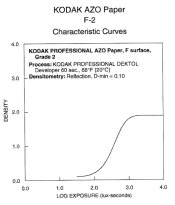
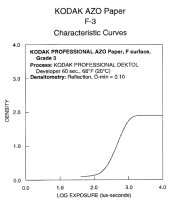
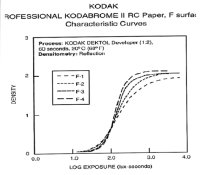
There is some difference of opinion over why and how Azo yields unique results. Well, over and above the fact that it is a contact paper and a chloride paper (not really, but yes for all practical purposes....) Here are the curves of Azo grade 2 and 3 compared to an old favorite of mine, Kodabromide.

These curves have been normalized as much as possible on both the X and Y axes so that when printed out, they can be overlain for comparison. If you do this, you will see that the Azo F3 is about like Kodabromide F2 but with a lower Dmax and the Azo has a softer toe and shoulder thus rendering more detail throughout the entire tone scale of the negative that it can capture.

There is no doubt in my mind that expert handling in the process and using Amidol developers with after rinses further enhance the tonality.

Now, I am not an Azo expert by any means when it comes to printing, but I am an expert in reading these sensitometric curves. Ilford MGIV and Kodak Polycontrast were similar to the Kodabromide. They are all quite different than Azo, and these differences go towards explaining all of the "mystery" here. It is no mystery to me. It is by design!

PE
 

Attachments

  • Normalized Azo F2.jpg
    Normalized Azo F2.jpg
    92.7 KB · Views: 184
  • Normalized Azo F3.jpg
    Normalized Azo F3.jpg
    112 KB · Views: 183
  • Normalized Kodabromide.jpg
    Normalized Kodabromide.jpg
    89.2 KB · Views: 177
[/B]
Does that mean that negatives processed specifically for contact printing on AZO or Lodima, benefit being developed to a higher contrast than those for enlarging papers? Also, which modern film and developers work well with these type of papers? So far, this thread has only mentioned the availability of the new paper and not how to get optimum results from the product.
These questions are not specifically for David, it`s just that I noticed what I have highlighted in bold. :confused:

I like Tri-X and ABC pyro, but that's a matter of personal taste, and yes, Azo likes a negative developed to higher contrast than for enlarging papers.

I was very impressed by a print on Lodima that I saw recently through one of the APUG print exchanges that was developed in Agfa Neutol WA 1+15. I used Neutol WA with Azo for a while at 1+15 and 1+7, and it just didn't come close to Ansco 130 or amidol, but the new Lodima paper gets very rich blacks in Neutol WA 1+15, so it may be amenable to a wider range of developers than Azo was.

Amidol and Ansco 130 should produce a similar tonal range, but amidol will give you more flexibility to control contrast with water bath processing, which is a very useful technique with graded papers.

All these subjects are discussed in great detail in the Azo forum at http://www.michaelandpaula.com
 
Whoa Michael, I saw your post on the "smokin deal" for a 5x7 or 10x10 Durst. As you know I already have a 5x7 Durst in my darkroom... But how about that rusty and dusty Linhof that's sitting unused and lonely on the floor of your closet?

Help finance that 1150 GS.
 
To answer Keith Tapscott and Travis Nunn:

Develop negatives that will print on Azo to a higher contrast? Etc.

Yes, this thread is about the availability of the new Lodima paper. All other discussion is in other threads and even more in depth on the Azo Forum at www.michaelandpaula.com under "Azo." And on our web site there are my articles about Azo.

What I have found is that any film and any developer work well, though I like, personally, because of my aesthetic choices, a film that has more straight line and less toe and shoulder. But those are MY aesthetic choices. They need not be everyone else's. As a consequence, for current films I would use TMax 400 rather than Tri-X, but again, and I cannot stress this enough: this is a personal preference and is by no means would it necessarily be the right choice for you.

Same with developers. Start with the one you always use and don't worry about it.

Develop to a higher contrast: I think that is only necessary because there is no grade 4 currently available. I have found that I can print any negative beautifully on Azo--dense, thin, normal. As long as it is not underexposed or too overdeveloped. Again, just do what you do normally and make some prints and see how they look.

No Amidol. I feel Amidol gives the best tones with this paper. But others have gotten tones that please them with other developers. Dektol makes the prints too cool in my opinion. Outside of Dektol, use whatever you have. Only change if you are not happy with the result.

What photography is all about, at least it is for me, are the pictures. One wants them to be well seen (that is the most important thing) and well printed. Since we are discussing the print here (as in print quality), do whatever you do and do not change until you are dissatisfied with your print quality. Then, and only then, look for something that may give you better (in your own terms) results. Folks worry too much about films and developers. Just relax about all of that stuff and go make new pictures.

Michael A. SMith
 
Whoa Michael, I saw your post on the "smokin deal" for a 5x7 or 10x10 Durst. As you know I already have a 5x7 Durst in my darkroom... But how about that rusty and dusty Linhof that's sitting unused and lonely on the floor of your closet?

Help finance that 1150 GS.

You have that right. The Linhof is not getting any more use this winter than the Durst enlargers. Next time you come through Colorado leave the back seat out of your van and you can take the Linhof 8x10 Color Karden or the big Durst 184 home with you.

Did you get your 800GS?
 
FWIW, I've had pleasing print tones with Lodima using Ilford/Harman WT print developer dil.1:9 for 1 min. development time. The print tones are slightly warmer then with Amidol. Although these prints did not tone in selenium, diluted 1:25, as readily as the prints developed in Amidol. They did tone but it took longer. The toning was stopped when a hint of red-brown colour was detected in the darker tones.

For me, as it is for many here, a most excellent paper.
 
Obviously amidol is the preferred developer for this type of paper, but if one does not have any amidol, what would be the next preferred developer? I know this is a subjective question.

I have no experience with silver chloride papers and I don't have LF negatives to contact print, but who knows in the future, plus I'm thinking about contact printing my 6x7cm negatives.

Travis,

We really need to cross paths. I'll be bringing LOTS of Azo prints to the VA get together May 13-15. I'm not sure if I'll be able to hang around for the weekend, but I MAY be able to stay. Perhaps you could arrive Friday afternoon (or sooner). I've never tried Ansco 130, but some photographers I trust tell me they like the tones. I don't think I have ever seen an Azo/Ansco 130 print. I've used Agfa Neutol WA with good results with Azo. I thought Dektol was too green. I've also seen some 6x6 & 6x7 contact prints on Azo and they were wonderful, so don't be afraid to contact print your medium format negatives on Azo/Lodima.
 
plus I'm thinking about contact printing my 6x7cm negatives.

I can't recommend that enough, Travis. I've been making 6x6 contact prints on Azo and Lodima in amidol and they have this incredibly precious, jewel like quality about them. Plus, it's a great way to learn the paper without breaking the bank.
 
Ron,

Nice information. I have compared curves of AZO 2 and AZO 3 with curves of a number of other silver papers and there is no question but that the toe and shoulder of AZO is quite different. As you say, there is no mystery to the look, one can see it in the curve if you know how to look.

So far I have not seen a Lodima curve. I did not buy any of the paper because at present I am only working with carbon transfer and other hand coated processes, and I still have quick a large supply of AZO 2 and AZO3. However, if Michael or someone else would send me a few sheets of the new paper I would be happy to test it and make the results available to the forum.

Sandy King


Now, I am not an Azo expert by any means when it comes to printing, but I am an expert in reading these sensitometric curves. Ilford MGIV and Kodak Polycontrast were similar to the Kodabromide. They are all quite different than Azo, and these differences go towards explaining all of the "mystery" here. It is no mystery to me. It is by design!

PE
 
Sandy;

My wife and I are still in awe of your portfolio of prints!

You don't need Azo or Lodima IMHO. Kudos and best wishes!

Ron
 
Well Kirk, since you have never printed on silver chloride paper your comments really are meaningless.
Michael A. Smith

Thanks for spending so much of your time on my appearantly meaningless comments.

Speaking of prefering Ansels contact to his enlargments or not, I really found your giant, color enlargements of convicted criminals more interesting than your contact prints. Are you going to do any more work of that style?

And that's just my opinion.
 
To answer Keith Tapscott and Travis Nunn:

Just relax about all of that stuff and go make new pictures.

Michael A. SMith

Amen, brother. Too much endless rambling on this board about chemicals and densitometers, not enough about important stuff like seeing. Let's all quit arguing and make some kick-ass new work.
 
Photrio.com contains affiliate links to products. We may receive a commission for purchases made through these links.
To read our full affiliate disclosure statement please click Here.

PHOTRIO PARTNERS EQUALLY FUNDING OUR COMMUNITY:


Ilford ADOX Freestyle Photographic Stearman Press Weldon Color Lab Blue Moon Camera & Machine
Top Bottom