• Welcome to Photrio!
    Registration is fast and free. Join today to unlock search, see fewer ads, and access all forum features.
    Click here to sign up

list of photographic problems, photographs? troubleshooting ...

Mackenzies Pocket

A
Mackenzies Pocket

  • 3
  • 2
  • 38
Flush

H
Flush

  • 2
  • 0
  • 39

Recent Classifieds

Forum statistics

Threads
202,914
Messages
2,847,472
Members
101,532
Latest member
pepo007a
Recent bookmarks
0
When you turn on the enlarger and realizes that the lens is wide open because you forgot to stop it down after refocusing .

Karl-Gustaf
 
One of the funniest things a student once said to me is "Clive, please come and look at my enlarger, as the image is very dim and I think the bulb maybe going".
 
The best guide to darkroom disasters was a book by the East German ORWO I found in a university library (along with a whole lot of excellent books on the technical aspects of photography, a far cry from the "just follow the manufacturer's data sheet" given in modern books on darkroom technique). I wish I could remember the title. It was an English edition. Something like "Faults in Photography". Imagine an entire book devoted to all the things that go wrong in photography! It would be a bestseller even today.
 
When you turn on the enlarger and realizes that the lens is wide open because you forgot to stop it down after refocusing .

Karl-Gustaf

Or... you don't realise it and then get a test strip with various shades of black.
 
Well, I thought I would post this here, since I have no idea what this is. FYI - this is about 1/20th of a 120 negative.

a8ubu5er.jpg


I've examined the negatives with a loupe -- there doesn't appear to be residue on either side. I've not seen this before on my negatives. This was my first roll of neopan acros 100, developed in DDX, all my usual protocols observed and traditional workflow followed. Apologies if this is some incredibly common thing and TIA.

Edited to add that this is in the negatives (ie, not a scanning thing) and is not on the surface of the negatives.

Sent from my iPhone using Tapatalk
 
Well I would have pointed to noise-reduction on scanning, but if it's not that then I'm stumped.
Halation? It does seem to follow the contours of the hair.
Maybe some weird thing where the developer has been working on a high-activity area and somehow stripped the emulsion from the plastic?
 
Well I would have pointed to noise-reduction on scanning, but if it's not that then I'm stumped.
Halation? It does seem to follow the contours of the hair.
Maybe some weird thing where the developer has been working on a high-activity area and somehow stripped the emulsion from the plastic?

Yes, I was wondering about that. In the other frames with this problem, it does seem to sort of (?) stick to certain areas. Could this be because I over-developed? Or is it the film?


Sent from my iPhone using Tapatalk
 
Two pages from Kodak's 1988 Darkroom Dataguide ​:

David, thanks for that. I thought the first example of wine glasses was a good guide for beginners and worth studying. It gives some guidance as to what is more easily or less easily recoverable when printing. It would have been even more helpful if Kodak had shown what the same exposure straight print looked like.

pentaxuser
 
Well, I thought I would post this here, since I have no idea what this is. FYI - this is about 1/20th of a 120 negative.

a8ubu5er.jpg


I've examined the negatives with a loupe -- there doesn't appear to be residue on either side. I've not seen this before on my negatives. This was my first roll of neopan acros 100, developed in DDX, all my usual protocols observed and traditional workflow followed. Apologies if this is some incredibly common thing and TIA.

Edited to add that this is in the negatives (ie, not a scanning thing) and is not on the surface of the negatives.

Sent from my iPhone using Tapatalk

ive had stuff like that,
i just chalked it up to luck ..

are the negatives thin? dense?
 
When I saw the thread title I parsed it in the sense of "chess problems" or "bouldering problems", and I thought it was going to be about photographic exercises chosen to highlight specific technical challenges. You know: Exposure handling to get a good portrait of a black cat, compositions that are challenging to frame, stuff like that. Which might have been a pretty interesting though quite different thread.

There isn't already a body of that stuff, is there? _1001 Technical Problems For Students Of Photography_?

-NT
 
when i started this thread i had envisioned a photographic log of photographic problems
like
photoflo ripples from overly concentrated photoflow
white splotches on film from negatives touching in mal-spooled film
film holder abrasions
pinholes from stop bath
i am sure there are thousands of things that peoples' film
( problem film )
shows ...
since there are so many threads that are like
" hey what happened to my film "
this thread i imagined would show visuals if a cornucopia of film-issues
rather than "funstuff" from darkroom/camera problems ...
i would post pages from the index of the horenstein book i have, it is very good
but i dont want to deal with copyright issues ...
and thought maybe we all would be able to come up with our own film problem index
not in the gallery since a lot of participants might not be subscribers, although
if this thread does good, maybe there could be a gallery sub area or group that deals with problems ..

thanks for the uploads and links so far ...
 
Last edited by a moderator:
ive had stuff like that,
i just chalked it up to luck ..

are the negatives thin? dense?

Negatives are otherwise nice. Here is one a few frames down that is relatively clean:

netuqy4y.jpg


OP - thanks for starting this. I have a handful of books and sites that I run all my 'what is this?' queries through, but couldn't find anything like this.


Sent from my iPhone using Tapatalk
 
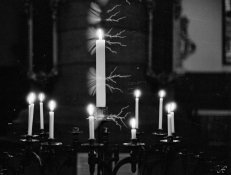
I just remembered an odd negative I got a couple of months ago:

12035986176_ac513b7aeb_o.jpg

I asked an experienced photo journalist about it. He said the flashes were most likely discharges of static electricity on the film itself. It happens if you advance the film too fast in cold weather, which fits the conditions when I took it.
 
big thank you to professor horenstein. he gave me permission to upload a few pages from his book.
it is a great book to learn photography with, easy to understand well written lots of visuals too.
if you don't have this one, its definitely worth purchasing !

these are pages 208-211

full citation:

Horenstein, Henry. Black and White Photography A Basic Manual. 2nd ed. Boston: Little Brown and Company, 1983. 208-11.

thanks again!
 
Today's screw up, mixing LPD in spring water instead of distilled. I was perplexed at the initial color of my developer, then aghast at the scum forming on the surface of the mixing container. Then I turned the water jug to read the label, AAAAAAAAAAAAAAAaaaaaaaaaaaaaaaaarrrrrrrrrrrrrrrrrrrrrrrrrrrrgggggggggggggggggggggggggghhhhhhhhhhhhhhhh. The bottle of spring water was on the shelf next to my distilled, I don't remember buying mineral water, I only buy distilled. Well, it's either money down the drain, or (here's hoping).
 
well, since you bumped this thread, I am having difficulty keeping the film flat in my Bantam Special. The 828 reel is so tiny the film develops a very strong curl. lack of sprockets may also be a factor. I'm considering wedging the pressure plate to put more pressure on film but not sure that will help.
 
Today's screw up, mixing LPD in spring water instead of distilled. I was perplexed at the initial color of my developer, then aghast at the scum forming on the surface of the mixing container. Then I turned the water jug to read the label, AAAAAAAAAAAAAAAaaaaaaaaaaaaaaaaarrrrrrrrrrrrrrrrrrrrrrrrrrrrgggggggggggggggggggggggggghhhhhhhhhhhhhhhh. The bottle of spring water was on the shelf next to my distilled, I don't remember buying mineral water, I only buy distilled. Well, it's either money down the drain, or (here's hoping).

I doubt you will see much difference, honestly. I've mixed LPD with water fresh out of the tap for over ten years, and I haven't been able to kill a batch yet. I say relax. If you're really worried, keep a batch of LPD mixed with distilled on hand. Since it lasts pretty much forever, you can switch any time if you must.
 
I know of some photo books which show a 3x3 matrix of negative images. The examples illustrate negatives which go from under-exposed and under-developed to over-exposed and over-developed. The negative in the center of the matrix shows a correctly exposed and developed negative. This can be very useful to those new to photography is diagnosing their negative problems.
 
Last edited by a moderator:
R3 Monobath -repost

[h=2]R3 Monobath[/h] I love the idea of a single chemical developer that is reusable and keeps well. I'm afraid I will have to reserve this developer for 120 sized film with no sprocket holes only. I am guessing that due to the non-agitation of this developer, it has a tendency to drip down from the sprocket holes creating lines on the negative. Anyone see this before?
attachment.php
attachment.php
 

Attachments

  • img649.jpg
    img649.jpg
    698.2 KB · Views: 149
  • img664.jpg
    img664.jpg
    599.4 KB · Views: 148
That does happen sometimes when not agitating. Certain developers seem to be more prone than others.
This is probably the worst example of sprocket hole banding I have ever seen. It goes from top to bottom, and is extremely pronounced. Sorry this happened to you.

R3 Monobath

I love the idea of a single chemical developer that is reusable and keeps well. I'm afraid I will have to reserve this developer for 120 sized film with no sprocket holes only. I am guessing that due to the non-agitation of this developer, it has a tendency to drip down from the sprocket holes creating lines on the negative. Anyone see this before?
attachment.php
attachment.php
 
Photrio.com contains affiliate links to products. We may receive a commission for purchases made through these links.
To read our full affiliate disclosure statement please click Here.

PHOTRIO PARTNERS EQUALLY FUNDING OUR COMMUNITY:



Ilford ADOX Freestyle Photographic Stearman Press Weldon Color Lab Blue Moon Camera & Machine
Top Bottom