
-
Welcome to Photrio!Registration is fast and free. Join today to unlock search, see fewer ads, and access all forum features.Click here to sign up
You are using an out of date browser. It may not display this or other websites correctly.
You should upgrade or use an alternative browser.
You should upgrade or use an alternative browser.
Let's Build a (Dry) Sink
-
A
- Thread starter Sundowner
- Start date


Recent Classifieds
-
For Sale Mint Nikon Lenses
- Started by Barlow
-
For Sale 3 Mint Nikon D2X Camera Bodies
- Started by Barlow
-
For Sale Minolta SR Extension Tube Set
- Started by Jon Shiu
-
For Sale Job Lot of Out of Production B&W Paper - UK only.
- Started by Gary Holliday
-
Sold Rollei RPX 135-36
- Started by Roger Thoms
Forum statistics

OP
OP

And this is why we do mockups.
Pictured: Because we screw it up, otherwise.

Turns out that any interior depth over 3.5" inches is just enough to be annoying unless I'm using the biggest/tallest of my current trays; that's the grey one above, and it's the same height as the stainless ones I just bought (which may end up as garage trays because they're really nice) so it's a good maximum value for me. I used some scrap shelving parts to approximate heights between 2.75" and 3.75", and the 3.5" height works just fine for the big tray, but it's kind of awkward when using my normal 8" by 11" tray. I did my best to show that tray's relation to a 2.75" interior depth...
Pictured: ...sort of seen here...

It's not easy to see, but that gray piece of square tubing kind of shows the relationship; if the tray edge goes too far below the sink edge - here approximated at 2.75" - it's just really uncomfortable to work with. I have this mock-up on an adjustable-height table right now, so I'm able to fine-tune the working height...but past a certain point overall height adjustment doesn't have any impact: it's just not comfortable to reach too far inside and over the lip of the sink. So... I'm actually rather glad that I did this.
Time to do plywood layouts and maybe even square up an edge or two.
Pictured: Because we screw it up, otherwise.
Turns out that any interior depth over 3.5" inches is just enough to be annoying unless I'm using the biggest/tallest of my current trays; that's the grey one above, and it's the same height as the stainless ones I just bought (which may end up as garage trays because they're really nice) so it's a good maximum value for me. I used some scrap shelving parts to approximate heights between 2.75" and 3.75", and the 3.5" height works just fine for the big tray, but it's kind of awkward when using my normal 8" by 11" tray. I did my best to show that tray's relation to a 2.75" interior depth...
Pictured: ...sort of seen here...
It's not easy to see, but that gray piece of square tubing kind of shows the relationship; if the tray edge goes too far below the sink edge - here approximated at 2.75" - it's just really uncomfortable to work with. I have this mock-up on an adjustable-height table right now, so I'm able to fine-tune the working height...but past a certain point overall height adjustment doesn't have any impact: it's just not comfortable to reach too far inside and over the lip of the sink. So... I'm actually rather glad that I did this.
Time to do plywood layouts and maybe even square up an edge or two.

You might call it a “dry sink”?
A good idea - I'll update the thread title accordingly.
OP
OP
A good idea - I'll update the thread title accordingly.
The parentheses are a nice touch; thank you. I should've thought of that, myself.
Regardless of where you're heading with that (quasi-)sink, this bit here looks really nice:
Old work that needs re-matting - or just a total reprint - but thank you.
I don't know whether this will help you, but I use wire rack shelving over a bathtub in my temporary darkroom.
I print normally 11x14 or smaller, and use 11x14 trays that nest comfortably in the Paterson 12x16 trays. The outer trays catch all but the largest spills, and the two together are easier to handle when pouring solutions out.
It does require a bit more storage space and cleanup time.
I print normally 11x14 or smaller, and use 11x14 trays that nest comfortably in the Paterson 12x16 trays. The outer trays catch all but the largest spills, and the two together are easier to handle when pouring solutions out.
It does require a bit more storage space and cleanup time.
OP
OP
I don't know whether this will help you, but I use wire rack shelving over a bathtub in my temporary darkroom.
I print normally 11x14 or smaller, and use 11x14 trays that nest comfortably in the Paterson 12x16 trays. The outer trays catch all but the largest spills, and the two together are easier to handle when pouring solutions out.
It does require a bit more storage space and cleanup time.
I like the tray-in-a-tray idea; that's essentially what I'm going for, on a larger scale. I mostly just want this as a big catch basin that could be a plumbed sink, if I wanted to add that kind of feature. I've actually considered roughing in a drain and simply leaving it blocked off for now, just in case I want to wall-supply a faucet in a future location.
Meanwhile, I've had to start clearing out a workspace in the garage, which means taking up my entire second work table with this monstrosity.
Pictured: Ew, gross.
Picked that up yesterday because it was a good deal...but it's gonna need a total rebuild. And I do mean total: the motor is straining because the carriage is out of alignment by at least two teeth, literally nothing is tightened and/or lined up, and I'm pretty sure that Resistrol is about nine seconds away from catching on fire. So, yeah, we're just gonna have to go ahead and take this thing apart and then put it all back together, possibly with some improvements that'll make it suck a bit less. It's work, and although I'm allergic to work I've rebuilt one of these before, so I know what I'm in for...but that's a thread for another time.
I've actually considered roughing in a drain and simply leaving it blocked off for now, just in case I want to wall-supply a faucet in a future location.
A really good idea, because you can deal with all the waterproofing issues at the time of initial construction.
I don't see how you could get a whole lot of splashing when using a Nova. The prints slide in/out vertically after all, and you don't rock the processor like you rock a tray.
There should be little to no splashing with the Nova for the reasons that @koraks mentioned. You might get a little bit of dripping around the final slot as you slide the print along the top edge of the slot to remove excess chems before placing the print in a water bath, but nothing should actually splash out of the processor itself.

My wet sink is made from form ply and is painted with pond paint, I just repaint once a year or so and works fine. I use slatted timed matts between the tray and sink leveled up to be flat to the sinks 1/60 fall.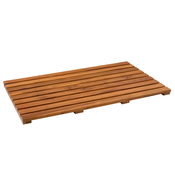
OP
OP
A really good idea, because you can deal with all the waterproofing issues at the time of initial construction.
What I absolutely don't want to do is spend all of this time and effort to waterproof a piece of not-waterproof plywood, only to then cut a hole directly through all of my efforts.
There should be little to no splashing with the Nova for the reasons that @koraks mentioned. You might get a little bit of dripping around the final slot as you slide the print along the top edge of the slot to remove excess chems before placing the print in a water bath, but nothing should actually splash out of the processor itself.
If there is a way to accidentally splash chemicals everywhere, I'll find it: you see, the Klutz is strong with this one...
My wet sink is made from form ply and is painted with pond paint, I just repaint once a year or so and works fine. I use slatted timed matts between the tray and sink leveled up to be flat to the sinks 1/60 fall.
I didn't even know that pond paint was a thing until just now. Finish-wise, I'd really like to use something like an epoxy garage floor coating, but it only seems to come in $200 containers that would be sufficient to coat ten sinks, and it's also for concrete...and plywood is almost entirely - but not quite - unlike concrete. Still, the genuine imitation faux-stone patterns would look pretty cool on a dry sink, and that little bit of texture and color would do a lot to cover up my inevitable mistakes and mis-cuts.
On that note: I did get started on some basic layout last night, and right from the start I was reminded that there's no such thing as a dependably-straight factory edge on sheet goods.
Pictured: This is why we can't build nice things.
It's hard to see, but that pencil line is about 1/16" from the edge, and that's important because it's a straight line that was pulled from corner to corner along one factory-crosscut end of the plywood. Translation: that factory edge has a bow in it, so it had to be re-trimmed in order to establish a straight edge that was squared to one of the other factory edges, so I'd at least have a reference corner to start from. Thankfully the ripped sides - the long edges of the sheet - were both straight and parallel, so I just took a half-inch from one end...
Pictured: ... would've been easier with a legit panel blade...
...and then checked the square on everything so I could trim the panel to length on the other end. I used a 48" by 58" right triangle with a hypotenuse of somewhere around 75.29", and I got pretty close.
Pictured: Missed it by *that* much.
It's out by 1/64"; that's acceptable for a skilsaw and a straightedge but I'd whine about it if I was cutting on a table saw and I'd be actively furious if this piece was cut by a panel router.
The surface veneers did okay with the cuts, but by the end of the second crosscut there was some splintering on the top veneer. I ran a masking tape line on the bottom of the panel to preserve that side of the cut - often, that side splinters worse than the upper side, contrary to all logic - and it did fine, but the blade that I was using just wasn't up to the task. I'll fix that problem in a few minutes by finding one locally or (more likely) ordering one online; it's a small saw, so I'm limited to 5-1/2" blades...and I'll need a good one because this is, in fact, imported plywood.
Pictured: Totes called it.
There's nothing inherently wrong with plywood from Southeast Asia, but it often shows up with thin veneers and variable thickness across the sheet; the former is pretty easy to see, but the latter can be only found with a micrometer unless it's really bad (this one varied from .695" to .707", which isn't too bad). I don't particularly care about the thickness variance, but I'll have to be careful with the surface veneer.
Anyways: after I got the first corner squared I checked the other side that had been cut on the panel saw at the lumberyard. I had them rough-cut the sheet at 59" in order to get this piece in the back of the car, and I made sure to leave myself room to trim it down to final dimensions. I'm really glad that I did that second part, because after trimming the first factory edge by about a half-inch I was left with a tiny bit less than that on the other side...and also quite a bit less, somehow
Pictured: 7/16-ish"...
Pictured: ...and, uhh...what?
...and - again - this is why we can't have nice things.
So, okay: that's a lot of posting about drawing two lines on a sheet of plywood, and then eventually (almost) making two cuts, but I'm mentioning all of this because it's how I see so many people get into trouble when they start working with plywood. Simply put: people assume the sheet is square...but it probably isn't because it's not the job of the factory to provide an accurately-sized product. For the most part, factories simply meet minimum standards; here, the result is plywood that can vary by a significant degree in both length, width and thickness, but as long as the manufacturing standards are achieved and the finished sheet meets minimum sizing, it's considered acceptable. So, here's the takeaway: before you do anything else, square up your panel stock.
Also, here's a second small bit of advice that I had to learn the hard way: when you make a cut list, sanity-check it at least twice. If that method is good enough for Santa, it's good enough for us as well; it saves him from accidentally reinforcing and rewarding the poor behavior of undeserving urchins, and it'll save you both time and material, both of which are objectively more valuable than children. When it comes to plywood, I like to draw out a quick diagram and make a plan for how I'm going to arrange and cut the parts, and then storyboard all of it onto the actual sheet on a piece of tape. It's extra work, but in this case it actually helped me rearrange the parts into an order that's going to waste very little, and help reduce the overall number of cuts.
Pictured: And it only took me about five revisions to get it correct.
So, that's where I stopped last night: I should be able to get eight out of ten-ish pieces cut from this single sheet, and the other two or three will come from the offcut end...but before I do any of that, I have to go saw blade shopping. Hopefully that'll be successful, because it'll help lift my mood after discovering a rather disconcerting thing about ODB Enlarger:
Pictured: ... that's not a good sign...
Found it, yet? If not, don't fret: took me a bit to notice it as well. Here's a hint: take a closer look at the side of the motor housing, right across the center of the image.

I guess I need to start that thread at some point, in case anyone cares to see what happens when you chop one of these things apart.
OP
OP
No blades were locally available for my tiny little saw, so I ordered one that was on next-day delivery; 36T crosscut/panel/whatever blade from Milwaukee. I don't usually get blades from them, so we'll see how this one performs; if it's terrible, at least everything is getting covered up.
Also, there's fiberglass resin on the way: after a lot of research and at least one sleepless night, I went with a general-purpose epoxy from Total Boat, with a medium-speed catalyst. That should be a one-and-done purchase for me, even though I only got a quart of it; I'll get some silica on the way as well, and that'll let the epoxy do triple duty as an adhesive, a filleting compound and a sealer/primer.
That said, I may not use the epoxy as the wood adhesive. I don't really need it in that application, so it may make more sense to just leave that job to some Titebond. I'll be screwing the various pieces together, regardless, so that'll give me all of the clamping pressure I need to make Titebond work very well...so that means I probably need to pick up a small pack of screws, along with some threaded inserts for affixing thetray sink to the base.
Also, there's fiberglass resin on the way: after a lot of research and at least one sleepless night, I went with a general-purpose epoxy from Total Boat, with a medium-speed catalyst. That should be a one-and-done purchase for me, even though I only got a quart of it; I'll get some silica on the way as well, and that'll let the epoxy do triple duty as an adhesive, a filleting compound and a sealer/primer.
That said, I may not use the epoxy as the wood adhesive. I don't really need it in that application, so it may make more sense to just leave that job to some Titebond. I'll be screwing the various pieces together, regardless, so that'll give me all of the clamping pressure I need to make Titebond work very well...so that means I probably need to pick up a small pack of screws, along with some threaded inserts for affixing the
So soot is normal, right?  I bought one of these blue beasts in 1973. Sold it to a friend who still uses on occasion. The resistrol is a marketing joke, discard it. Usually the elevator motors work well when everything is in square. These are the most common 4x5 enlarger in the USA, I have 4, 2 setup, newer.
That is wired differently than the current ones. Front plug marked switch is where you used a toggle switch to turn the lamp on, it's not an outlet. Could be someone got wires crossed. Lamp housing can go directly to a timer, let the power to the motor be plugged in to the wall.
I bought one of these blue beasts in 1973. Sold it to a friend who still uses on occasion. The resistrol is a marketing joke, discard it. Usually the elevator motors work well when everything is in square. These are the most common 4x5 enlarger in the USA, I have 4, 2 setup, newer.That is wired differently than the current ones. Front plug marked switch is where you used a toggle switch to turn the lamp on, it's not an outlet. Could be someone got wires crossed. Lamp housing can go directly to a timer, let the power to the motor be plugged in to the wall.
OP
OP
So soot is normal, right?
Totally, yes. Soot lubricates motors, which is why they seize up when you let the magic smoke out: there's no more soot inside. That's a scientific fact.
I bought one of these blue beasts in 1973. Sold it to a friend who still uses on occasion. The resistrol is a marketing joke, discard it. Usually the elevator motors work well when everything is in square. These are the most common 4x5 enlarger in the USA, I have 4, 2 setup, newer.
I actually have a mostly-restored one in storage; it's a good chassis, from what I can tell. But yeah, that "Resistrol" is kind of useless-flavored.
That is wired differently than the current ones. Front plug marked switch is where you used a toggle switch to turn the lamp on, it's not an outlet. Could be someone got wires crossed. Lamp housing can go directly to a timer, let the power to the motor be plugged in to the wall.
It's definitely wired differently than the one I rebuilt before...but I also know that someone's been inside the motor housing: that's what I was hinting-at in my previous post. You can see where they put the cover back onto the motor and got it halfway out of alignment: the upper half of the back cover is outside of the front cover, but the lower half of it is inside the front cover. There's more evidence, too; missing screws, mangled nuts, lightly-bent sheetmetal, etc. Someone wasn't nice to it: even the lower frame is bent on the right side.
Part of me wants to restore it, and part of me doesn't really want to bother; right now, I have two 23's that I can use...and I'm strongly tempted to see what it's going to take to fit a few of these 45 bits onto one or the other of the 23's.
On another note: we're debating whether or not we really want to make the sink into a possibly-wet sink. Both of us keep saying "wouldn't it be better to just park a laundry tub next to this?" and we really don't have too many objections to that plan. So, that's still being decided.

OP
OP
Pictured: The New Hotness

Pictured: Oh yes...oh very yes.

That's better cut quality, for sure...and as such, I went ahead and ripped a few parts to final size. That went pretty well, except I noticed that my cuts were wandering a bit; it turns out that the straightedge I'm using is actually somewhat flexible - up to 1/16", right in the middle - so I'm gonna have a bit of cleanup and filling to do after final assembly. Thankfully I'm using epoxy that I can thicken with silica, so making a faring compound is actually pretty simple; thus, I should be able to fix the variance without too much hassle. Still, this would've all be avoidable with a better straightedge or a track saw.
Pictured: This'll have to do for now, though.

That center brace clamped against the joint took care of most of the flex in the straightedge, but now that I've got a couple of straight parts cut, I can actually use them as a more rigid cut guide. So, we'll see what happens when I get back on it tomorrow; evening and rain got me, tonight.
Also, I originally set my side height at 4-1/2", but I decided to cut that down to 4-1/4; that gave me better material usage on the sheet, and when all is said and done it should create a little bit of wrist relief as well. I may actually trim things a bit further, down to 4" total; that will give me a 2-1/2" interior tray depth, which is enough to confine a lot of liquid without being too tall, overall.
More tomorrow.
Pictured: Oh yes...oh very yes.
That's better cut quality, for sure...and as such, I went ahead and ripped a few parts to final size. That went pretty well, except I noticed that my cuts were wandering a bit; it turns out that the straightedge I'm using is actually somewhat flexible - up to 1/16", right in the middle - so I'm gonna have a bit of cleanup and filling to do after final assembly. Thankfully I'm using epoxy that I can thicken with silica, so making a faring compound is actually pretty simple; thus, I should be able to fix the variance without too much hassle. Still, this would've all be avoidable with a better straightedge or a track saw.
Pictured: This'll have to do for now, though.
That center brace clamped against the joint took care of most of the flex in the straightedge, but now that I've got a couple of straight parts cut, I can actually use them as a more rigid cut guide. So, we'll see what happens when I get back on it tomorrow; evening and rain got me, tonight.
Also, I originally set my side height at 4-1/2", but I decided to cut that down to 4-1/4; that gave me better material usage on the sheet, and when all is said and done it should create a little bit of wrist relief as well. I may actually trim things a bit further, down to 4" total; that will give me a 2-1/2" interior tray depth, which is enough to confine a lot of liquid without being too tall, overall.
More tomorrow.
Oh yes...oh very yes.
You're putting my DIY skills to shame. I'm sitting in a corner right now, looking and feeling mightily embarrassed.
All this makes me a little cautious about your earlier self-critical comments. I have a feeling this dry-sink (or whatsitsname) is going to turn out a very tidy job indeed.
Pictured: The New Hotness
View attachment 387005
Pictured: Oh yes...oh very yes.
View attachment 387006
That's better cut quality, for sure...and as such, I went ahead and ripped a few parts to final size. That went pretty well, except I noticed that my cuts were wandering a bit; it turns out that the straightedge I'm using is actually somewhat flexible - up to 1/16", right in the middle - so I'm gonna have a bit of cleanup and filling to do after final assembly. Thankfully I'm using epoxy that I can thicken with silica, so making a faring compound is actually pretty simple; thus, I should be able to fix the variance without too much hassle. Still, this would've all be avoidable with a better straightedge or a track saw.
Pictured: This'll have to do for now, though.
View attachment 387007
That center brace clamped against the joint took care of most of the flex in the straightedge, but now that I've got a couple of straight parts cut, I can actually use them as a more rigid cut guide. So, we'll see what happens when I get back on it tomorrow; evening and rain got me, tonight.
Also, I originally set my side height at 4-1/2", but I decided to cut that down to 4-1/4; that gave me better material usage on the sheet, and when all is said and done it should create a little bit of wrist relief as well. I may actually trim things a bit further, down to 4" total; that will give me a 2-1/2" interior tray depth, which is enough to confine a lot of liquid without being too tall, overall.
More tomorrow.
That's a mean-looking saw blade and a beautifully-cut edge!
OP
OP
You're putting my DIY skills to shame. I'm sitting in a corner right now, looking and feeling mightily embarrassed.
Thank you, but there's no reason for embarrassment over anything... unless it's me being embarrassed over not realizing how much that cutting guide was flexing until it was too late. I should've thought about that; they're notorious for it, at those center joints. Thankfully I had already been seriously thinking about trimming the skirts to 4-1/4" and leaving myself a cozy 2-3/4" interior height; that gave me room to shave the bad edge and get the slight inconsistency out of it. Either way, doing something yourself - no matter how good or bad you are at it - is a reason to be proud.
All this makes me a little cautious about your earlier self-critical comments. I have a feeling this dry-sink (or whatsitsname) is going to turn out a very tidy job indeed.
I hope it will; I try to give most things my best efforts, even if I don't have most of the "proper" tooling to do it with. But hey, at least it's proof that you can actually do this kind of stuff without dedicating a small bathroom's worth of garage footage to a cabinet saw and dust collector. That being said: I'm always self-critical, even when it isn't being done in jest. You should see me on a bad day in the darkroom: I look at literally everything I've done and I'm like "It's all trash"...and that's how I know it's time to go do something else.

That's a mean-looking saw blade and a beautifully-cut edge!
I'm happy with that edge, for sure... especially so, for having been cut by a $14 saw blade. I will definitely be buying a few more of these blades while they're on sale. I absolutely love the form-factor and compactness of the 5-3/8" saws, but they still have a very limited selection of blades; it's about 5% of what you can find for a 7-1/4" saw...so when you find one that works, you buy a few more. Hopefully the carbide on this one holds up; 1/16" thin-kerf blades are great, but there isn't a lot of real estate for that joint. Still, for $14 I'd almost think of it as a disposable blade...so I'll take what I can get.
All this being said, I do have an opinion question: what color should I paint this thing?
My original thought was to just use some black bedliner that I have sitting around in the chemical cabinet, taking up space and generally doing nothing productive with its life; I wanted to do that because if there's one thing that annoys me, it's material that sits around forever, unused. It'll also keep my cost down, and if I roll it on correctly it'll have a nice texture and cover up literally all of my screw -ups. But, I'm open to other ideas, even if I'm currently favoring this one.
I guess it's worth mentioning that I don't see anything wrong with black: it's a bit dark, but it'll be a neutral, uniform background for the prints while they're in the chemicals. I figured that white would just show stains, and gray could be okay... but either of those options just adds cost for no real gain. At least, not one that I can think of.

I was going to chime in earlier, but I thought between your knowledge and the other linked threads, I figured there was enough information to be had.
I too lament the loss of true Baltic Birch or "Russian" Birch if we go back in time 20 years. I love the stuff, I've built 4 night stands, an entertainment console and a bookshelf out of it over the years. 18mm (3/4") 13 ply, voids filled, "exterior" glue.
Tear out along the cut is hard to mitigate, but you've found the most common solution for that (a nice fresh saw blade)
At any rate, it looks like you're well on your way.
I too lament the loss of true Baltic Birch or "Russian" Birch if we go back in time 20 years. I love the stuff, I've built 4 night stands, an entertainment console and a bookshelf out of it over the years. 18mm (3/4") 13 ply, voids filled, "exterior" glue.
Tear out along the cut is hard to mitigate, but you've found the most common solution for that (a nice fresh saw blade)
At any rate, it looks like you're well on your way.
Sorry, one more quick thing
this is one of the other common products to get the Baltic Birch look, and it's made in Oregon.
this is one of the other common products to get the Baltic Birch look, and it's made in Oregon.
ApplePly Hardwood Plywood
Need hardwood panels cut to size for your hobby woodworking projects? ApplePly hardwood boards can be used in furniture, cabinetry, fixtures & more!
www.buyappleply.com

...
All this being said, I do have an opinion question: what color should I paint this thing?
...
I guess it's worth mentioning that I don't see anything wrong with black: it's a bit dark, but it'll be a neutral, uniform background for the prints while they're in the chemicals. I figured that white would just show stains, and gray could be okay... but either of those options just adds cost for no real gain. At least, not one that I can think of.
I would try to limit the black to around an enlarger. Otherwise, if one is working under safelights, it is nice to have that nice safe light bounce around a little to help find things on the bottom of sinks, countertops, etc. And judging from cars -- black seems to be as hard to keep looking clean as white. My dirty silver van does a pretty good job of looking decent...and SS sinks can be kept looking good for years. So perhaps about a Zone VII or so gray glossy paint might do the trick.
But if you go with what you have -- always a nice idea -- just use tools and trays that are light in color!
OP
OP
I was going to chime in earlier, but I thought between your knowledge and the other linked threads, I figured there was enough information to be had.
I know a tiny little bit about a very few things, and that's probably the most honest way I could ever state it.
I too lament the loss of true Baltic Birch or "Russian" Birch if we go back in time 20 years. I love the stuff, I've built 4 night stands, an entertainment console and a bookshelf out of it over the years. 18mm (3/4") 13 ply, voids filled, "exterior" glue.
Commercially, Baltic started seriously declining in availability about ten years ago; it was rare on the consumer market long before, as you indicated. Covid didn't help the situation; the supply became unstable and the supply chain became a complete guessing game at best...and then the Ukraine War started, and that was the end of it. By the end of the the first week, the supply had been preemptively declared nonexistent. That void was then filled by China and Southeast Asia, with middling quality at best. That quality has improved over time, but it's still far short of what we used to get from the good factories in Russia and the Baltic region.
Tear out along the cut is hard to mitigate, but you've found the most common solution for that (a nice fresh saw blade)
Scoring blade, FTW...but for anything that's not a panel saw the size and general shape of Oklahoma, that isn't an option. This did pretty well, though; again, it's really good for $14.
this is one of the other common products to get the Baltic Birch look, and it's made in Oregon.
ApplePly Hardwood Plywood
Need hardwood panels cut to size for your hobby woodworking projects? ApplePly hardwood boards can be used in furniture, cabinetry, fixtures & more!www.buyappleply.com
Looks like a good product; thanks for that link. If I need actual appearance at any point I'll definitely consider it...and I'm right up the road in Olympia, so it's probably available around here, somewhere.
OP
OP
I would try to limit the black to around an enlarger. Otherwise, if one is working under safelights, it is nice to have that nice safe light bounce around a little to help find things on the bottom of sinks, countertops, etc. And judging from cars -- black seems to be as hard to keep looking clean as white. My dirty silver van does a pretty good job of looking decent...and SS sinks can be kept looking good for years. So perhaps about a Zone VII or so gray glossy paint might do the trick.
In my old darkroom, I had the wall behind the enlarger painted flat black, and the cabinet underneath was black as well. The countertop was actually white, but I didn't have many problems with it...and that actually helped me find things easily, as you said.
But if you go with what you have -- always a nice idea -- just use tools and trays that are light in color!
Solid point, there; I could always put lighter-colored handles on things. Good idea!
I went with a very light blue (marine topside paint) for my sink, and I’ve been happy with it. I’m glad I went with a light color—but choose whatever pleases you!
OP
OP
I went with a very light blue (marine topside paint) for my sink, and I’ve been happy with it. I’m glad I went with a light color—but choose whatever pleases you!
Now what I ought to do is accent a black sink with Old School Beseler Blue pinstriping, or do some blue/grey/white TRD-style stripes across one corner of the front skirt; that would be both awesome and completely pointless, and therefore superior.
Speaking of front skirts: I decided to resize them. I made a quick mock-up of everything at-height and I decided that losing a quarter-inch from the current skirt-height was, in fact, worth the hour that it took to set up and trim them down...which is just proof that things take a lot longer when you don't have a big, stationary table saw with 60" of outfeed table. Or, failing that, a track saw.
Pictured: So I guess we'll just approximate one. Or both. Whatever.
Out of all the things that my dad taught me, these three consistently stand out:
- Buy the best you can afford.
- If you don't have what you need: improvise.
- You can never have too many clamps.
Yes, I actually measured it.
With a feeler gauge.
Pictured: Because I'm *that guy* today.
In all seriousness, I'm not really showing off those cuts as a way to aggrandize myself. Rather, I'm making a point: you can do accurate and good work at home with a $100 skilsaw if you know what you're doing...and I actually don't know what I'm doing, so imagine what a legit craftsman could accomplish? Sure, a $20K Casolin with a sliding bed and the afore-aforementioned scoring blade would've done this in about ten seconds, but I would've had to mortgage all of my non-existent children in order to afford it...so, this works just as well. And because we can never have too many clamps, we had enough left over to hold the bracing strips that were the last bits that I cut today.
Pictured: Best $6 I've ever spent.
I guess those clamps are breaking the "buy the best you can afford" rule because they were exactly $3 each at Hobo Freight, but if I designate them as the always-necessary beater clamps - you know, the ones that you use when you're ready, willing and excited about breaking stuff - then they're perfectly acceptable. Normally I'd just get someone to hold the offcut, but the only other two people in the house were doing work and/or school stuff, my dog doesn't know how to hold things steady, and my rabbit would have eaten the plywood and then demanded treats...so, yeah: you can never have too many clamps. Or rabbit treats.
So, I have both the front and rear skirts are cut, as well as all of the stock for the subfloor bracing-
...oh, yeah: there's a subfloor/bracing structure under the floor. Forgot to mention that. Moving on...
...so my last project for today was laying out the floor on the remainder of the sheet. Everything I've cut so far has been pretty simple because it didn't really have to be that square: for the skirts, simple parallelism is much more important than perfect squareness, and the subfloor doesn't really have to be that accurate at all. The floor, however, is a different story: it actually needs to be dead on the money in every direction, or I'm going to have a ton of gaps to fill and things aren't going to fit well. So, I went ahead and ripped it to final width and then began to lay and correct a set of squared lines to designate the length...and then I called it quits for the night because I had a feeling that I was about to screw something up. So, I found something frothy to enjoy...
Pictured: ...seen here...
...and just kind of checked my math and layouts for a bit: they all look okay, but I'm going to give it a night, regardless. I'll pick it back up tomorrow and try to generate something that's more rectangular than rhomboid or trapezoidal; in the meantime, it's back to thinking on this 45, and what I might be able to do with its various parts and pieces. I've been meaning to do an LED head for one of my 23's for a long time, but I'm kinda tempted to shift that goalpost a bit and create a lightweight 4x5 head to graft onto the other 23 chassis... because why would I do anything the easy way?
Ugh... I really do have issues. Stay tuned.
| Photrio.com contains affiliate links to products. We may receive a commission for purchases made through these links. To read our full affiliate disclosure statement please click Here. |
PHOTRIO PARTNERS EQUALLY FUNDING OUR COMMUNITY:  |