
Ben Altman
Allowing Ads
Two coat-expose-process cycles will definitely give better results (in terms of dmax) than a single cycle by double coating, because printing out (which is present even in develop out pt/pd) will decrease the efficiency (in providing good dmax) of the double coat (kind of diminishing returns situation...), I mean it may (will) still be better than single coating but not as good as printing the same negative twice, in registration...
Regards,
Loris.
P.S. Also, double coating increase the emulsion contrast (shortens the ES), often affecting the ultra-smooth tonal transitions (especially in the highlights) we're after, when doing pt/pd...
P.S.2. I think Dave will have to use two separate negatives for the exposures, since tonal relations will change considerably (e.g. too dark midtones and such...) if he uses the same negative on every cycle...
That's a pretty solid increase, Dave. What's in your sensitizer?
I'd suggest doing a control test in which you double coat before exposure and expose once for the total time of your separate-double-coat-and-expose printing. That way you'll get a feel for how much is gained from the double work and registration hassle
Keep up the good work!
Ben
Hi Loris, I'm sure you are right that the results are better but, due to my now-distant science background, my question is: how much better? If, say, log 0.14 of Dave's log 0.17 increase in d-Max is obtainable by double coating and extra exposure, it would not be worth the registration hassle. If the numbers are the other way around it might well be.
With digital negatives, couldn't one "simply"profile the whole process to one negative?
Best, Ben
Hi Ben
The registration should not be a problem if one bonds the paper to the aluminium correctly as the paper is not moving/sizing at all. If i read correctly Sandy said earlier in the thread that it should be possible to achieve a similar effect with a good digital negative.
For me really the end goal is not layering platinum on platinum rather an interesting experiment along the way at the moment, gum layers and layering other alt processes is more meaningful to me in the future, however I will keep testing this method to see where it takes me.
Dave,
Since you have the paper fixed to aluminum to ensure dimensional stability of the paper but I'm curious how you keep the negative registration correct from printing to printing or did I miss that part?
Thanks,
Don Bryant
Hi Don
Just by using simple pins and marking the edges of the negative in pencil at the moment, for larger prints i will punch holes in the aluminum and use registration pins, you can see Penn used this method as the prints are still attached to the aluminum. The good thing about the fusion 4000 bond is its reversable, although i may just keep them attached.
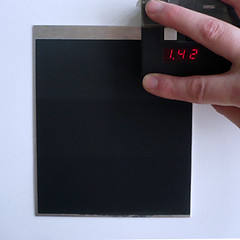
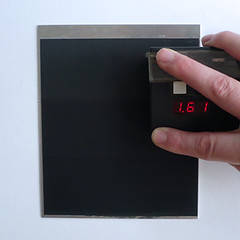
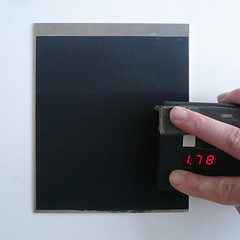
Here are the results from my tests of multilayering platinum prints. The dmax on the single coated print is 1.41 and the second is 1.58,mimicking the initial test results reported previously.
Hi Dave,
Whilst it appears you have achieved your goal of increased DMAX you have the added side effect of changing the overall contrast of the print. Although most iron based processes are self masking there are limits of that effect that we can depend on. Seems to me that at some point you will need to use contrast masks to control your print contrast range.
Don Bryant
I think your right Don, to gain control over the second layer, contrast masks could possibly be the way to go. Either that or i create a number of serperation negatives the way Penn did to achieve a really rich final print. Although as we have already discussed on this thread is this really necassary when we have all the control that one digital negative should give. I need to put some more time in to see what benefits are to be had. I have yet to try coating the first layer with Platinum and the second with Palladium to asses the effects. I remember reading that Penn also mixed in Iridium, anyone tried this?
At the moment i am more interested in trying other alternative processes over the platinum such as gum and cyanotype before i embark on further research into multilayered platinum prints and will post the results when i get a chance.
Try with the attached file, for instance...
It's not optimized for least possible ink consumption, just a crude separation - but tones are close enough to the original. In any case, you've got the idea, just fiddle with this or devise your own from scratch.
Hope this helps,
Loris.
How to use: Change the file to grayscale mode, then to duotone mode and load this tritone profile. Then change to multichannel mode and split channels. Treat each file as a single grayscale image and print a negative for each - by using the curve and other settings you had devised before for single-layer prints...
Dave, is this your photograph? Beautiful...!
Looks nice Dave. Do you get a substantial increase in the max. density? (And more punch?) And, how did you prepare the mask? (What understand from the images is that you practically re-exposed the negative excluding the upper right corner and the right edge - is that correct?)
Regards,
Loris.
We use cookies and similar technologies for the following purposes:
Do you accept cookies and these technologies?
We use cookies and similar technologies for the following purposes:
Do you accept cookies and these technologies?