

• Welcome to Photrio!
    Registration is fast and free. Join today to unlock search, see fewer ads, and access all forum features.
    Click here to sign up

Leading the eye through focus - Critique sought

Recent Classifieds

Forum statistics

Threads
204,296
Messages
2,866,821
Members
102,214
Latest member
AvGordon
Recent bookmarks
0
Joined
Mar 1, 2026
Messages
74
Location
London
Format
Multi Format
Hello,

I know that putting together macro, flowers, and B/W is usually a perfect way of asking for trouble :D The picture I am seeking critique about is below:
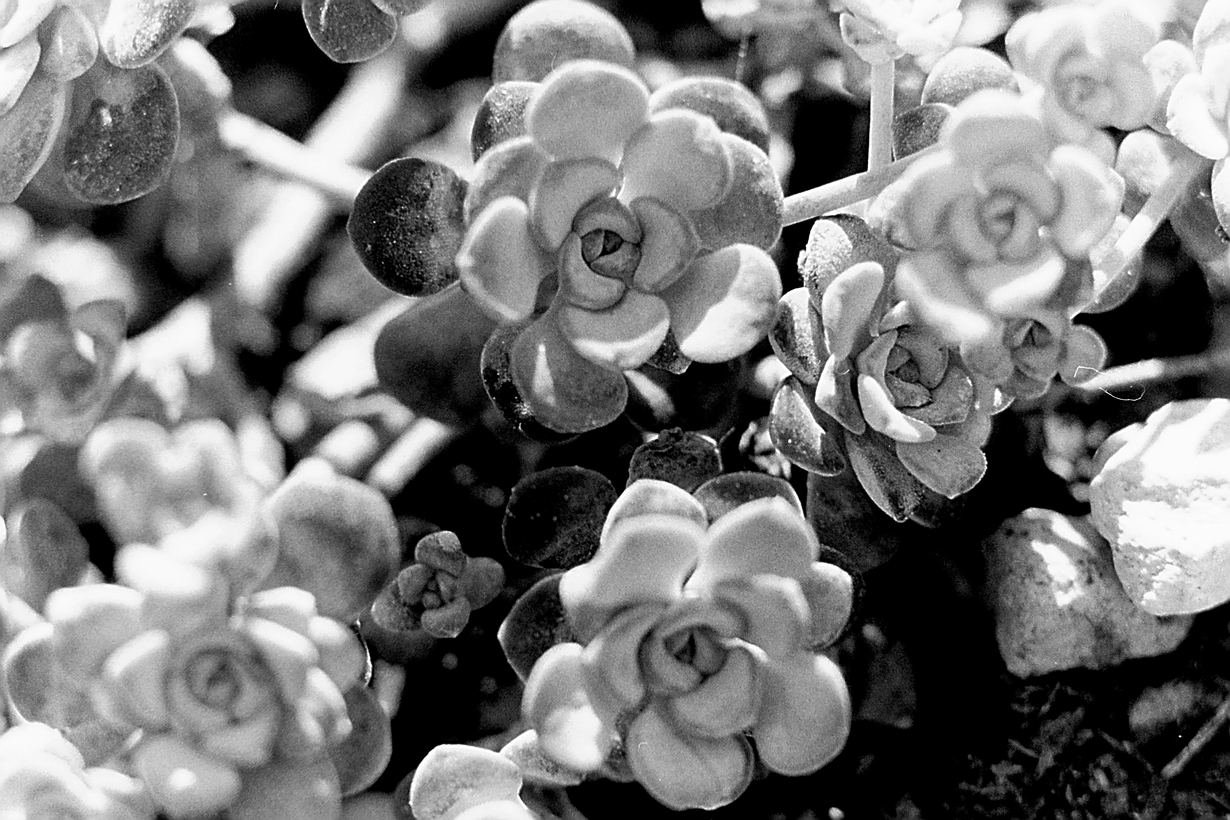

This is a 1:1 macro of a minuscule succulent in my garden (technical data in the Gallery entry). I had shot the same plant several months ago (at that point I was using a digital camera), keeping most of the flowers in sharp focus, but the resulting image looked quite flat and uninteresting. So I decided to experiment with leading the eye of the viewer through selective DOF. The obvious trick here is that the only flower in sharp focus is the medium-sized one on the right-hand side of the shot, while none of the other ones are perfectly focused. The effect on me is that the eye wanders a bit around the frame, starting from the centre, where the big flower not-in-sharp-focus is located, then it notices all the remaining out-of-focus stuff, and keeps looking until it finds the "shy" flower that is in focus. At that point, the eye comes back to each of the other flowers, recognising that their shape is an extremely close reproduction of the shy, in-focus one. To my eye, the picture becomes a dynamic pattern only by finding those implied similarities, and at that point I am content to note that the same exact form is also discernible in the smaller flowers on the left-hand side of the picture, although they are very blurred and rendered almost at the same bouquet-like level of the background.

I wonder whether the picture stimulates any similar dynamics in other viewers. I am interested in whether the pattern constuction mechanism based on the comparison with the only in-focus element is elicited in other viewers as well. I am fine with hearing also some blunt "look mate, honestly, this stuff just sucks!", as I understand that the whole reasoning behind the composition might not have been conveyed clearly by the choices made in constructing the shot. I am sure some good lessons will come out of this experiment :smile: Worst of all, it would be another "meh" one to add to that big pile I got already :wink:

Thanks in advance for your comments.

OneEyedPainter
 
I only noticed the single sharp rosette after reading the text, sorry. I don't think the technique works very well for me in this image. It's a little too subtle, I think. What doesn't help is the high values of the out-of-focus areas around the edges which draw a lot of attention. Sharp focus can draw the eye in, but light vs. dark is a much more powerful 'signal' and in this case it drowns out the more subtle effect of sharp vs. unsharp. The more so because the difference between sharp & unsharp is still fairly limited here; the unsharp areas still retain plenty of form, so they're still instantly recognizable for the visual cortex. Also, in terms of composition, I feel there's a decent amount of confusion that further muddies the water. There's the rather visually jarring cross-shaped form of the very bright bars in the top left quadrant, as well as a high-contrast section in the bottom right that has no discernible logical form, but still draws a lot of attention due to its high contrast. I also admit I find it a little difficult to look past the prominent patches of burnt-out highlights. Finally, if that one sharp rosette is somehow more important to the others, I can't really think of a good reason why. It's one just like the others, not particularly different or more interesting than all the others, expect from the apparently somewhat random choice of the photographer to render this one more sharply than the others.

Overall there's a lot going on here and in my view it just doesn't want to line up. The overall impression I'm left with is one of randomness.
 
I don't automatically see the single sharp element - I see that one flower is almost entirely sharp, the one next to it has the middle sharp, and a couple of petals or leaves in the upper left are sharp. I see the depth of focus, and it looks more like a mistake than something to "lead the eye" - particularly because of the prominent bright very out of focus one to the right of the sharp one. But with such things, you may be better off asking the opinion of people who are not hung up on the technical aspects of using a camera.

I'd try reducing the contrast a bit and see how that looks.
 
I only noticed the single sharp rosette after reading the text, sorry. I don't think the technique works very well for me in this image. It's a little too subtle, I think. What doesn't help is the high values of the out-of-focus areas around the edges which draw a lot of attention. Sharp focus can draw the eye in, but light vs. dark is a much more powerful 'signal' and in this case it drowns out the more subtle effect of sharp vs. unsharp. The more so because the difference between sharp & unsharp is still fairly limited here; the unsharp areas still retain plenty of form, so they're still instantly recognizable for the visual cortex. Also, in terms of composition, I feel there's a decent amount of confusion that further muddies the water. There's the rather visually jarring cross-shaped form of the very bright bars in the top left quadrant, as well as a high-contrast section in the bottom right that has no discernible logical form, but still draws a lot of attention due to its high contrast. I also admit I find it a little difficult to look past the prominent patches of burnt-out highlights. Finally, if that one sharp rosette is somehow more important to the others, I can't really think of a good reason why. It's one just like the others, not particularly different or more interesting than all the others, expect from the apparently somewhat random choice of the photographer to render this one more sharply than the others.

Overall there's a lot going on here and in my view it just doesn't want to line up. The overall impression I'm left with is one of randomness.

Hello @koraks thanks for your comments. I have gone through your feedback, and I will take it on board. I gather that the thinking behind that composition was probably a bit far-fetched :smile: The subject is still in my garden, so I will probably have another go at it at some point.

Regards
 
I don't automatically see the single sharp element - I see that one flower is almost entirely sharp, the one next to it has the middle sharp, and a couple of petals or leaves in the upper left are sharp. I see the depth of focus, and it looks more like a mistake than something to "lead the eye" - particularly because of the prominent bright very out of focus one to the right of the sharp one. But with such things, you may be better off asking the opinion of people who are not hung up on the technical aspects of using a camera.

I'd try reducing the contrast a bit and see how that looks.

Thanks @Don_ih much appreciated. I don't think that reducing the contrast would do any good here, as the point was to use DOF and apparently it did not work well. Tough luck! :D I will have another go at it sooned or later, taking your feedback on board.

Regards

OneEyedPainter
 
Hello,

I know that putting together macro, flowers, and B/W is usually a perfect way of asking for trouble :D The picture I am seeking critique about is below:


This is a 1:1 macro of a minuscule succulent in my garden (technical data in the Gallery entry). I had shot the same plant several months ago (at that point I was using a digital camera), keeping most of the flowers in sharp focus, but the resulting image looked quite flat and uninteresting. So I decided to experiment with leading the eye of the viewer through selective DOF. The obvious trick here is that the only flower in sharp focus is the medium-sized one on the right-hand side of the shot, while none of the other ones are perfectly focused. The effect on me is that the eye wanders a bit around the frame, starting from the centre, where the big flower not-in-sharp-focus is located, then it notices all the remaining out-of-focus stuff, and keeps looking until it finds the "shy" flower that is in focus. At that point, the eye comes back to each of the other flowers, recognising that their shape is an extremely close reproduction of the shy, in-focus one. To my eye, the picture becomes a dynamic pattern only by finding those implied similarities, and at that point I am content to note that the same exact form is also discernible in the smaller flowers on the left-hand side of the picture, although they are very blurred and rendered almost at the same bouquet-like level of the background.

I wonder whether the picture stimulates any similar dynamics in other viewers. I am interested in whether the pattern constuction mechanism based on the comparison with the only in-focus element is elicited in other viewers as well. I am fine with hearing also some blunt "look mate, honestly, this stuff just sucks!", as I understand that the whole reasoning behind the composition might not have been conveyed clearly by the choices made in constructing the shot. I am sure some good lessons will come out of this experiment :smile: Worst of all, it would be another "meh" one to add to that big pile I got already :wink:

Thanks in advance for your comments.

OneEyedPainter

I think this is a brilliant idea to look at composition with a lot of potential, and it deserves more experimentation. No meh from me, but a big fat Wow!
 
the point was to use DOF and apparently it did not work well.

I think it can work. I think the near out-of-focus elements maybe make it not work in this instance.

I tried to eliminate them in the following by rotating and cropping. I also adjusted contrast and levels. Just to illustrate

1778758373847.png


I think that makes the points of focus look more on purpose? Forgive my messing with your photo.
 
I think this is a brilliant idea to look at composition with a lot of potential, and it deserves more experimentation. No meh from me, but a big fat Wow!

Thanks for the encouragement @RalphLambrecht I realise that there is more work to do here, and I am determined to give it another shot (pun intended! :D). We have rain with forecast of rain for the next 10 days over here, mostly uninterrupted, so will need to be double lucky and get 30 minutes of sunshine and some proper light for another attempt.

Regards

OneEyedPainter
 
I think it can work. I think the near out-of-focus elements maybe make it not work in this instance.

I tried to eliminate them in the following by rotating and cropping. I also adjusted contrast and levels. Just to illustrate

View attachment 424614

I think that makes the points of focus look more on purpose? Forgive my messing with your photo.

Thanks a lot @Don_ih I see what you meant here, and I think it makes sense. I agree that the large blown highlights on the right and some of the out-of-focus flowers are distracting, so cropping in removes that problem in part. But I wanted to include many more flowers to give the pattern a chance to form, so perhaps a new shot and a more thoughtful composition is the only way to go here :smile:

No worries at all about messing up with my picture: the whole point of seeking critique is to get your own work shredded to bits by other photographers (either through words or through actual manipulations), hoping that somehting meaningful remains of your original idea. I guess so far I got some good comments, so the experiment is not a total failure for me.

Regards

OneEyedPainter
 
Your focusing concept is solid, but in the example you provided, for me the effect of the focus is over-powered by the effects of the lighting. That is, the leading ability of the various amount of focus is overpowered by the leading ability of light. My eyes prioritize light over focus in this image.

For example, Don's cropping eliminates most of the distracting light.
 
Your focusing concept is solid, but in the example you provided, for me the effect of the focus is over-powered by the effects of the lighting. That is, the leading ability of the various amount of focus is overpowered by the leading ability of light. My eyes prioritize light over focus in this image.

For example, Don's cropping eliminates most of the distracting light.

Thanks a lot @Vaughn much appreciated. Your comment is indeed in line with the feedback provided by @koraks and @Don_ih above. I guess here my general (peculiar?) "focus on focus" has obfuscated a more careful consideration of other compositional elements. The comments above point all in the same direction, so this was evidently a blatant mistake on my side :smile: I am happy you folks helped me realising that.

I will definitely give it another try, as I really want to elicit the same "pattern construction" dynamics I mentioned in the OP. Don't know if that is easy with this specific subject, but now I am determined to get to the bottom of it :smile:

Thanks again

Regards

OneEyedPainter
 
I recently gave a workshop in Yosemite -- one of the students (or one of my assistants) tried a shallow focus image (8x10) of a line of dogwoods in bloom. It was a horizontal image, and as my eye scanned across the image, it was drawn to the few blossoms in focus. A very nice effect.
 
Photrio.com contains affiliate links to products. We may receive a commission for purchases made through these links.
To read our full affiliate disclosure statement please click Here.

PHOTRIO PARTNERS EQUALLY FUNDING OUR COMMUNITY:


Ilford ADOX Freestyle Photographic Stearman Press Weldon Color Lab Blue Moon Camera & Machine
Top Bottom
