

What is the best way to take a notes when you mixed a new chemistry and how many times you used it? Like fixer, stop bath. Do you simply check it by the color or smell, or do you guys take these notes, so you know exactly when is it good time for the new solution?
-
Welcome to Photrio!Registration is fast and free. Join today to unlock search, see fewer ads, and access all forum features.Click here to sign up
You are using an out of date browser. It may not display this or other websites correctly.
You should upgrade or use an alternative browser.
You should upgrade or use an alternative browser.
Labeling the use of chemistry
-
A
- Thread starter hiroh
- Start date

Recent Classifieds
-
Want to Buy Workhorse Canon F-1
- Started by BHuij
-
Want to Buy Gossen Multibeam Spot Attachment
- Started by Srahimian24
-
For Sale Canon Strap and Canon battery magazine BGM-E2(unused)
- Started by absalom1951
-
For Sale Beseler Enlarger Lens Boards
- Started by absalom1951
-
For Sale Yashica LM
- Started by absalom1951
Forum statistics
Buzz-01
Member
Still fairly new to the game, about 2 years in on darkroom printing, I put some white electrician's tape on the bottle, write the date of mixing on it and I mark the number in equivalent of 8x10" sheets (eg 2 sheets of 5x7 count as 1 sheet of 8x10) of paper (or number of films in case of film dev) on it. The datasheet of the chemical usually states the yield per liter and this tells me when it's time to make fresh chemicals.
Paper dev I usually use max 2-3 sessions over 2-3 weeks time, or the maximum amount of sheets as stated in the datasheet (whichever comes first). After that I mix it fresh.
Or whenever I want the best possible quality for a print, then I always mix paper dev fresh.
Fix can go a long time AFAIK, so do the same thing (count sheets) and use it up to ~3 to 4 months max. Fiber based sheets count for 2 sheets (read that somewhere in a datasheet, don't exactly know why).
My films are always developed one shot and I use water as stop but fix for films I also re-use for several films according to the datasheet of the fixer.
Paper dev I usually use max 2-3 sessions over 2-3 weeks time, or the maximum amount of sheets as stated in the datasheet (whichever comes first). After that I mix it fresh.
Or whenever I want the best possible quality for a print, then I always mix paper dev fresh.
Fix can go a long time AFAIK, so do the same thing (count sheets) and use it up to ~3 to 4 months max. Fiber based sheets count for 2 sheets (read that somewhere in a datasheet, don't exactly know why).
My films are always developed one shot and I use water as stop but fix for films I also re-use for several films according to the datasheet of the fixer.

- Joined
- Feb 17, 2008
- Messages
- 2,190
- Format
- Multi Format
- Fixer. Clearing time of a piece of neg film. With usual rapid fixers, at 1+4 dilution, clearing time approx 30s, at 1+9, 1min. Discard when clearing time has doubled.
- Stop. Watch the indicator color
- Dev. Piece of white tape on bottle, use marker to add one bar for each use. Or (better IMO) use diluted (like 1+1) and discard.
- All: Two printed labels. First: what is it. Second: date prepared.
- Joined
- Dec 4, 2007
- Messages
- 259
- Format
- 4x5 Format
More or less like Buzz-01, except that i keep the notes an a two tables on my darkroom door, one for paper and one for film.
For film developer i use XTOL in replenishment, which i have used for 4 years now, developer for paper i discard after two or three sessions or after two to three weeks. With stop bath i look at the indicator and when it changes colour it gets discarded. For fix i look at the capacity on the bottle, noting down the amount of sheets and films in 8x10 equivalents. Because i use a double fixing bath for paper i discard when nearing 100% of its capacity, with film i change around 75% of its capacity, just to be sure.
For film developer i use XTOL in replenishment, which i have used for 4 years now, developer for paper i discard after two or three sessions or after two to three weeks. With stop bath i look at the indicator and when it changes colour it gets discarded. For fix i look at the capacity on the bottle, noting down the amount of sheets and films in 8x10 equivalents. Because i use a double fixing bath for paper i discard when nearing 100% of its capacity, with film i change around 75% of its capacity, just to be sure.

Sirius Glass
Subscriber
- Fixer. Clearing time of a piece of neg film. With usual rapid fixers, at 1+4 dilution, clearing time approx 30s, at 1+9, 1min. Discard when clearing time has doubled.
- Stop. Watch the indicator color
- Dev. Piece of white tape on bottle, use marker to add one bar for each use. Or (better IMO) use diluted (like 1+1) and discard.
- All: Two printed labels. First: what is it. Second: date prepared.
That is what I do and the mixing dates and usage are kept in a darkroom log book.

- Joined
- Oct 9, 2010
- Messages
- 7,957
- Format
- 35mm RF
Colour code your solutions. Dev - blue, Stop - yellow, Fix - red. Use dev 1:1 and discard after use. Use indicator stop bath until it starts to turn purple. Use fix and discard dependent on use with film, or through put of prints.
Buy enough Rodinal while it's in stock and you won't have to keep notes or buy it again for many, many years. I ck my stop bath supply by glancing at the big bottle of vinegar on the floor, and do a clip test for the fixer.
Reusing chemicals is something I seldom do unless it's just covering my trays at night and doing another print run in the morning. Developer is always mixed up fresh for film, and fresh water for the stop. Using something like F76 Plus or any liquid/one-shot developer makes it easier. It's just one less thing to go wrong, so I just use fresh stuff every time.
Reusing chemicals is something I seldom do unless it's just covering my trays at night and doing another print run in the morning. Developer is always mixed up fresh for film, and fresh water for the stop. Using something like F76 Plus or any liquid/one-shot developer makes it easier. It's just one less thing to go wrong, so I just use fresh stuff every time.

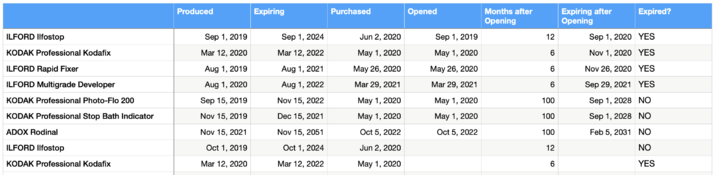
I made this table with the chemistry I currently have. I couldn't find info for Kodak Photo-flo and Indicator Stop Bath, but I read they can be stored for a really long time, so I put 100 months, just for the formula.
Basically, most of my chemistry has already expired, but I don't see it affects my negatives. Do you think I should refresh it with the new one, or am I good with this?
Last two are not opened, so that's why there's no date in the Opened column.
Basically, most of my chemistry has already expired, but I don't see it affects my negatives. Do you think I should refresh it with the new one, or am I good with this?
Last two are not opened, so that's why there's no date in the Opened column.
Attachments
- Joined
- Feb 17, 2008
- Messages
- 2,190
- Format
- Multi Format
Ilford and Kodak are quite conservative in their lifetimes of (un-)opened (half-)full bottles.Basically, most of my chemistry has already expired, but I don't see it affects my negatives. Do you think I should refresh it with the new one, or am I good with this?
A minimalist form of proces control that I've started to implement is to expose one ZoneV frame (uniform surface, strongly defocussed, following meter indication) at the beginning of each roll. Visual comparison with similar frame (same film+dev) when dev was fresh will give you a factual basis for confidence or disposal. Of course, a bit costly with MF...

B&W and color C41 film developer, stop bath for all processes, and fixer for color & B&W (film + prints) I all use one shot and discard.
RA4 paper developer I replenish according to the manufacturer's specifications.
RA4 blix and C41 bleach I replenish royally and perhaps a bit too much, but this doesn't hurt. Replenished and stored properly, they last very long and I see no need to write down how old they are etc. Same for the RA4 developer BTW.
B&W paper developer I replenish more or less like RA4 developer, but more using a seat-of-the-pants approach by checking its color, how fast it develops and if it still produces a decent black. Once in a while I start over, especially if it has been sitting around idle for some time.
So basically in my workflow there is little to no need to keep notes on working stock chemistry. I can keep track of it as I go, which is what works for me. I know that record-keeping isn't my strong point, so I work in a way that is reliable within my own shortcomings
RA4 paper developer I replenish according to the manufacturer's specifications.
RA4 blix and C41 bleach I replenish royally and perhaps a bit too much, but this doesn't hurt. Replenished and stored properly, they last very long and I see no need to write down how old they are etc. Same for the RA4 developer BTW.
B&W paper developer I replenish more or less like RA4 developer, but more using a seat-of-the-pants approach by checking its color, how fast it develops and if it still produces a decent black. Once in a while I start over, especially if it has been sitting around idle for some time.
So basically in my workflow there is little to no need to keep notes on working stock chemistry. I can keep track of it as I go, which is what works for me. I know that record-keeping isn't my strong point, so I work in a way that is reliable within my own shortcomings

Still fairly new to the game, about 2 years in on darkroom printing, I put some white electrician's tape on the bottle, write the date of mixing on it and I mark the number in equivalent of 8x10" sheets (eg 2 sheets of 5x7 count as 1 sheet of 8x10) of paper (or number of films in case of film dev) on it.
^^^This^^^
Low tech. When exhausted, dump it out, add new solution and a new label. Waterproof pen is a must.

About 10 years ago I finally finished using a glass bottle of Kodak Photo-flo that I had owned since the 1970s - it was the same at the end as when I first started using it.
And as for Indicator Stop Bath, the contents of the bottles will probably last forever, but the bottles themselves may not last nearly as long.
Many of the "use before" recommendations relate to the integrity of the packaging.
And as for Indicator Stop Bath, the contents of the bottles will probably last forever, but the bottles themselves may not last nearly as long.
Many of the "use before" recommendations relate to the integrity of the packaging.
Sirius Glass
Subscriber
^^^This^^^
Low tech. When exhausted, dump it out, add new solution and a new label. Waterproof pen is a must.
For printing, I always start with fresh developer.

I have masking tape on every container that says the date it was mixed. For chemistry that's likely to go bad from exhaustion rather than age (basically just fixer for me), I also have a piece of tape on there to keep track of capacity. The amount of fixer I mix up at a time is good for 20 sheets of 8x10 or 20 rolls of 135-36/120 film. Each time I use it, I put tally marks for how many 8x10 sheet equivalents I ran through it. When it hits 20 I toss it and mix up fresh fixer.
I learned in WHIMIS training the value of labelling what is in the bottle. No colour codes.
I add mix dates. I record the number of 8x10 equivalents on my kodafix.
I add mix dates. I record the number of 8x10 equivalents on my kodafix.
Colour coding can be problematic if you intend to rely upon it under safelight illumination.
- Joined
- Oct 9, 2010
- Messages
- 7,957
- Format
- 35mm RF
Colour coding can be problematic if you intend to rely upon it under safelight illumination.
If you are developing film you are not under safelight illumination.
| Photrio.com contains affiliate links to products. We may receive a commission for purchases made through these links. To read our full affiliate disclosure statement please click Here. |
PHOTRIO PARTNERS EQUALLY FUNDING OUR COMMUNITY:  |