• Welcome to Photrio!
    Registration is fast and free. Join today to unlock search, see fewer ads, and access all forum features.
    Click here to sign up

Lab or film

The Hot Waters

A
The Hot Waters

  • 2
  • 2
  • 57
The Hot Waters

A
The Hot Waters

  • 1
  • 0
  • 69

Recent Classifieds

Forum statistics

Threads
204,446
Messages
2,868,800
Members
102,279
Latest member
Darr-nG
Recent bookmarks
0

Misko78

Member
Joined
Aug 23, 2013
Messages
74
Location
Belgrade, Serbia
Format
Multi Format
Hey guys, i haven't developed this film, some lab did it and they told the customer that probably the whole batch of fresh Kodak CP200 film is bad. Well i'm not sure about it and trying to help a friend. Any ideas, i've read the Z-131-5 tech doc but can't find any clue?

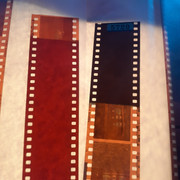
Bad film is on the left side, properly developed CP200 on the right.
 
That looks like the film got exposed to light. Camera back opened under green/blue light, and fogged up to the cassette light trap.

Some labs will always try to blame the film, but bad film wouldn't have part of one good image on it.
 
The whole film is bad, images have low contrast and have a red-yellowish tint when scanned. The left film leader is transparent and red and not black as it should be.
 
I note that one small portion looks fine. I'd agree with Donald - it looks like it has been exposed to light.
 
Underdeveloped film will often have a yellow or red cast, because the cyan-forming color layer (and the green-forming, in Fuji films) are below the yellow-forming and magenta-forming layers; those cyan and green layers will get less development if the temperature or pH are too low. I think it's extremely unlikely that Kodak could have coated, confectioned, and shipped a whole master roll of bad consumer film without making the news -- though maybe it just hasn't made the news yet.
 
Like Matt has said there is clearly part of what may be the first frame on the damaged film that looks to have an image. Yes the rest of the left hand side film is red, If what looks like half a frame with an image on it had been exposed to light then there would be no image and just a black frame

Four questions: 1.Can you tells us what we are looking at if it is not part of an image on the left hand film ?
2. Are you saying there was no black leader anywhere on the damaged film and the rest of the roll was this red colour?
3. Who developed the OK CP200, was it the same lab?
4. Has your friend has any other films developed by this lab and if so were they OK?

Thanks

pentaxuser
 
Can you show another strip of the "bad"negs, showing image frames and edge markings, alongside the strip of "bad" film you have already shown?

You are correct when you say the bad film leader should be black (the leader will always have the lab twin check number label on it).

When I looked at the bad film strip in the photo, I can see just a small amount of edge markings, the barcode. It's very hard to tell from such a small sample what may have happened. Hence the reason I asked to see another strip of bad negs.
 
I'm helping a friend from the FB group i administer, negs are not in my possession.
Lab said to her that there is a batch of CP200 that "lacks the blacks" and i think that is not truth. I've read the FUJI and Kodak tech doc but it can be many things and without test strips
or ph meter or densitometer one can only guess. She took the picture of leader of newly developed negs (left side) and ones developed few weeks earlier (right side), both negs are from the same lab.
Leader on previously developed film is normal but on newly developed one is red and transparent. I never seen this problem because when i do developing in Jobo ATL1000 i use fresh developer and i use it one shot.
 
I'm helping a friend from the FB group i administer, negs are not in my possession.
Lab said to her that there is a batch of CP200 that "lacks the blacks" and i think that is not truth. I've read the FUJI and Kodak tech doc but it can be many things and without test strips
or ph meter or densitometer one can only guess. She took the picture of leader of newly developed negs (left side) and ones developed few weeks earlier (right side), both negs are from the same lab.
Leader on previously developed film is normal but on newly developed one is red and transparent. I never seen this problem because when i do developing in Jobo ATL1000 i use fresh developer and i use it one shot.

Thanks for getting back so quickly.

What the lab said is untrue ( in all my years I never heard this) and sound to me like it is a (bad) cover-up for their mistake.

If I was to make a guess (from just seeing the bad reddish leader) I would say that the film was underdeveloped. The leader should be black and not transparent like in your example.
In a minlab with a leadercard processing machine (which this appears to be from looking at the twincheck and splice cut) it is hard to underdevelop a film.
The machine and chemicals are fairly foolproof. Temperature control and chemical replenishment are all automatic and if something fails then the machine alarms.

I only saw a case of underdevelopment once where someone mixed up the rep tubes and put the wash water tube into the dev slot and so diluted the dev.
The only solution for the lab, in this scenario, is to dump the dev tank and mix fresh tank solution (rep & starter).

Did your friend get scans or prints from these bad negs?
If the scans/prints look murky, have a yellow tinge, lack blue, and contrast then it would appear that they were underdeveloped.

 
There appears to be no end to the excuses that labs will come up with to deflect their responsibility for their bad processing and it is such a short-sighted policy.

pentaxuser
 
Agree, this looks like severe underdevelopment. In the setting of any decent volume lab, something like this is nearly inconceivable; it's pretty challenging to mess up this badly. It's different for a 'lab' that works more like a home darkroom where someone commercially develops a low volume of film for customers using e.g. a Jobo machine. In that setting, it's a little easier to see how a massive malfunction like this could occur.

The notion that the defect would be in the film flies in the face of quality control at companies like Kodak. While film defects certainly can and do occur, ones of this severity are virtually impossible to actually end up in the market.
 
Thanks everybody for the quick answers. Is it possible that the cause of severe underdevelopment is a bad mix of developer or some kind of contamination in dev tank?

Couple of scans from the roll:

118702555_10219314522668609_892386457791149769_o.jpg 118706628_10219314522148596_751222298114965528_o.jpg
 
Last edited:
Thanks everybody for the quick answers. Is it possible that the cause of severe underdevelopment is a bad mix of developer or some kind of contamination in dev tank?
Certainly. Developer may be badly oxidized (stored too long under adverse conditions and without replenishment), too dilute (due to improper mixing), heavily overused without replenishment, contaminated with something such as bleach or fix, etc.
 
There appears to be no end to the excuses that labs will come up with to deflect their responsibility for their bad processing and it is such a short-sighted policy.

The notion that the defect would be in the film flies in the face of quality control at companies like Kodak. While film defects certainly can and do occur, ones of this severity are virtually impossible to actually end up in the market.

"Always blame the film or the consumer, never let it be said that our complete lack of quality control could have ruined dozens of rolls of customer film. And for heaven's sake, NEVER admit that this happened to fourteen other customers the same day!"

Hey, at least their scanning does a good job correcting the cast!
 
I do some small scale processing and scanning (ATL1000 + Fuji SP3000) to cover my expenses and i had ruined few rolls myself, few months ago rotation motor was rotating the drum unevenly during the process. I've ruined 5 rolls of 120 portra i was doing for an art photographer, man i felt so bad. I admited the fault as soon as i realized what was the problem and compensated him. Errors happen, just be fair and admit it.
 
Errors happen, just be fair and admit it.

Yes that is the best way to do it.
In all my years processing C41 films, thankfully I haven't made too many mistakes but I still made a few of them. AND even though I didn't look forward to telling the customer, once I admitted my mistake, took responsibility for my action, the customer's reaction was not what I anticipated. They were understanding and thanked me for my honesty. (Of course they were compensated)

I think some labs hide behind their perceived superior knowledge versus the customer lack of same and try to blame the product/customer/camera/etc. to excuse their mistake. (be an adult and own up)
 
Yes that is the best way to do it.
In all my years processing C41 films, thankfully I haven't made too many mistakes but I still made a few of them. AND even though I didn't look forward to telling the customer, once I admitted my mistake, took responsibility for my action, the customer's reaction was not what I anticipated. They were understanding and thanked me for my honesty. (Of course they were compensated)

I think some labs hide behind their perceived superior knowledge versus the customer lack of same and try to blame the product/customer/camera/etc. to excuse their mistake. (be an adult and own up)

Definitely true. I remember being taught in Business Studies that a complaining customer (whether they're justified or not) can very often be turned into an opportunity and even a goodwill ambassador. Just takes immediate honesty, admission of blame and compensation or rectification if appropriate.
 
Photrio.com contains affiliate links to products. We may receive a commission for purchases made through these links.
To read our full affiliate disclosure statement please click Here.

PHOTRIO PARTNERS EQUALLY FUNDING OUR COMMUNITY:


Ilford ADOX Freestyle Photographic Stearman Press Weldon Color Lab Blue Moon Camera & Machine
Top Bottom