

• Welcome to Photrio!
    Registration is fast and free. Join today to unlock search, see fewer ads, and access all forum features.
    Click here to sign up

Kodak Reintroduces Ektachrome.

Recent Classifieds

Forum statistics

Threads
203,045
Messages
2,849,088
Members
101,618
Latest member
4-Perf
Recent bookmarks
1
Got a notice from B&H this morning that E100G is back in stock at $12.99 per roll. I immediately purchased four rolls.
 
Got a notice from B&H this morning that E100G is back in stock at $12.99 per roll. I immediately purchased four rolls.

I ordered 3 Last night, the rest of my order shipped, but the e100 is status "backordered - Delivery Estimate Pending"
 
Does think/know if there is a blue cast added to Ektachrome to compensate for tungsten projection bulbs? I am gearing up to scan slides (old Kodachromes, Ektachromes, Agfa, GAF, etc.) and wonder if this is universal. My light source is tungsten. I will use a Fuji XT-2, so no problem there, but am considering using film to copy some of the most precious slides also. I have a Durst copier with dichroic head, so I could also dial in some compensating color (it also has a 4"x4" filter drawer so I could add a compensating filter too).
 
Halogen projection bulbs are very close to a daylight source when it comes to projecting an image. No blue necessary.
 
EA0B25F3-1A3E-46D0-A551-400EDB35F250.jpeg
Not to be a "wet blanket" but one has to wonder -- given that the availability of E6 processing has been plummeting over the years, will this work? I know I have pretty much given up on color film as getting it processed takes too long and costs a lot, especially transparencies. The last roll of 120 Fuji I had done took me three weeks to get back from a small local chain that does it in house but apparently waits until they have a pile to do. I understand that thinking, but I found it discouraging.

None the less, if they are seeing the sales potential to make the move, hey -- go for it!


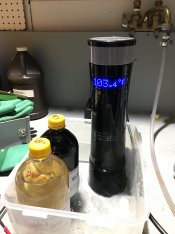
Why dont you just do it at home ? I use my Sansaire Sous Vide and it works out everytime. Chems are like $35.
 
Does think/know if there is a blue cast added to Ektachrome to compensate for tungsten projection bulbs? I am gearing up to scan slides (old Kodachromes, Ektachromes, Agfa, GAF, etc.) and wonder if this is universal.

the film is intended to give plain colour, although Ektachrome is Known to be a touch blue. I doubt if the bias is intended mind you.

SOME Motion Picture PRINTS used to be made with a different colour balance to be used where ARC Lamps, particularly Xenon Arcs were in use. That change too away some blue to make up for the higher colour temperature of the Arc light.
 
Your eyes adapt! This is virtually unrelated to illumination.

PE

I think the key there is there is no ambient light to confuse the eyes. I have heard this also. Some people are saying Kodachrome specifically has a blue tint added, I wondered if it were universal among slide films. Fortunately the Durst slide copier has a filter drawer so if I choose to copy film-film, I can at least color balance (given that likely the slides themselves may not do the balancing for you).
 
No normal slide film has an intentional colour tint.
Thousands of sides viewed by holding them up and looking through them tell me that.
 
There is no tint added. There is a UV filter in all color films though.

PE

Thanks. Lot's of internet chatter, but nothing to back it up from Kodak or any other company.
 
Halogen projection bulbs are very close to a daylight source when it comes to projecting an image. No blue necessary.
The maximum colour temperature of a halogen bulb is only about 3400K.
If at projection there is barely daylight, or other light, then there is nothing the projected image to correspond to, and colour temperature of a projection lamp within limits is not of effect. In this respect you are right.
 
Often a projector will have an element of heat adsorbing glass between the bulb and film. This glass a light bluish green most of the time so I would expect that the color temperature of the light that reaches the film would differ from the 3400K that the bulb puts out.
 
Ok. Got the slide copying going on the Durst. I am using an e-Komura 75mm enlarging lens (with a Fuji XT-2, APS-C). I can get full frame easily. I dial in 120 C + 110 M, and I get pretty good color balance. For 1948 Kodachrome I need another white balance correction in ON1, but with 1975 Kodachrome, the white balance just requires a tweak. The white balance calculated temperature numbers between the two are quite different, but I am using the same color-head correction for now. I will work with that. I may not need the C+M correction for the 1975 Kodachrome, which is in much better condition than the 1948 (yellow shift). I use the histogram to help determine exposure then shoot RAW. Here is an example of the 1975 Kodachrome:

Ducks_1975_1k.jpg


EDIT: For sure the Durst CC was not required for the 1975 Kodachrome. The correction I made only corrected the yellow color shift in the 1948 Kodachrome slides. Here is an uncorrected and looks much closer to the original (by eye):

ducks_NoDurst_CC1k.jpg


Typical color for the white of the ceramic duck is R240 G236 B235 without any digital constraints on highlights, etc. The light in the background does look yellow/red on the slide (like late afternoon light perhaps).
 
Last edited:
KOdachrome used to often require a different colour filter pack when making duplicate slides I am told. Probably since the dyes are different, they look more different to the duplicating film than they do to the eye.
 
KOdachrome used to often require a different colour filter pack when making duplicate slides I am told. Probably since the dyes are different, they look more different to the duplicating film than they do to the eye.

That is what I heard. I just color balanced by eye on the rear LCD. Auto white balance was not doing much for me for some reason. It worked pretty well.
 
The specific Kodachrome spectral dye density and Ektachrome spectral sensitivity and resulting dye densities creates the need for filters when making dupes. The analysis is called a print-through. This is a spectral analysis. The characteristics are cascaded to determine the best filter pack. Modifyingthe filter pack doesn't give the best possible dupe from Kodachrome. So Kodak had a special Ektachrome dupe film, Type K that had spectral sensitivity and image dyes to optimize duplication of Kodachrome (K-14) Film on to a E-6 dupe film.

Bob Shanebrook www.makingKODAKfilm.com
 
Are you saying that colour transparency film isn't simple and easy? :whistling::wink::wondering:
 
The specific Kodachrome spectral dye density and Ektachrome spectral sensitivity and resulting dye densities creates the need for filters when making dupes. The analysis is called a print-through. This is a spectral analysis. The characteristics are cascaded to determine the best filter pack. Modifyingthe filter pack doesn't give the best possible dupe from Kodachrome. So Kodak had a special Ektachrome dupe film, Type K that had spectral sensitivity and image dyes to optimize duplication of Kodachrome (K-14) Film on to a E-6 dupe film.

Bob Shanebrook www.makingKODAKfilm.com

Glad to see your book is back in print!
 
Everything Ektachrome seems to be elusive, this thread has an ad from Amazon today with a "Vintage EKTACHROME Film Logo T-shirt" of course i click on it, and find it does not ship to Canada. :sad:
 
Photrio.com contains affiliate links to products. We may receive a commission for purchases made through these links.
To read our full affiliate disclosure statement please click Here.

PHOTRIO PARTNERS EQUALLY FUNDING OUR COMMUNITY:



Ilford ADOX Freestyle Photographic Stearman Press Weldon Color Lab Blue Moon Camera & Machine
Top Bottom