
• Welcome to Photrio!
    Registration is fast and free. Join today to unlock search, see fewer ads, and access all forum features.
    Click here to sign up

Kodak Monographs etc now avail for download

Somewhere...

D
Somewhere...

  • 0
  • 0
  • 15
Iriana

H
Iriana

  • 4
  • 1
  • 73

Forum statistics

Threads
202,734
Messages
2,844,808
Members
101,489
Latest member
Sunnydoran
Recent bookmarks
3
Thanks for that analogy. I think I understand what you mean there...it would be near impossible to recreate some of these products due to the artistic nature of the process.

What I meant by corporate greed (and perhaps that was the wrong term) was the fact that so many nice products seem to get killed off entirely instead of still being around in a lesser quantity that might be viable. For example, the bean counters say a product has to make $X to be around next year...or it gets the axe. What I was wondering was, are so many products being cut because they don't hit a magic number in sales, or is it really so bad that supply is too great for the demand and no one wants those products anymore at all?
Obviously if no one wants to buy (no demand), then the supply must be shut off, or the company goes bankrupt.
I was just curious where we're at on the supply/demand curve. For example, if you took all the analog products together, as if they were produced by one company, and then added up all the income from sales - would that company float? Would it be in the red or the black?
I'm not sure if I'm saying it right...did that make any more sense?
Jed
 
"I try to teach my "art" to those who take my classes. I would like to do the following as well.... I could teach system design of negative films and papers, and system design of posiitive systems. I could teach developer design, fixer design and bleach/blix design.

In fact, fix, bleach and blix chemistry is much the least understood amongs the general users of these chemistries.

I could teach stabilzer design and image stability testing. This is another poorly understood area amongst the general analog photography population.

All of these involve "art" that is very esoteric, that the student could then take off on and extrapolate into new areas."

"I tried those system design threads here, and on PN, but there was little to no interest. In fact, there was quite a bit of contention from time to time, so I gradually gave up. My associates that have tried that here and elsewhere also found the same thing and advised me to give up."

PE

Hello PE,

Have you considered writing a 'systems design" book as an follow-up to your book / CD (due out soon)? You know that the moment film becomes obsolete for motion picture purposes, and film's days become numbered (more than they are now), folks will be hounding you night and day for more 'systems design' information than what is discussed here. Perhaps dedicating systems design information to the public domain will allow some enterprising folks to one day start up film production all over again.

Thanks,

Bob M.
 
Well, Bob, from the response so far, there seems to be little interest and if you had ever tried to do such a project you would realize how much effort it is for the return (if any).

My friends have advised me against it due to the effort vs return and I'm not to excited about it based on the response here on APUG and on PN. After all, with over 30,000 members and only about a dozen or so interested people, doesn't that give you a clue? :smile:

Really, some people have told me that if I was about 10 years later, there would be people beating a path to my door, but as it is......

Of course, 10 years from now, there will be no one who knows how to do what I am able to pass on. :sad:

PE
 
Stick with emulsions, pleeeeese!
 
Kirk;

Both are needed actually, for one to make total sense of the other. They are interlocking fields.

Jedidiah;

I cannot see how your example relates to corporate greed. If the sharholder wants profit and a product is not profitable, then they put pressure on the company officers to cancel unproductive products. If the officers do not comply, they are replaced. This happened with Azo paper and in fact, all B&W papers when the profitability fell below a certain level or actually became negative.

As a more recent example, Kodak no longer makes their own processing chemicals for B&W and color. In the first place, the new producer has cancelled a variety of color kits. Is that Kodak? I think not. It is the new company seeing the ROI on these small runners and they cannot make a profit with them. As for spinning it off, well Fuji saw the same problem of profit years ago and we have Fuji-Hunt making chemistry kits. This is kind of like Kodak-Champion. Kodak and Fuji have both seen that making the chemistry is giving a lower ROI as time goes on. Fuji saw it years and years ago, but Kodak had a stronger position and held on as long as possible.

So, with Champion, they are dropping products as well, and you cannot blame Kodak for this decision. It is the market and the shareholders of the companies involved.

PE
 
One Shot Cameras and Dye Transfer not obsolete!

Hi Ron - I am regularly using a 5x7" NPC one-shot camera, and using the seps to make Dye Transfer prints. I'm also restoring a very nice Curtis 4x5" one-shot camera. While I have been using a Leica M8 digital camera, I use the one shot as a replacement for large format color film as it is getting difficult to find a place around here to process it. For my money, the combo of large format in-camera seps and a highly tuned dye transfer process doesn't really represent a 'retro' process, I use it because it simply gives the absolutely best color print results possible. Its worth the effort, and will never be obsolete. As a plus, this technology can not be 'taken away' from me, as all of this can be done with modest means, the materials can be made in a fairly unsophisticated lab.

Regards - Jim Browning


Sandy;

Chromogenic color films will be virtually impossible to recreate if there are none being made. Photos taken with tricolor cameras will work well and color bromoil will be useful in printing as will home-made dye bleach. It is possible to hand coat color dye bleach print materials, but dye bleach films with decent camera speed and with decent properties regarding grain are virtually impossible for technical reasons related to having the dyes present to begin with.

PE
 
Jim;

I was hoping you would add to this discussion.

I would like to add that someday, as I mentioned in another post here, matrix film may be unobtainable except by making and coating using methods you have published. This is a real possibility as the market for everything decreases.

Jim's flat bed coater makes excellent 30x40 sheets of film and may be one of the few routes to large sheets of film or paper that is coated in small shops. He has published the plans on his web site.

In fact, I would like to mention that Jim's Matrix emulsion formula will be in my book with Jim's kind permission and for which I thank him here in advance. Thanks Jim!

PE
 
Are dye transfer materials (matrix film and dyes) available from any commercial sources at the moment? I'd like to give it a shot but the financial and technical requirements of making my own materials are a major barrier to me right now!
 
Large numbers are not needed to 'pass on' information.
I want to learn.
What else do you need?
 
Yes, design theory is important too... and some of this may be "hidden" in basic chemistry.

One thing that keeps reappearing in photographic chemistry is buffers and their use/design/calculation whathave you.

I for one would like to have course work dealing specifically in working with buffers in photographc materials... course work which would prepare me to design working materials that meet given design goals.

Such a course could be designed by Kirk, a chemist, or a photographic engineer;
However, the more real life material used in the examples and exercises, the better...
as that is what holds our attention.

How many people would actually use such a program/study guide or article?
Well, at least one!
I feel there is a real need for such material... despite there being many introductory lessons in chemistry on the net... because if relevancy is not obvious, dedication and probably, efficiency grows weak.
 
Such a course could be designed by Kirk, a chemist,

Ray, about all I know on buffers is "A buffer solution is an aqueous solution consisting of a mixture of a weak acid and its conjugate base or a weak base and its conjugate acid."

For application in emulsion making, that's about it for me. Oh, citric acid buffers I think are OK, but there's some acids/salts you don't want to use in emulsion making.

Unless you want a 15 minute class, we'll need someone else to teach it!
 
Last edited by a moderator:
Buffer capacity as normally used in photography is used with respect to developers for the most part. It is also important in fix baths and stop baths, but not nearly so as in developers.

In emulsion making it becomes important when scaling. The smaller kettles have less "buffer capacity" which in this case isn't related to acid-base reactions but to the inertia or resistance to vAg (pAg) change. The bigger the make, the larger the inertia of the bigger kettle.

PE
 
Ray, about all I know on buffers is ...
Unless you want a 15 minute class, we'll need someone else to teach it!

Sorry Kirk.

In that case, I would have to agree with you.

One "should" be able to get the level of "expertise" needed from published materials and sources... but I haven't found it possible to get past a certain level.... yet.
 
Matrix film possibilities?

The Fotokemika run of my matrix film emulsion sold out a few years ago, but it is still working well and isn't showing signs of age such as fogging or long wash-off times. Currently, there is no commercial supply of matrix film, but it is possible that this may become available in the future. Until then, making the film yourself is the only option. The main problem there is that the Dupont Melinex 582/3 isn't available as a stock item, so you have to do a factory run of 12 master rolls, costing about $ 150,000. There is the possibility of using corona discharge techniques so you don't need the special subbing layer, but I haven't tried it. If worse comes to worse, and I can't get a commercially made supply of the matrix film, I will build a 50" coater with a corona discharge unit, and coat my own film - probably 100 to 200 feet at a time, as that would be the limit of my space for drying the film. Its small scale, but more efficient than my simple flat-bed travelling slot coater, which is great for coating small amounts of film as cut sheets. You need to coat fairly large amounts of film to be useful, since you need at least 3 sheets of film at the final size of the print - there is no enlargement.

Regards - Jim


Jim;

I was hoping you would add to this discussion.

I would like to add that someday, as I mentioned in another post here, matrix film may be unobtainable except by making and coating using methods you have published. This is a real possibility as the market for everything decreases.

Jim's flat bed coater makes excellent 30x40 sheets of film and may be one of the few routes to large sheets of film or paper that is coated in small shops. He has published the plans on his web site.

In fact, I would like to mention that Jim's Matrix emulsion formula will be in my book with Jim's kind permission and for which I thank him here in advance. Thanks Jim!

PE
 
Hi PE,
Sorry about that post - poor choice of words when I said "corporate greed". What I meant was the bean-counters making all the decisions. I do realize that a company has to make money to survive - I own my own small business, and boy do I know that the hard way! :wink:

What I was trying to get at, was this:
Do you think we have reached a point where demand about equals the supply of analog products out there? Or, is the supply still too great (or is demand dropping so fast) that if you put all the analog products together, as if they were made by Company X...would that company be making money or losing it?

If it would be losing money, then we will see products cut and the hemorrhaging continue. If it would make money, then we can be assured of analog products for the foreseeable future.

Where this comes into play for this thread in my mind, is:
If the only way to perpetuate the knowledge / manufacturing of analog products is to make them, then we need some artists to pass down the info in books/classes to those of us who care. Obviously you had a hard time finding enough to justify a class...but there are those, like myself, who may not ever have the time to make emulsions ourselves, but would like to see the art continued. We would be willing to pony up $50 - $120 for a nice book, or access to the information, etc, just to have the knowledge and to help offset the costs of teaching those who can. This way the cost burden is distributed amongst those who care about it (kind of like forming a research society), and the art is passed down to those who have the time to do it.
Hope that makes sense,
Jedidiah
 
Jedidiah;

Antonio Perez used exactly that word "hemorrhaging" when speaking directly to me about the cancellation of B&W paper products, and some products are being returned unsold when they pass their expiration date.

So, what are they to do? IDK and I think that in this case the bean counters are the only ones who do or can at least give guidance as they see the whole (or at least the bigger) picture. I certainly don't nor does anyone here.

PE
 
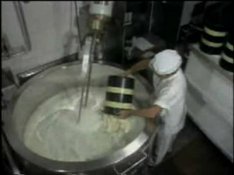
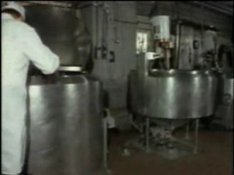
Attached is a screenshot from a video available at:
http://www.archive.org/details/corona_overview

The scene starts at 6:00 minutes

It shows some "kettles" used for emulsion making. The scene is VERY brief. I don't think it is worth downloading the video...just view the screenshots.

Emulsion
 

Attachments

  • Screenshot3.jpg
    Screenshot3.jpg
    13.5 KB · Views: 354
  • Screenshot1.jpg
    Screenshot1.jpg
    12.6 KB · Views: 333
This was a hodgpodge of images from the 60s, 70s, 80s and 90s actually, and the screen shots do show a melt being prepared, probably for a color emulsion coating. The emulsion is not yet added as they are in the light and the mixture is already white as if it were carrying a color dispersion. Very nice overview of the project.

The estar used was 2 mil (0.002") thick and was used for John Glenn's launch as well as on the moon. It was developed for NASA and the USAF in the late 50s for space use. A Kodak engineer from the project was shown in one of the quick cuts.

Thanks for the information.

PE
 
Thanks Emulsion, that was interesting.

PE, this is the frst time I have seen those black buckets in use... have you seen these before?
Were they plastic?

I still remember being pulled out of bed REALLY early one morning (it was still dark outside!) to meet John Glenn. I guess he was just doing my dad a favor. Nice memory!
 
Ray;

I have never seen black buckets like that before, no. We had square black and also blue containers called bakelites and knee high stainless steel cans in film manufacturing. Paper mfg used more plastic containers, but I never saw round ones there. The square ones were used due to ease of stacking and storing.

But, I never saw every nook and cranny at KP let alone other plants.

PE
 
shame there apparently was little response to the suggestion. I for one would not hesitate to pay for a publication like this
 
It is good that this came up again.

I have been looking at those buckets and kettles again. They are not for emulsion making. They have the wrong type of mixer. And the buckets are for addition of chemicals that are being mixed. The emulsion kettles look quite different as does the support equipment.

PE
 
Photrio.com contains affiliate links to products. We may receive a commission for purchases made through these links.
To read our full affiliate disclosure statement please click Here.

PHOTRIO PARTNERS EQUALLY FUNDING OUR COMMUNITY:


Ilford ADOX Freestyle Photographic Stearman Press Weldon Color Lab Blue Moon Camera & Machine
Top Bottom