
• Welcome to Photrio!
    Registration is fast and free. Join today to unlock search, see fewer ads, and access all forum features.
    Click here to sign up

Kodak HIE film grain

Lutheran Cemetery Angel

H
Lutheran Cemetery Angel

  • 0
  • 0
  • 6
Dystopia

A
Dystopia

  • 1
  • 0
  • 31

Recent Classifieds

Forum statistics

Threads
202,944
Messages
2,847,923
Members
101,549
Latest member
AHK
Recent bookmarks
0

brian_mk

Member
Allowing Ads
Joined
Jan 10, 2010
Messages
60
Format
Medium Format
Hi,

I have used 35mm Kodak HIE B&W infrared film many times in the past.
Before it became obsolete, I bought several rolls and have kept them
stored in the fridge.
I have been gradually using the outdated film with no problems.

I recently returned from a photographic trip to Yorkshire during which
I shot a couple of rolls.

I processed the film in stock ID11 as usual (this batch was 7.5 min at 21 degC).
For some reason the grain on the two films appears considerably larger
than usual and I can't figure out why.

I do quite like the grain on Kodak HIE, but this time it is excessive.

There is no evidence of fogging on unexposed areas of film, so I doubt
it's down to the age of the film.

The wash water was tempered at around 20degC, so it's not reticulation.

The developer was made up from raw chemicals using the published ID11 formula as
I have done many times in the past.

I'm pretty sure it's not a mistake with the weighing or mixing of the chemicals
because I mixed the batch of developer about 6 weeks ago and have used
the same batch to develop a part roll of Rollei infrared film with no problems.
I have kept stock ID11 for much longer than 6 weeks in the past and
had no issues.

Just wondered if anyone out there who used to use Kodak HIE film has experienced
something similar or can offer any suggestions?
 
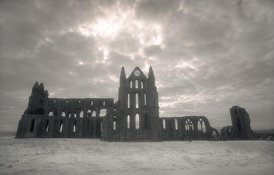
Here is a resized scan of one of the frames that shows how bad the grain is.

WhitbyAbbeyIR_589_00.jpg
 
WoW !! BUT it makes it very 'Pictorial' and should win you some PRIZES !!
 
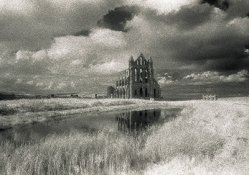
Compare the grain in the last image with a frame I shot at Stowe a few years ago.

StoweIR_480_04.jpg
 
When I use my out of date HIE I tend to develop it in ID11 (1+1) for 13 minutes. It is quite grainy but I put that down to the fact that it is out of date. I have photos on this site if you wish to check them out.
 
It is quite grainy but I put that down to the fact that it is out of date.

That's it. When film ages it loses its intended properties. You lose film speed, the emulsion fogs from cosmic radiation and other things I don't understand, and its grain becomes more pronounced. It's just the nature of the beast.

If you want smaller grain I recommend perhaps shooting it in a medium format camera with a 35mm adapter, where each negative would be of a larger area, or a panoramic camera such as a Hasselblad Xpan.
You may also use a developer that yields a bit finer grain than D76, but it wouldn't really make that big of a difference. If you try Xtol, for example, you will get finer grain and a bit less fog. But when you look at the prints the difference is more in a slight shift in tonality than the grain department, honestly.
 
I am beginning to conclude that it's down to the age of the film (It's dated 2008).
I now only have 2 rolls left in the fridge.
When that's gone, it will have to be Rollei 400 IR film.
That's the only IR film that seems to be available now.
I have a Bronica ETRSi, so will use 120 roll film.
Although it's slower than Kodak HIE, the results look ok.
 
Last edited by a moderator:
I've discovered that I can reduce the grain by using 3 scans from bracketed frames and combining them using Photoshop's HDR.
It makes a moody pictorial image that I quite like.

WhitbyAbbey_558_33-34.jpg
 
Last edited by a moderator:
I have a feeling that part of what you are seeing also has to do with the fact that you are using a scanner. With higher base fog in the film, you add more contrast in order to get a similar looking photograph. When contrast is added, the grain is accentuated. Same as printing in the darkroom with a higher grade filter but more prominent, due to things like grain aliasing in the scanner, etc.
 
Here's the first image after the 3 frame HDR treatment to reduce grain.

WhitbyAbbeyIR_558_00-03.jpg
 
I used my last roll of HIE in about 2012(?) and it was grainy as golf balls. I would put it down to age. It's also not just the scanning, though that might emphasize it more. I had great balls of grain in darkroom prints, too. Part of it was not increasing the exposure quite enough. Your shots are great, though! I wish I had some more. That's the only film that I really lament the loss of.
 
You didn't have Digital ICE or some other scratch and dust removal option switched on. These systems don't work with traditional black and white films as the infrared scan picks up the silver grain as dust and tries to clean it. I know scanning isn't talked about here on APUG but it I thought it was worth mentioning.

If you are looking for alternative IR films, don't forget about Rollei Retro 80s. It is a couple of stops slower than the IR400 but it has good infrared senstivity (better than SFX for instance) and is incredibly fine grained. It is quite contasty though, so may not be suitable for every occasion.
 
You didn't have Digital ICE or some other scratch and dust removal option switched on. These systems don't work with traditional black and white films as the infrared scan picks up the silver grain as dust and tries to clean it. I know scanning isn't talked about here on APUG but it I thought it was worth mentioning.

If you are looking for alternative IR films, don't forget about Rollei Retro 80s. It is a couple of stops slower than the IR400 but it has good infrared senstivity (better than SFX for instance) and is incredibly fine grained. It is quite contasty though, so may not be suitable for every occasion.

Nope, ICE was not enabled on the scanner - The Epson 4870 flatbed I use makes a loud CLUNK and takes twice as long to scan when ICE is enabled.
As you say, ICE does not work with B&W negs.

I really like the images I can get from B&W infrared film but it's become hard to find and expensive now. Eventually I will probably upgrade my 'old' Nikon D200 DSLR to a full frame D750 or D810 and get the D200 converted for infrared. It's a shame the D200 doesn't have live view.
 
Last edited by a moderator:
Refrigrated HIE with an expiration of 2008 should not be a problem.
 
Photrio.com contains affiliate links to products. We may receive a commission for purchases made through these links.
To read our full affiliate disclosure statement please click Here.

PHOTRIO PARTNERS EQUALLY FUNDING OUR COMMUNITY:


Ilford ADOX Freestyle Photographic Stearman Press Weldon Color Lab Blue Moon Camera & Machine
Top Bottom