• Welcome to Photrio!
    Registration is fast and free. Join today to unlock search, see fewer ads, and access all forum features.
    Click here to sign up

It's official, Kodak is selling its film business.

Recent Classifieds

Forum statistics

Threads
203,583
Messages
2,856,812
Members
101,912
Latest member
Emily Cook
Recent bookmarks
0
IDK how many research machines still exist nor do I know their condition. They might make usable product, but you would need a slitter, chopper and perfer. You would need spooling equipment for 35mm or interleaving equipment for sheet film. You would need an emulsion engineer and a coating engineer. Etc!!!

So, Kevin, what is your point?

If you bought one, who will make the emulsion, design the coatings, get your support and package it?

PE
 
IDK how many research machines still exist nor do I know their condition. They might make usable product, but you would need a slitter, chopper and perfer. You would need spooling equipment for 35mm or interleaving equipment for sheet film. You would need an emulsion engineer and a coating engineer. Etc!!!

So, Kevin, what is your point?

If you bought one, who will make the emulsion, design the coatings, get your support and package it?

PE

PE, with 20,000+ posts here, you appear to have some free time. Might you consider putting your chef's hat back on again?? :laugh:
 
So, Kevin, what is your point?

If you bought one, who will make the emulsion, design the coatings, get your support and package it?

PE

Well, Kevin mentioned Efke. Just as a thought exercise, if Fotokemika or some other company with current expertise in filmmaking were to buy one, they would presumably have the experienced engineers and could figure out how to use the machine. If someone else without expertise were to buy one, he'd need to hire some old pros and train some new pros. Seems like, anyway. Not that someone who bought such a machine could make Kodak emulsions, but if they had the skill to formulate emulsions, do the coating, slit, perf, package, etc., then they could make use of it.
 
I was more curious as to if one were available to purchase (it doesn't sound like it), if it has any value to a smaller film maker or wannabe film maker. If you could get one and it saved 20-30% of a start-up costs over building a new machine, you wonder if that amount would be the tipping point between some company/individual purchasing it for usage or not investing in film production at all. I could see some movie maker with a passion for film (Christopher Nolan, for example) working the price of purchase and start up into a movie and using the film from that machine for their movies - what is a $1m expense for most blockbusters? The travel and feeding of the crew costs more in a couple weeks and it would free the studio from relying on Kodak for final analogue copies/back-ups. I actually think this might be the salvation of film to a limited extent, the movie studios forming a consortium to make film for their own purposes; they might not care about us still users but would preserve the knowledge/skills required (can't get a job at Universal Studios? See if Ilford/Adox/Fuji has an opening).

I was more interested if they are (were) fully functional machines capable of being used for production or if they have limited functionality.
 
Kevin, the studios are increasingly going the digital route.
 
Kevin, the studios are increasingly going the digital route.

I am aware studios are going digital at an exponential rate and there is no going back to film only. However, there are a number of famous film makers who still prefer film (Christopher Nolan being one of my favorites) and a lot of Bollywood shoots film (for the time being). However, even a film shot entirely on digital is backed up on analog film in separate colour streams (a blue reel, a red reel, etc.) so that: (a) a hard drive crash does not mean nobody ever watches the Avengers again (Pixar almost lost one of it's films which was 90% complete, due to a hard drive crash and was saved by a producer who had a back-up copy at home for review); and (b) when super high-definition is released in 10 years, they can re-scan the film to produce a higher resolution product. So even if Hollywood went entirely digital in the shooting, the storage will still be analog.
 
Day's salary? Right now at B&H a 36x roll of Provia 400 is $6.49. Dwayne's charges $8.95 for processing. Add $4.50 shipping, though it's much less per roll if you have more than one roll processed. Total $19.94. A minimum wage burger flipper earns more than that in three hours, maybe 3.5 hours after withholdings, and most people aren't minimum wage burger flippers.

I will grant that the price of transparency film has skyrocketed, and very recently, so much so and so recently that I wasn't even aware of it until I checked just now as I bought my last batch late last year (about half of which is still in my freezer.) Provia 400 is $10.99 at B&H and a whopping $15.49 at Freestyle. The latter is outrageous when you can get it for almost 30% less from B&H. Still, it's an amazingly good film and it's worth even the $15 to me. (But not when I can get it for $10 just as easily!)

Trying to make film cheap is the wrong tactic. Make it as good as possible, make it the thing to shoot, make it popular, and people will pay for it. You're never going to compete with the marginal cost per shot of digital, which is basically free once the equipment is purchased. So don't try. If people want it they will pay what it costs (I am not talking, obviously, about $50 a roll and another $50 for processing or anything like that - within reason) and if more and more people want it there will be competition and economies of scale and the price will come down, at least some. That can happen, but obviously not to the degree of the old days.


US$20 is approximately RMB¥120 which is easily a day's wage in China. That is where I am talking about.

We need cheap slide film as an entry point. Once people try it and like it, they can move up the ladder to the more expensive and higher quality Fuji products. The high price of those products is too much of a barrier to entry into shooting E6. Once we get a cheaper alternative, you will see more consumption, and lower prices overall because of the increased economies of scale. Tons of people in China like shooting film, and tons more would like to start, but we need those price barriers to come down. It will benefit film shooters everywhere, not just in China.

This is why I'm thinking a Chinese buyer for Kodak might be a good idea. The market in China is potentially huge, but gaining access to it is tough and requires lower price points, because people here simply don't have the money like in western countries. Kodak is already a household name in China though, and there are Kodak branded shops all across the country. So it might be a good match.
 
US$20 is approximately RMB¥120 which is easily a day's wage in China. That is where I am talking about.

We need cheap slide film as an entry point. Once people try it and like it, they can move up the ladder to the more expensive and higher quality Fuji products. The high price of those products is too much of a barrier to entry into shooting E6. Once we get a cheaper alternative, you will see more consumption, and lower prices overall because of the increased economies of scale. Tons of people in China like shooting film, and tons more would like to start, but we need those price barriers to come down. It will benefit film shooters everywhere, not just in China.

This is why I'm thinking a Chinese buyer for Kodak might be a good idea. The market in China is potentially huge, but gaining access to it is tough and requires lower price points, because people here simply don't have the money like in western countries. Kodak is already a household name in China though, and there are Kodak branded shops all across the country. So it might be a good match.

I'm pretty sure no one in China is going to end up using film, regardless of the cost. One of my friends is a film photographer that lives in Chengdu, Sichuan. He constantly tells me about how as soon as people make enough money to buy a decent camera, they run to a DSLR, usually the most expensive one they can afford. He is constantly annoyed at the fact that there are thousands of D3s in China stuck in P because they think that the more money you spend on the camera, the better the picture. It's going to be all but impossible to tell them that technology that is, at its core, over 100 years old is better than the latest and greatest.

Besides, Even if they would try this, there's no reason to try it with slide film. Most people want either a print or a digital file as the final product. Slides are not the best product to use in either situation (and this is coming from someone whose workflow is 75% E-6). If you want a print, you have to find someone that can scan an individual slide and then print it. Since it's not the lab's standard workflow, the cost will be higher than scanning and printing a negative. If you want a digital file, you have to scan it, which adds a major step compared to digital.

I love film as much as the next guy, but China will not be the solution to Kodak's problems.
 
Most of you seem to be unaware of the new Kodak product introduced recently. They now make an archival color print film for storage of master copies of digital motion pictures. This is their effort to give the digital world a method of backing up images.

As for my number of posts, well two things come to mind.

1. I like to help - and also defuse myths.
2. I was writing a book and visits to APUG broke the monotony.

I might add that sometimes I like a laugh! :D A big reason to visit APUG!

PE
 
Most of you seem to be unaware of the new Kodak product introduced recently. They now make an archival color print film for storage of master copies of digital motion pictures. This is their effort to give the digital world a method of backing up images.

I did some work with these folks: http://www.acmeworksdf.com/ and their business is archiving digital motion pictures. We tried to drum up some interest in archiving professional/consumer digital images, but didn't get much interest.
 
I have a thought, but first a question: what is the maximum time that film could be stored and have reasonably good quality?

Here is the idea. What if someone were to buy Kodak, not with the idea of running the machines forever, but rather running the machines for a few weeks, or a few months at most, and make enough film to last forever? Then the film would need to stored somewhere. The machines could be scrapped, and the real estate converted to condos or whatever.
 
Storage life varies from product to product. B&W generally is better than color, and slow films are better than fast films. There is no one answer.

How long does a lump of beef keep in the freezer?

PE
 
Here is the idea. What if someone were to buy Kodak, not with the idea of running the machines forever, but rather running the machines for a few weeks, or a few months at most, and make enough film to last forever? Then the film would need to stored somewhere. The machines could be scrapped, and the real estate converted to condos or whatever.
This sounds similar to what happened when the former Agfaphoto closed down.APX 100 coated in 2005 is still available today.Coating and storing may be the most economical way to close production?
 
[...] and (b) when super high-definition is released in 10 years, they can re-scan the film to produce a higher resolution product. So even if Hollywood went entirely digital in the shooting, the storage will still be analog.

If they want to take advantage of the new higher resolution to re-release an old film, they must have captured it on film.
If they capture a film in a digital format and they back it up to film, when they rescan it they will not have a higher resolution than what they originally had.

Films that have been captured digitally those last years will inevitably become "obsolete" and might fall into oblivion and be lost, like many films of the silent movie age.

Films that have been captured on film have always been able to be re-released in higher-definition home-video formats (VHS, DVD, Blu-Ray, and whatever comes next) and will continue to be until digital home video reaches a very high resolution.

This alone should be a sufficient reason for film producers to capture using film technology instead of switching the capture stage to digital technology. A film is a product with a "long tail" of revenue stream. Walt Disney is still making money out of Snowwhite and the seven Dwarfs.

A few nights ago I re-saw Mutiny of the Bounty with Charles Laughton, 1935.
 
Last edited by a moderator:
US$20 is approximately RMB¥120 which is easily a day's wage in China. That is where I am talking about.

This is why I'm thinking a Chinese buyer for Kodak might be a good idea. The market in China is potentially huge, but gaining access to it is tough and requires lower price points, because people here simply don't have the money like in western countries. Kodak is already a household name in China though, and there are Kodak branded shops all across the country. So it might be a good match.

That's the old China you are talking about. Today China is far richer than $15 a day in income. The average price of a home in Shanghai is over $200,000 and there are hundreds of thousands of homes that cost over one million dollars. I'm renting a home (well my company is) that cost over $800,000. There is enormous wealth in Chinese cities now. Shanghai has over 24 million people and many many are extremely wealthy. You would have to go way out into the countryside to find someone living on $15/day.
 
I'm pretty sure no one in China is going to end up using film, regardless of the cost. One of my friends is a film photographer that lives in Chengdu, Sichuan. He constantly tells me about how as soon as people make enough money to buy a decent camera, they run to a DSLR, usually the most expensive one they can afford. He is constantly annoyed at the fact that there are thousands of D3s in China stuck in P because they think that the more money you spend on the camera, the better the picture. It's going to be all but impossible to tell them that technology that is, at its core, over 100 years old is better than the latest and greatest.

Besides, Even if they would try this, there's no reason to try it with slide film. Most people want either a print or a digital file as the final product. Slides are not the best product to use in either situation (and this is coming from someone whose workflow is 75% E-6). If you want a print, you have to find someone that can scan an individual slide and then print it. Since it's not the lab's standard workflow, the cost will be higher than scanning and printing a negative. If you want a digital file, you have to scan it, which adds a major step compared to digital.

I love film as much as the next guy, but China will not be the solution to Kodak's problems.

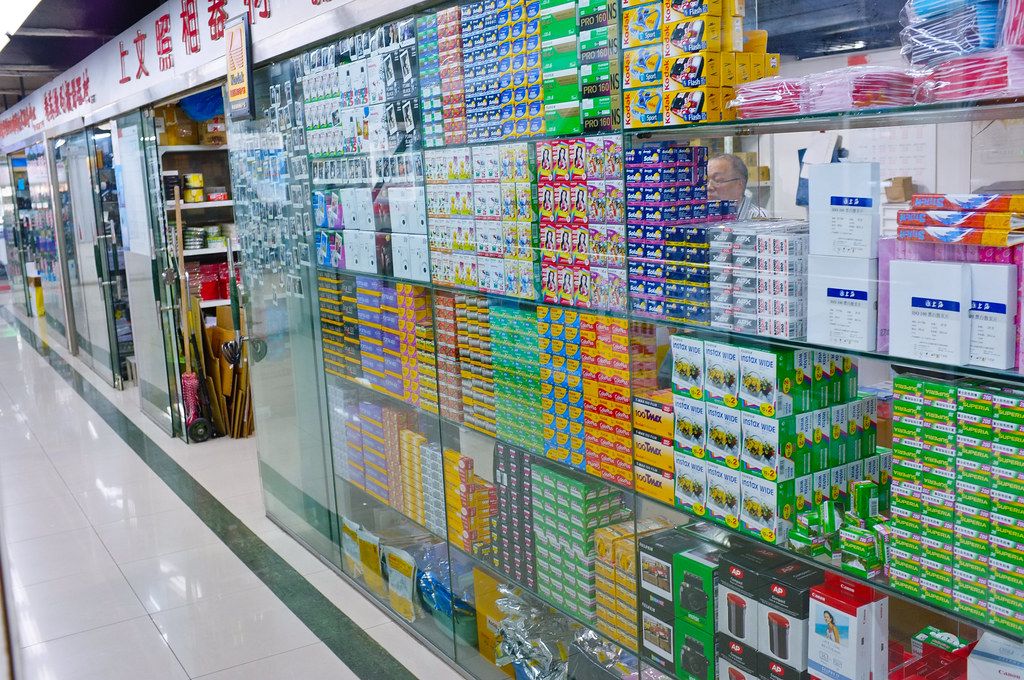
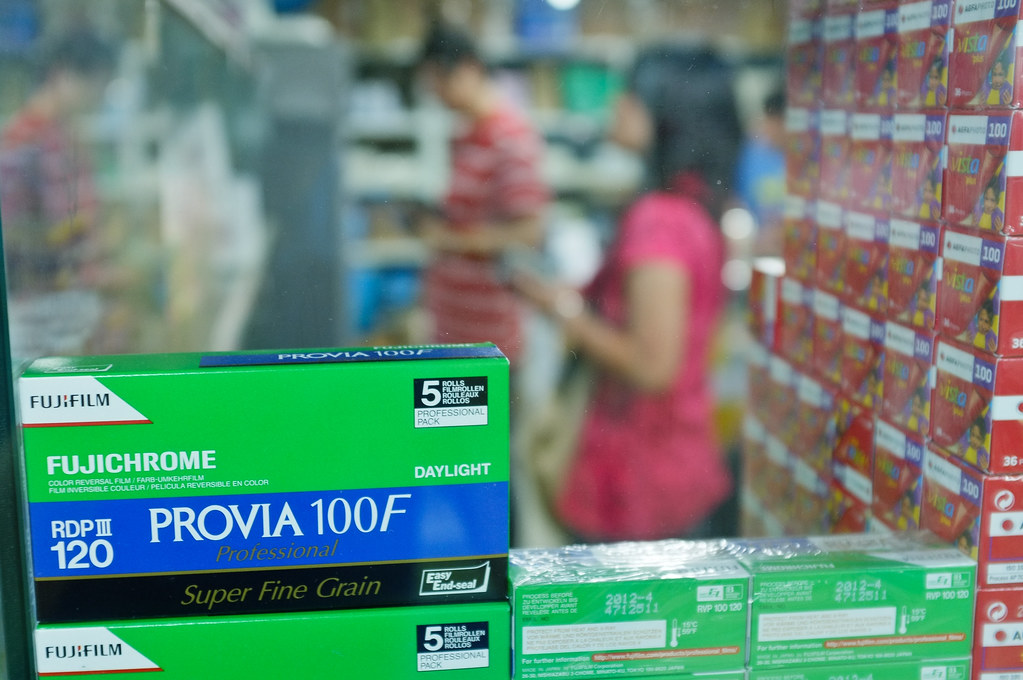
Pictures from a part of Shanghai's largest photography mall.....There are also thousands and thousands of used film cameras available on TWO floors of this mall. Someone is buying.

6064087124_51711e7a75_b.jpg


6063546429_49f665a687_b.jpg
 
I need to go on vacation to Shanghai - how are the prices compared to North American for both film and cameras?
 
I'm pretty sure no one in China is going to end up using film, regardless of the cost. One of my friends is a film photographer that lives in Chengdu, Sichuan. He constantly tells me about how as soon as people make enough money to buy a decent camera, they run to a DSLR, usually the most expensive one they can afford. He is constantly annoyed at the fact that there are thousands of D3s in China stuck in P because they think that the more money you spend on the camera, the better the picture. It's going to be all but impossible to tell them that technology that is, at its core, over 100 years old is better than the latest and greatest.

Besides, Even if they would try this, there's no reason to try it with slide film. Most people want either a print or a digital file as the final product. Slides are not the best product to use in either situation (and this is coming from someone whose workflow is 75% E-6). If you want a print, you have to find someone that can scan an individual slide and then print it. Since it's not the lab's standard workflow, the cost will be higher than scanning and printing a negative. If you want a digital file, you have to scan it, which adds a major step compared to digital.

I love film as much as the next guy, but China will not be the solution to Kodak's problems.

One other thing.....0.30 Yuan for a nice quality scan in Shanghai. I use this lab and I get a lot of praise specifically for the scanning. You can spend 23 Yuan if you want even higher.

http://item.taobao.com/item.htm?spm=a1z10.3.17.10&id=7342584184&
 
... but rather running the machines for a few weeks, or a few months at most, and make enough film to last forever?

Maybe not run it to produce skids of film forever, but maybe go full speed to make film for a year. Keep critical employees with the knowledge and skills on staff and contract general workers for the month or so that they're needed. While that inventory is being sold off, prepare for next years run doing all the steps that PE mentions in other posts. In the meantime, the coating facility has been cleaned, maintenance is carried out with a smaller staff and is otherwise shut down and consuming minimal resources. Would a model like that be realistic?
 
...film producers to capture using film technology...

Capture doesn't seem to be so much the issue or argument with the filmmakers. It's distribution. They want to get the physical film out of the distribution chain and have automated theaters they can run from some central location. So they employ less people and collect more money.
 
Brian;

Kodak can coat master rolls faster than one per day. They can make enough for the whole world in one day!!
PE

As you've posted earlier, Kodak has a problem with overcapacity. A purchaser of the Rochester facility will also have the same problem. The coating machines are fabulous beyond belief, but at some point the demand will drop below what is sustainable for those machines. As you've posted, Kodakchrome was being coated once every two years. E-6 was more popular than Kodachrome, but it also could not be economically produced at the end.

That's why I used the example of one master roll per day, 85,000 rolls of film per day, to give people on the forum a sense of what is produced. I don't know if National Geographic used 85,000 rolls in a year, but 15 minutes of coating time was enough for them, and very likely a healthy surplus. As you've stated, today's world-wide demand can be met in one day by Kodak.

Unfortunately, market demand is everything. Efke is going away because even if the repair to their machinery was paid for by someone else, they still don't have enough market demand to sustain the factory. I've read that one of the pressures on Kodak is their coal-fired electric plant. Here in Washington state our only coal-fired plant was shut down due to emissions, even though we have a live volcano here. If Kodak's plant is shut down, then they'll have to pay for the plant's decomissioning, along with buying all of their electricity from the local grid, and they already owe the local electric utility quite a bundle. And once the movie industry winds down on film, then what? That's the thing that really bothers me. If Kodak loses that revenue, then what will become of the still film production?

So far, there's been no "magic bullet" still film application. The only thing that I really can guess at is that after a total Kodak collapse, somebody decides to make film in Rochester using a plant with a far lower overhead, employing the former Kodak employees. The current Kodak plant has X overhead, and I'm guessing that overhead is too high for just still-film production. So the only way that Kodak film will be made is with some kind of "mini" machine, with a smaller overhead.
 
I need to go on vacation to Shanghai - how are the prices compared to North American for both film and cameras?

Film processing is reasonably cheap, but cameras and film are the same or more expensive. If you are good at bargaining, then you can get better deals.
 
So if Kodak can produce the world's film needs in a single day, then already the plant must be sitting idle the vast majority of the year. Kodak isnt building up massive stock piles of film, are they? What do the employees do for the rest of the year?

I wonder to what degree Fujifilm has over capacity.
 
Ratty, I think that "world's supply in one day" refers to still film production. The other films are things like movie film, film for non-photographic industrial applications like circuit board production, and things like that.
 
Photrio.com contains affiliate links to products. We may receive a commission for purchases made through these links.
To read our full affiliate disclosure statement please click Here.

PHOTRIO PARTNERS EQUALLY FUNDING OUR COMMUNITY:


Ilford ADOX Freestyle Photographic Stearman Press Weldon Color Lab Blue Moon Camera & Machine
Top Bottom