• Welcome to Photrio!
    Registration is fast and free. Join today to unlock search, see fewer ads, and access all forum features.
    Click here to sign up

Is there an 'ideal' focal length for zooms?

Tompkins Square Park

A
Tompkins Square Park

  • 3
  • 0
  • 47
Siesta Time

A
Siesta Time

  • 1
  • 0
  • 37

Recent Classifieds

Forum statistics

Threads
202,858
Messages
2,846,670
Members
101,572
Latest member
apltd
Recent bookmarks
0
It depends on the lens and how it was designed. It's virtually impossible to make a zoom lens equally sharp across all focal lengths.

Sorry, that’s just patently false in this day and age, even for zoom ranges far wider than what’s seen in the consumer market.

Regards,
Jason
 
Easy Nikon 20mm to 35mm AF zoom and Nikon 28mm to 200mm AF zoom. I also have a Tamron 28mm to 300mm AF zoom.
 
When I was doing newspaper stuff back in the dark ages my two favourite zooms were the Nikkors 43-86 and the 80-200. Now my favourite zoom is the Nikkor 24-120. For your application the Nikkor 28-105 macro is probably your best bet.
There were two versions of the 43-86. The first, with the engravings inside the filter ring, was a dog. It had horrible distortion on the edges, and the color rendition was always suspect.

The second, with the engravings outside the filter ring, is a very nice zoom, and I use it as a "walk around" lens with my FE, FE2, FM2n, and a Nikkormat FT3. Although it's a push-pull lens, I also carry a 80-200 f/4, and a 24mm f2.8, as a "street kit".
 
My gut feeling, and I have no emperic evidence to support it, is that zooms can sometimes be a little soft at their maximum zoom. I would therefore pick the 80-200 if shooting at 80. When using older zooms, it might come down to a question of whether I could more easily tolerate barrel v. pin-cushion distortion.

In general, my favorite zoom range is 35-70, with my favorite zoom lens being the Minolta 35-70 f4 (mini-beercan). I don't own any fast zoom glass since that gets expensive, and if I need speed, I'll stick with much more affordable fast primes.
 
  • Wallendo
  • Deleted
  • Reason: duplicate
I'm an Oldster from the 80's. Back then, as a general rule, prime lenses are always sharper then zoom lenses. I don't know if the same applies today 30+ years later.
It is the same today! Alltough each manufacturer state : best quality you can get to zooms - zoom
is a compromiss from optical design (computer aided)!
But perhaps modern zooms are better and better - I want to belive :

For the same price to a real superior zoom you can get the better prime lens for sure !

with regards
 
I have two of the 28-80 Nikkors mentioned. I use them mostly in N90S cameras. They don't look like much but are sharp. In my experience, 80-200 lenses are sharper at 80 and 28-80/85 lenses are also sharper at 80/85.
If you are shooting a three dimensional subject then you will need enough depth of field to cover the important parts. This may require stopping down past the optimum aperture for flat subjects. Then there is the issue of out of focus rendition. Zoom lenses can have very odd out of focus rendition so first see what that's like with each lens. Do both lenses have adequately close focusing at 80mm for your subject? If your lighting is difficult, which lens handles that situation better. Lens hoods can be handy here. At last Sunday's camera show in NJ I found and bought three nice Nikon hoods. Two screw in and one is a clip-on. I should use hoods ore often.
 
Hypothetical question: You are required to take a very sharp photo of a product. You have only two lenses (of the same generic brand) to choose from: a 28 - 80 and an 80 - 200. You MUST use a focal length of 80mm. Which lens would you choose in order to obtain the sharpest result?

Perhaps is does not matter, but maybe it really does. I do not know. Is there an 'ideal' focal length for zooms? - David Lyga

80-200 because fewer compromises in design vs 28-80.
 
Ignoring the 'sharpest' question, my first reaction is that if the product shot required the most 'accurate' portrayal of the shape of the object, I would choose to use the lens with 80mm at the long end of its zoom range...pincushion distortion most often occurs at the short FL of the zoom range, and gets lesser as you increase FL in a zoom.

photozone.de tests of the Nikon 80-200mm IF ED lens shows 1.56% barrel distortion at the 80mm FL
Unfortunately there are no tests of the Nikon n-80mm
 
Last edited:
Hypothetical question: You are required to take a very sharp photo of a product. You have only two lenses (of the same generic brand) to choose from: a 28 - 80 and an 80 - 200. You MUST use a focal length of 80mm. Which lens would you choose in order to obtain the sharpest result?

Perhaps is does not matter, but maybe it really does. I do not know. Is there an 'ideal' focal length for zooms? - David Lyga
as Dennis said, my first option would also be a prime lens. zoom lenses must have an optimum focal length but ,I doubt the manufacturer will tell us what that is. All I know is that zoom lenses often operate less than optimum at both the focal-length extremes.
 
The new Sigma Art lens are just as sharp as primes, and are as sharp wide open as they are stopped down. Most have short ranges, fast, and expensive. I wanted a 24 to 35 F2, but not available in Sony/Minolta A mount. Canon L, Sigma Sports and Nikon are very close to being as sharp as primes, for that matter in terms of practical use I think all will resolve 200 LPMM with very little distortion. Going back 2 or 3 generations, no questions primes are sharper with much less distortion. I tend towards primes as they are lighter and less likely to get joutled and become misaligned .
 
Hypothetical question: You are required to take a very sharp photo of a product. You have only two lenses (of the same generic brand) to choose from: a 28 - 80 and an 80 - 200. You MUST use a focal length of 80mm. Which lens would you choose in order to obtain the sharpest result?

Perhaps is does not matter, but maybe it really does. I do not know. Is there an 'ideal' focal length for zooms? - David Lyga

Since you don't specify the brand or max speed of the lens, I can't give a definitive answer, as several factors are in play.

1) Speed - As others have noted, you will be shooting a couple of stops down for maximum sharpness, presumably on a tripod. If the maximum apertures are different, you'd be better off with the one providing the depth of field you need in the shot.

2) Range - Both lenses qualify as moderate ratio zooms, so some of the problems inherent in larger range zooms should not especially factor in.

3) Specific Lens Performance - Again, speaking only from my fifty-something years as an advanced amateur, today's zooms are weakest at their extremes, both short and long. I'd guess that most suffer quality degradation more at the long than the short end, but it's not universal.

So, with those three assumptions, and all other factors being equal, I'd go with the 80-200 lens at its shortest FL.

There are lots more complicated answers above, but without more information, that would be my answer.

Andy
 
There were two versions of the 43-86. The first, with the engravings inside the filter ring, was a dog. It had horrible distortion on the edges, and the color rendition was always suspect.

The second, with the engravings outside the filter ring, is a very nice zoom, and I use it as a "walk around" lens with my FE, FE2, FM2n, and a Nikkormat FT3. Although it's a push-pull lens, I also carry a 80-200 f/4, and a 24mm f2.8, as a "street kit".

I did not know this! I remember working in a camera shop in the 1970s where the Nikon salesman was constantly pushing the 43-86, but when I test shot with it, I thought the images were awful, displaying both distortion in the corners and chromatic aberration. Others have called me out on this, especially journalists, and now I understand why. If I add an F series to my collection (which I plan to) I'll know which to search for. Do you have access to any photos or specifics to help distinguish the two versions?

Thanks!
Andy
 
20191114_094708.jpg
 
The poorer performer is on the right. It's non-ai. The lens on the left, I believe, is ai-s.
 
The poorer performer is on the right. It's non-ai. The lens on the left, I believe, is ai-s.

Thanks a lot! It's going in the "Nikon F System File", which I hope to begin acquiring early next year. Unless those dang kids start buying them all up to use with their dang digital thingamabobs... :D

The one on the right is the model I remember the Nikon guy pushing. I feel much better knowing that I wasn't the only one who thought it was a woofer.

Andy
 
Sorry, that’s just patently false in this day and age, even for zoom ranges far wider than what’s seen in the consumer market.

It depends upon how literal you are in what defines 'virtually same' performance...for example, the Nikon 70-200 f/2.8 ED lens at max FL delivers only 79% of the MTF that is available at shortest FL. Visit photozone.de and look at various lens MTF for yourself.
 
It depends upon how literal you are in what defines 'virtually same' performance...for example, the Nikon 70-200 f/2.8 ED lens at max FL delivers only 79% of the MTF that is available at shortest FL. Visit photozone.de and look at various lens MTF for yourself.

Why would I go look at charts of questionable parenthood when I have the insight of decades of optical design experience? :smile:
 
Why would I go look at charts of questionable parenthood when I have the insight of decades of optical design experience? :smile:
To see Objective measurement data vs. Subjective guesses about resolution at different f/stop and FL.
Do you similarly question the value of MTF ratings published by lens manufacturers like Rodenstock?...what methods did they use, that makes their test more fundamentally believable?!
 
The poorer performer is on the right. It's non-ai. The lens on the left, I believe, is ai-s.
I enjoy the rendering of pre-AI Nikkors, but sometimes the resolution is night and day. Yesterday I developed a roll that was split between the Nikkor H 50mm f2, a well regarded lens, and a 135mm f3.5 AIS. The tele looked like it was shot on different film, being sharper and having more contrast. That's what 20 years of optical coating development does to an image.
 
I have the luxury of enough lenses to cover all my needs. Of them all, the one that gets used the most is the 28/105 AFD. This cover the vast number of my requirements and can be depended on the be sharp enough to make a 12x16 print at all apertures. I made one last night and towards the edge of the negative it clearly resolved a television aerial which was close to too 200 yards away. The next lens up is the oft maligned Nikkor 70/300 AFD. It is also sharp but for getting the best out of it is to use a tripod. So these would be my two lenses if I had to choose.

Are my 20/35 and 35/70 AFD Nikkors redundant - not a chance - it is they add extra weight and only used if I have a specific use.
 
To see Objective measurement data vs. Subjective guesses about resolution at different f/stop and FL.
Do you similarly question the value of MTF ratings published by lens manufacturers like Rodenstock?...what methods did they use, that makes their test more fundamentally believable?!

I think you should go re-read my statement in post 26 a bit more carefully, consider that your responses don’t align well with my original statement, and then leave it at that.

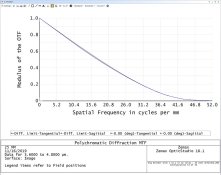
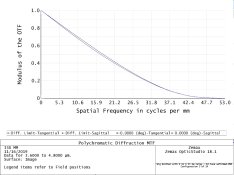
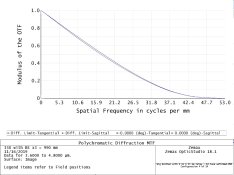
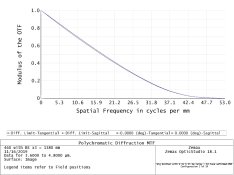
As an example, the following are what MTF plots I can share of a 50x zoom lens that I designed in 2013 (the date in the plots are today's date when I dredged up the design and captured these plots, but I worked this design in the spring of '13). It required on-axis diffraction-limited performance across the entire range of focal lengths. This was the upper range of focal lengths for a two-objective system.. hence "big brother" in the title. The other half, "little brother", extended the focal length range to 138x -- overall the focal length ranged from 10mm to 1380mm at the same f/# -- with overlap at the lower focal lengths.

At 25mm focal length
25mm.jpg
At 330mm focal length
330mm.jpg
At 990mm focal length
990mm.jpg
At 1380mm focal length
1380mm.jpg

Other examples cannot be shared, and I cannot and won't share further information on this design. It simply serves as a real-world example.

In any case, perhaps now you understand what I mean when I say I am speaking from experience, and that it is possible to achieve consistent performance across the entire range of a zoom design. I can say this because I've achieved it myself many times over my lens design career, of which you see one example here. The old myth that zoom lenses cannot be as good as a fixed lens are, in this day and age, just that: A Myth.

What you don't know is what the design team decided was "good enough" MTF performance across the range of focal lengths... you are making an assumption which may not be correct. If you see a performance variation across the range of your modern zoom lens, it's because there are other considerations (size, weight, cost, schedule) that came into play during the design of that lens. As a general statement about optical design: Rarely is optical performance pushed to the max at the sacrifice of all other considerations. I only see that in astronomical telescopes, where optical performance is the most important consideration.
 
Last edited:
In any case, perhaps now you understand what I mean when I say I am speaking from experience, and that it is possible to achieve consistent performance across the entire range of a zoom design. I can say this because I've achieved it myself many times over my lens design career, of which you see one example here. The old myth that zoom lenses cannot be as good as a fixed lens are, in this day and age, just that: A Myth.

What you don't know is what the design team decided was "good enough" MTF performance across the range of focal lengths... you are making an assumption which may not be correct. Il.

The lens test reports by photozone. de are done by ONE set of testers using uniform conditions across all lens brands and body brands tested.

Indeed, it is improper to directly compare MTF values published by different testing bodies. it is even improper to compare Rodenstock lens tests vs. Schneider lens tests!

I conclude with the statement that the tests by photozone.de are objective measurements with statements of absolute resolution per picture height... there is no assessment of what is good enough versus not good enough ..there is no subjective labelling of resolution... They only report the hardn resultant from their uniformly done tests.

I do NOT state that zooms can never be equal to fixed focal length lenses. I am in fact a contrarian to that position; I know that that recent zoom lenses today have performance in excess of fixed focal lenses that were in their day superlative lenses, but fall which nowbehind the newest zoom designs!
 
Last edited:
Photrio.com contains affiliate links to products. We may receive a commission for purchases made through these links.
To read our full affiliate disclosure statement please click Here.

PHOTRIO PARTNERS EQUALLY FUNDING OUR COMMUNITY:


Ilford ADOX Freestyle Photographic Stearman Press Weldon Color Lab Blue Moon Camera & Machine
Top Bottom