• Welcome to Photrio!
    Registration is fast and free. Join today to unlock search, see fewer ads, and access all forum features.
    Click here to sign up

Is it possible to make a DIY LED splitgrade system?

Recent Classifieds

Forum statistics

Threads
201,819
Messages
2,830,621
Members
100,968
Latest member
Enrico_S
Recent bookmarks
0

dkonigs

Subscriber
Joined
Sep 17, 2009
Messages
387
Location
Mountain View, CA
Format
Multi Format
Weird, but at least its still something you can buy.

At some point I might have to just order a newer Intrepid head to make sure I'm wiring it all up correctly. But for any "adapter" it likely makes the most sense to just use screw/solder terminals and wire it up with whatever cable is requested.

Its a shame that neither of their chosen cables are friendly to just having an actual mount-able connector on the timer side.
 

tcolgate

Subscriber
Allowing Ads
Joined
Aug 28, 2025
Messages
112
Location
London
Format
Medium Format
Its a shame that neither of their chosen cables are friendly to just having an actual mount-able connector on the timer side.

They are very ver focused on that connection being water tight for some reason. Maybe its something they hut in a regulatory review, or just being ultra focused on it bein in super confined spaces with trays of liquid.? It is weird though. Its not super high current or voltage there and they could have had a connector straight into the LED head.
Still, in these circumstances I just assume they had a reason.
 

dkonigs

Subscriber
Joined
Sep 17, 2009
Messages
387
Location
Mountain View, CA
Format
Multi Format
They are very ver focused on that connection being water tight for some reason. Maybe its something they hut in a regulatory review, or just being ultra focused on it bein in super confined spaces with trays of liquid.? It is weird though. Its not super high current or voltage there and they could have had a connector straight into the LED head.
Still, in these circumstances I just assume they had a reason.

Its really hard to tell, given that there's absolutely nothing even remotely "water tight" about either their head or their timer. Or the power adapter's connection to the timer, for that matter.

It feels more like they didn't want to have a connector there at all, but it wasn't practical to have the two pieces permanently wired together.

Of course there's always concern about a cable being accidentally yanked out, especially when fiddling with the enlarger head. Maybe that's it.
 

jseidl

Member
Allowing Ads
Joined
Aug 7, 2013
Messages
27
Location
Erlangen, Ge
Format
35mm RF
Hello,

I had a chance to briefly see the Heiland Splitgrade system in action and I would really like it for some applications. But the price of the solution and the light source is out of my reach right now.
But I wonder how difficult it would be to put something like that together? I'm assuming it wouldn't be that fancy and comfortable.

It doesn't even have to be a fully automatic system. Let's say I have a basic electronic and programming skills and some of the following equipment:

Darkroom Automation Meter /RH Designs ZoneMaster/ another meter for measuring light levels.
Reflection densitometer for measuring density on paper.
Light source with suitable blue and green LEDs (maybe red for easel work) with PWM dimming.
Microcontroller (ESP32, Arduino MEGA) for light control and exposure management.

So i have the ability to measure/calibrate the paper and control exposure to blue and green light.

How to find out the parameters for splitgrade? Does anyone have an idea?
Thank you very much.

I just made one for my personal workflow, including a TSL2591 sensor probe, a webapp to program the dodge and burn sequences and a 3d printed LED head for my Kaiser and Focomat 2c. Totally over engineered and everyone else will hate it, but I have a specific need to address my problems staying focussed due to adhd.
Uploaded a video of the timer here: (sorry, just a quick and dirty demo, nothing fancy)
Some background on the build can be found here: https://adarkroomhelperdeluxe.wordpress.com Will also put some description of the functionality there soon. But I'll still have to experiment with brighter LEDs. In general this is still very much work in progress, but I've already been using it for a few weeks like this and pretty happy with it so far.
Happy to share more details in a separate thread if anyone is interested.
 
OP
OP

kuhyraco

Member
Allowing Ads
Joined
Feb 10, 2025
Messages
21
Location
Europe
Format
Large Format
Forget about official "grades" as they are just fairly arbitrary ranges of ISO-R. To "calibrate" your grades, all you need is a Stouffer step tablet and some paper. You can define the grades as a combination of blue and green exposure within your specific implementation of a light source.

W.r.t. the light source, for b&w multigrade you can use whatever arrangement of blue and green LEDs you like. These can be strips, stars, individual (smd) LEDs on a PCB, COB etc. Whatever you choose, you'll have to make a light path that results in even exposure of the negative. Duffusion-based systems are easy to make; just experiment a bit with LED arrangement and e.g. milky plexiglass.

As to the controller, use any old Arduino etc of your choice with and LCD hooked up to it and buttons, rotary encoders and keypads as you see fit. Making a simple timer with two PWM outputs isn't very complicated.

This is a pretty straightforward project that many have undertaken; it's definitely feasible, just get cracking and have fun!

So if I have an array of blue and green LEDs, what would be the easiest way to determine the ratios so that they are evenly distributed?
The extreme values are clear, only green or blue LEDS on...but how to proceed for the intermediate steps? Do a larger number of tests with the Stouffer tablet and then choose from the measured ISO R?
Should I add 10% at a time? 90:10, 80:20, etc.?
 

koraks

Moderator
Moderator
Joined
Nov 29, 2018
Messages
26,882
Location
Europe
Format
Multi Format
The extreme values are clear, only green or blue LEDS on
Not quite; you generally need to mix in a tiny bit of blue with the green to get a decent grade 0 or grade 00. With just pure green you often end up in some kind of below-zero twilight zone, and on some papers that can be very non-linear. On other papers, you can end up with no possibility to get a decent black on that grade. So add a little bit of blue; you could use a Stouffer print to hit something like grade 00 or so, or whatever you find useful as a grade at the lower extreme of the scale.

Do a larger number of tests with the Stouffer tablet and then choose from the measured ISO R?
That's what I did before I realized I could just as well forget about grades altogether. Yes, do a bunch of Stouffer prints and then plot the results. Using the plot, you can determine which mix you need for which grade. This is fairly simple/straightforward; things get a little tricky if you want your settings to behave like the Ilford Multigrade filters and produce the same exposure time across various grades, but that's also possible.
 

dkonigs

Subscriber
Joined
Sep 17, 2009
Messages
387
Location
Mountain View, CA
Format
Multi Format
Not quite; you generally need to mix in a tiny bit of blue with the green to get a decent grade 0 or grade 00. With just pure green you often end up in some kind of below-zero twilight zone, and on some papers that can be very non-linear. On other papers, you can end up with no possibility to get a decent black on that grade. So add a little bit of blue; you could use a Stouffer print to hit something like grade 00 or so, or whatever you find useful as a grade at the lower extreme of the scale.
This is interesting... Lately I've been doing some bench-tinkering with an Ilford 500 system to figure out its interface on an electronics level, and one of my to-do items there is mapping out its exact blue/green control signals for each combination of settings.
In the process of that, I noticed that the highest/lowest grades are all blue or all green. Of course I haven't yet mapped out the specifics, but eventually I will. Then again, this thing uses filtered halogen bulbs and not LEDs, so the light is not going to be as wavelength-pure as an LED system would be.
 
OP
OP

kuhyraco

Member
Allowing Ads
Joined
Feb 10, 2025
Messages
21
Location
Europe
Format
Large Format
Not quite; you generally need to mix in a tiny bit of blue with the green to get a decent grade 0 or grade 00. With just pure green you often end up in some kind of below-zero twilight zone, and on some papers that can be very non-linear. On other papers, you can end up with no possibility to get a decent black on that grade. So add a little bit of blue; you could use a Stouffer print to hit something like grade 00 or so, or whatever you find useful as a grade at the lower extreme of the scale.

Well, I quickly came across some gaps in my knowledge :smile: Thanks.

That's what I did before I realized I could just as well forget about grades altogether. Yes, do a bunch of Stouffer prints and then plot the results. Using the plot, you can determine which mix you need for which grade. This is fairly simple/straightforward; things get a little tricky if you want your settings to behave like the Ilford Multigrade filters and produce the same exposure time across various grades, but that's also possible.

Ideally, I would like to achieve a speedmatch, but from what I understand, it is only possible for one tone, for example highlights.
Now I'm content with evenly spaced "grades", for the one paper I use most often. with some kind of table for exposure compensation in stops.

Do you have any tips on a clear procedure to achieve this?
 

koraks

Moderator
Moderator
Joined
Nov 29, 2018
Messages
26,882
Location
Europe
Format
Multi Format
Ideally, I would like to achieve a speedmatch, but from what I understand, it is only possible for one tone, for example highlights.

That's correct. The benefit of a DIY solution is that of course you get to choose at what point in the tonal curve you want to match the times! Having said that, I implemented an algorithm for this once in an older version of my own LED head, but didn't bother with it in later versions.

Do you have any tips on a clear procedure to achieve this?
Not really; I'd just start by doing some strips with mixes of various ratios e.g. 10/90, 20/80 etc. and then plot the ISO-R you determine on the basis of a step tablet in Excel. Then make a chart from that and see how it behaves; take it from there.
 

BHuij

Member
Allowing Ads
Joined
Oct 12, 2016
Messages
961
Location
Utah
Format
Multi Format
I did my own custom LED head that allows me to change filter grades with a knob. 16x16 arrray of neopixel LEDs behind a diffuser panel, and a custom controller build around a Pico RP2040 and coded with CircuitPython. Works awesome. Ironically one of the reasons I built it was because I wanted to try split grade printing, and it was a huge pain to do so by swapping out physical Ilford MG filters in my condenser head. My experiments with split grade printing were brief and I no longer use the technique anymore, but I sure do love the LED head still.
 

albada

Member
Allowing Ads
Joined
Apr 10, 2008
Messages
2,177
Location
Escondido, C
Format
35mm RF
Not quite; you generally need to mix in a tiny bit of blue with the green to get a decent grade 0 or grade 00.

I discovered the same thing the hard way a while ago. With Ilford papers, reaching D-max requires so much exposure that the rest of the print will be too dark, producing mud. Graphically, the H-D curve has a very long shoulder, and adding a few percent of blue shortens it enough to make reasonable prints.

BTW, the ATmega328P has only two 16-bit PWMs, and to print in color we need three. So I switched to the Raspberry Pi Pico.

Mark Overton
 

dkonigs

Subscriber
Joined
Sep 17, 2009
Messages
387
Location
Mountain View, CA
Format
Multi Format
I did my own custom LED head that allows me to change filter grades with a knob. 16x16 arrray of neopixel LEDs behind a diffuser panel, and a custom controller build around a Pico RP2040 and coded with CircuitPython. Works awesome. Ironically one of the reasons I built it was because I wanted to try split grade printing, and it was a huge pain to do so by swapping out physical Ilford MG filters in my condenser head. My experiments with split grade printing were brief and I no longer use the technique anymore, but I sure do love the LED head still.

Psss... For anyone wanting to take the easy route, the Intrepid LED enlarger head is basically this design (array of RGBW Neopixel-style LEDs behind a diffuser).
 
OP
OP

kuhyraco

Member
Allowing Ads
Joined
Feb 10, 2025
Messages
21
Location
Europe
Format
Large Format
I did my own custom LED head that allows me to change filter grades with a knob. 16x16 arrray of neopixel LEDs behind a diffuser panel, and a custom controller build around a Pico RP2040 and coded with CircuitPython. Works awesome. Ironically one of the reasons I built it was because I wanted to try split grade printing, and it was a huge pain to do so by swapping out physical Ilford MG filters in my condenser head. My experiments with split grade printing were brief and I no longer use the technique anymore, but I sure do love the LED head still.

Psss... For anyone wanting to take the easy route, the Intrepid LED enlarger head is basically this design (array of RGBW Neopixel-style LEDs behind a diffuser).

I was considering neopixel/ws2812b LEDs. I really like the simplicity of working with them.
I initially rejected them because of the wavelength of the blue, but according to many, this should not be a problem.

But in the end, the biggest limitation for me was the low power. I have no idea how many diodes Intrepid crammed into his head, but for a larger negative (5x7 or 8x10) it just didn't work for me (of course, theoretically on paper). I was considering ready-made available solutions (neopixel panels, ws2812b on a strip, etc.), not my own PCB.

I read somewhere about the problem-free enlargement of 4x5 negatives using the Neopixel 16x16 array, even to a size of 50x60cm. But one diode has a maximum consumption of around 60mA at R+G+B at 100%. Even if each color had 20mA, it would be a maximum of 25W with 256LEDs. But I saw somewhere that in reality the power consumption is half that. And that's really not much light.
 

BHuij

Member
Allowing Ads
Joined
Oct 12, 2016
Messages
961
Location
Utah
Format
Multi Format
I've done informal tests with mine when I was figuring out the right blends of blue and green light to match Ilford MG filters, and did not find the condenser head to offer a better dmax at any grade than the LED head. Grade 5 is however 100% blue with no green. Now that I have a proper reflection densitometer, I have plans to revisit these tests and do them a bit more scientifically, as well as adding 1/4 grades into the controller (currently it only does half grades). For the life of me I can't find my order confirmation email that would tell me the exact model number of the 16x16 array I'm using, but the lights on it were either WS2812 or WS2812b.

Not sure what Intrepid is using or how much power they get. I get enough brightness that with 6x6 or 4x5 negatives, I generally have to use between 2 and 4 stops of "neutral density" (really just careful dimming) to get exposure times above 10 seconds at the lens sweet spot aperture (that's printing 8x10s). With 35mm I usually don't need ND for 8x10s, but sometimes need a stop or so for 5x7s.

Yes, n=1 and all that, and I print larger than 11x14 only extremely infrequently. But if my math checks out, I would be in very comfortable enlargement times even at 16x20 with my 256 LEDs, from a 4x5 negative. What attenuates the light is that I mask out the area around the negative at the negative stage when I'm printing smaller than 4x5, so I'm really only using a fraction of what's being produced, particularly when printing from 35mm negatives. In any case, I haven't found power to be a problem in real world use.
 
OP
OP

kuhyraco

Member
Allowing Ads
Joined
Feb 10, 2025
Messages
21
Location
Europe
Format
Large Format
Thanks for the insights.

I admit that I'm getting lost in the available information. When I look at the discussions here on Photrio or LF Photography, everywhere it is written about the necessity of using blue LEDs with a certain wavelength in order to be able to even approach a really hard gradation.

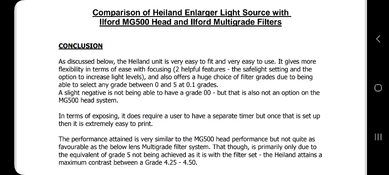
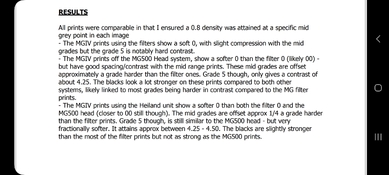
Ilford tested the Heiland LED light, its MG500 and MG filters and both the Heiland and the MG500 did not achieve as hard gradation as MG filters.

Screenshot_20260104_085602_OneDrive.jpgScreenshot_20260104_085642_OneDrive.jpg
https://heilandelectronic.de/files/Heiland_Enlarger_Head_Report.pdf

But then at the same time I read how with addressable LEDs, where "ordinary" blue around 465nm is used, people have no problem achieving the same hard gradation as with filters.
 

koraks

Moderator
Moderator
Joined
Nov 29, 2018
Messages
26,882
Location
Europe
Format
Multi Format
Ilford tested the Heiland LED light
A couple of centuries ago...also, there are several iterations/versions of "the" Heiland LED head. It's not even clear they use the same wavelengths for blue.

where "ordinary" blue around 465nm is used, people have no problem achieving the same hard gradation as with filters.
The question is also on which papers, specifically. Some papers don't do a true grade 5 to begin with. E.g. look at the Fomaspeed Variant III datasheet and its grade "5", which is more like a 4+:
1767516875369.png

Then there's the fickle issue of real-world curves not necessarily being the same as the neat plots in datasheets:
1767516457931.png

Above is a test I did on Fomaspeed paper with various wavelengths. Note how the toe of the (single!) 480nm wavelength exposure isn't anything like that of the 450nm exposure.
Also, in my interpretation/measurement, the highest grade was ISO-R 60, which is in my understanding grade 4.
Please do not misinterpret the plot above as a plot of various grades on this paper!!

So what's a "true grade 5" to begin with? It depends on definitions, as well as measurement methodology (which part of the curve do you use to determine ISO-R), as well as the paper you use, and perhaps a number of other things.

Now what, you might ask?

I'd consider the following:

If you want to enjoy the easy programming and spacing of RGB-LEDs like the WS2812 (and the conceptually similar ones used by Intrepid), then don't worry about it at all, because none of these products AFAIK has a shorter-wavelength blue anyway.
If you are OK with using your own selection of blue, green and red in distinct LEDs, and you want to play safe, go with 450nm blue. It'll work great.
If you want to get to the bottom of things, and are OK with potentially getting lost in a mass of definitions, curve shapes, differences in interpretations etc., then order a couple of flavors of blue and do your own testing with the papers you intend to use a lot.

Note that the first thing I said in this thread was "Forget about the official grades". Perhaps you're now beginning to understand why.

 
OP
OP

kuhyraco

Member
Allowing Ads
Joined
Feb 10, 2025
Messages
21
Location
Europe
Format
Large Format
A couple of centuries ago...also, there are several iterations/versions of "the" Heiland LED head. It's not even clear they use the same wavelengths for blue.

The report is from March 2017, when Heiland introduced a version of the LED source and controller on YouTube that looks the same as the one still offered. But maybe there was some fundamental change, I don't know.

By the way, Heiland has changed ownership and name, so I'm curious where they'll be heading.
https://heiland-vision.de/

The question is also on which papers, specifically. Some papers don't do a true grade 5 to begin with. E.g. look at the Fomaspeed Variant III datasheet and its grade "5", which is more like a 4+:

Then there's the fickle issue of real-world curves not necessarily being the same as the neat plots in datasheets:

Above is a test I did on Fomaspeed paper with various wavelengths. Note how the toe of the (single!) 480nm wavelength exposure isn't anything like that of the 450nm exposure.
Also, in my interpretation/measurement, the highest grade was ISO-R 60, which is in my understanding grade 4.
Please do not misinterpret the plot above as a plot of various grades on this paper!!

So what's a "true grade 5" to begin with? It depends on definitions, as well as measurement methodology (which part of the curve do you use to determine ISO-R), as well as the paper you use, and perhaps a number of other things.

Now what, you might ask?

I'd consider the following:

If you want to enjoy the easy programming and spacing of RGB-LEDs like the WS2812 (and the conceptually similar ones used by Intrepid), then don't worry about it at all, because none of these products AFAIK has a shorter-wavelength blue anyway.
If you are OK with using your own selection of blue, green and red in distinct LEDs, and you want to play safe, go with 450nm blue. It'll work great.
If you want to get to the bottom of things, and are OK with potentially getting lost in a mass of definitions, curve shapes, differences in interpretations etc., then order a couple of flavors of blue and do your own testing with the papers you intend to use a lot.

Note that the first thing I said in this thread was "Forget about the official grades". Perhaps you're now beginning to understand why.

I primarily use Foma papers, but only FB, Fomabrom Variant. When I made my curves with Ilford MG filters, G4-5 came out very similar to Ilford MGIV FB paper.
With Ilford filter 5 I got ISO R 45, with color head Meopta I got ISO R 75.

I don't need a "true grade", I just want to know what I can get out of the paper with my equipment.
 

john_s

Member
Allowing Ads
Joined
Nov 19, 2002
Messages
2,205
Location
Melbourne, A
Format
Medium Format
The report is from March 2017, when Heiland introduced a version of the LED source and controller on YouTube that looks the same as the one still offered. But maybe there was some fundamental change, I don't know.

By the way, Heiland has changed ownership and name, so I'm curious where they'll be heading.
https://heiland-vision.de/
...............................

It would be interesting for me to know if the higher grades are now a bit higher if the design has been improved since 2017. Also, interesting is the change of ownership
 

BHuij

Member
Allowing Ads
Joined
Oct 12, 2016
Messages
961
Location
Utah
Format
Multi Format
Yeah this is a good point - I've only ever used Ilford MG FB (or MGIV before the naming convention changed; I'm not sure one way or another whether MGIV and MG FB are actually meaningfully different). The spread of tones contact printed through a Stouffer wedge with 100% blue light using the "dmax through base" exposure looked identical to that produced by the condenser head and the Ilford Grade 5 filter. Identical in the sense that the place where I seemed to hit a paper base white and the place where I could no longer differentiate tonality in the dark parts of the print were the same. Nothing more scientific than that. But with this paper and the developers I've used with it (Dektol, Ilford MG, and E-72), I don't find I'm ever hurting for contrast. After all, I develop the majority of my negatives with the goal of printing them at grade 2, so it's not common I have to go higher than grade 3 anyway, let alone 4 or 5.
 

Pieter12

Member
Allowing Ads
Joined
Aug 20, 2017
Messages
8,186
Location
Magrathean's computer
Format
Super8
FWIW, my Heiland head prints much harder than using filters. That is, the #5 exposure is much shorter than what I would use with an Ilford #5 filter. And the blacks are as intense.
 

albada

Member
Allowing Ads
Joined
Apr 10, 2008
Messages
2,177
Location
Escondido, C
Format
35mm RF
If you are OK with using your own selection of blue, green and red in distinct LEDs, and you want to play safe, go with 450nm blue. It'll work great.

It'll work great, unless you use crummy LEDs. Lower quality LEDs splatter light across more of the spectrum, reducing the contrast obtainable with blue. For example, I compared a cheap violet-LED with a good Cree blue, and the blue produced higher contrast. Cree LEDs will serve you well, but buy them from reputable sellers to ensure they're not fakes.

Mark Overton
 

jseidl

Member
Allowing Ads
Joined
Aug 7, 2013
Messages
27
Location
Erlangen, Ge
Format
35mm RF
Psss... For anyone wanting to take the easy route, the Intrepid LED enlarger head is basically this design (array of RGBW Neopixel-style LEDs behind a diffuser).

@dkonigs Do you already know how the Intrepid panel is controlled by any chance (Pin Out)? I am using my DIY timer for my DIY LED heads that I used to convert my existing enlargers. This is using direct PWM only though. Looking for a more portable enlarger now and consider getting the Intrepid compact enlarger. But don't want to lose the comfort functions of my DIY timer. I have briefly looked into the Neopixel arrays, but it looks like they need 3 wires to the controller (data, 5V and GND). In another thread I read that the Intrepid uses only 2 wires though. So I am a bit confused if those are really the same thing.
 

koraks

Moderator
Moderator
Joined
Nov 29, 2018
Messages
26,882
Location
Europe
Format
Multi Format
In another thread I read that the Intrepid uses only 2 wires though.
Looks to be a 3-pin arrangement as would be expected. Of course 2 pins is possible if e.g. the head gets its power directly from an external power supply and the controller and the head only link with GND and Data. However, I assume that Intrepid have kept things simple with a control box that supplies both power and data to the head, requiring only two boxes and one cable between them. This is also consistent with the product description and photos on their website.
 

jseidl

Member
Allowing Ads
Joined
Aug 7, 2013
Messages
27
Location
Erlangen, Ge
Format
35mm RF
Ah, you're right. I think I misread the 'It's only a two wire setup' part in the post you quoted. Thought only 2 of the 3 pins are used. But now it's clear. Thanks!
Still didn't find any pin out diagram anywhere. Hopefully it should be straight forward to identify when I get one and open it myself. Unfortunately it can't be fully seen here
 

koraks

Moderator
Moderator
Joined
Nov 29, 2018
Messages
26,882
Location
Europe
Format
Multi Format
Hopefully it should be straight forward to identify when I get one and open it myself.
It will be. If you look at the video at 22:12 he has the light source open and there's three leads visible, red, black & blue. Those will be easily traced to +V, GND and data, and using a continuity tester you can easily verify which is which on the connector. But...you already knew this, having built your own systems!

Btw, I'm still amazed at how (for lack of a better word) amateurish the hardware on the Intrepid system is. Pot meters for setting filter values, a bog standard Nano clone, a hobby LCD with I2C backpack...this is evidently made by someone with hobby level EE skills. Hey, it works, so that's OK...
 
Photrio.com contains affiliate links to products. We may receive a commission for purchases made through these links.
To read our full affiliate disclosure statement please click Here.

PHOTRIO PARTNERS EQUALLY FUNDING OUR COMMUNITY:


Ilford ADOX Freestyle Photographic Stearman Press Weldon Color Lab Blue Moon Camera & Machine
Top Bottom