Of course Kodak knew about it. Ron Mowrey of this very forum explained it. We agreed that it was a distinct improvement over earlier Ektar 25, but involved its own kind of tradeoff. The lower curve warming crossover or "mud" characteristic of most color neg films was their formula to "pleasing skintones", but also dumped similar hues into the same bin, making related yellows, oranges, and tans often almost indistinguishable. That includes Fuji CN films too. This gradually improved but never disappeared. Ektar took its own path of evolution and to a real extent solved that chronic problem, but doing so, still has some underlying cyan crossover problems. Color dyes aren't perfect, and further improvement is warranted. But that doesn't mean the Kodak engineers can simply snap their fingers and have it done. It's apparently a complex issue.
Average viewers, like I already implied, are just so accustomed to color errors, especially in neg films, that they take them for granted.
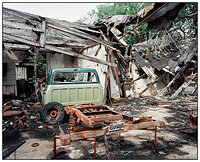
Many have exploited these same idiosyncrasies for creative purposes. Ektar is relatively new, and not amenable to the old 70's pumpkin versus poison green palette like Stephen Shore, for example, took advantage of. Ektar better fits the bill as a potential replacement for the look of chrome film when wisely handled - a very clean, well-balanced and saturated palette, provided one knows a few tricks.
It the likelyhood of green crossover into the blue, or a cyan inflection to blue, which is the biggest problem with Ektar, and which therefore requires stronger correction than a mere UV filter can provide, depending. A reasonable amount of actual color temp correction itself is necessary. I wasted a LOT of time and money learning that the hard way with 8x10 Ektar. Eventually, a highly experienced Hollywood cinematographer explained the whole situation to me. Of course, many times those experts deliberately overdo the correction to attain an amber "Godfather" movie look. But they do that relative to a very serious knowledge of how film itself behaves, for which they're accordingly paid very well. What they take for granted to make a good living is exactly the kind of thing so many film shooters on this forum outright deny, or shrug their shoulders at. And those big budget movie productions have access to far more skilled and sophisticated digital tweaks and corrections than the common crowd has, yet even they, whenever possible when using actual color film, still do the corrections with filtration over the lens at the time of shooting itself. That is just common sense. It's far more difficult and expensive to post-correct.
Serious film lighting is itself a higher notch up. Quite a bit of cinema filming is done in this area, and the specialized HMI and even high-end LED panels are generally rented to film crews due to the high cost of this equipment. This level of quality and color fidelity is specialized, and not the kind of thing you're going to find in any camera store. But there is still some use of traditional Lowell and Arri hot lights.