
Which method do you use to keep your film flat?You’re doing something wrong.
Critical focus is important.
That includes flatness and parallel sensor and film.
For large print work, it’s important to macro and stitch. Also to take exposures at different light levels and f stops to get all the shadow information.
A good drumscan can accurately “punch” through high Dmax slide, but can also avoid blooming and veiling in shadow areas on negative.
The same can be done with camera scanning with careful technique and gefühl, without the negative impact on micro aperture scanning on ultimate resolution.
-
Welcome to Photrio!Registration is fast and free. Join today to unlock search, see fewer ads, and access all forum features.Click here to sign up
You are using an out of date browser. It may not display this or other websites correctly.
You should upgrade or use an alternative browser.
You should upgrade or use an alternative browser.
Imacon Flextight II
-
H
- Thread starter campy51
- Start date
Recent Classifieds
-
For Sale Hasselblad V Adapter To Linhof
- Started by Jessxi
-
Sold Niko28mm f3.5 PC-Nikkor
- Started by Rayt
-
Want to Buy Rapid Rectilinear lens for 8x10 or larger
- Started by blee1996
-
Free GONE French lens probably early XIXcentury
- Started by Gaston 012
-
Sold Ilford 4x5 FP4+ (Expired June 2023)
- Started by CreationBear
Forum statistics

The film holder. What else? That’s the whole point.Which method do you use to keep your film flat?
In this case a Durst glass holder with a drop of naphtha in between the glass.
Doesn’t get much flatter than that.
Less will do just fine though.
Edit: I’ve been playing around with the idea of just projecting directly onto the sensor in a darkened room.
But that would necessitate a glass body cap and a really dark room.
As is now, with a macro lens with a deep lens shade on the camera, I manage fine with a murky room.
Last edited:
Facts are facts. Numbers are numbers.
It’s an ok scanner if you look at nothing else but the results. But only that.
The second you start to look at all other factors it’s dead.
The results are the whole point of using an Imacon.
If you are satisfied with the results from your Epson scanner or whatever, and don’t want to go to the time, trouble, and expense of acquiring, maintaining, and using an Imacon, just say so.
Last edited:
Are you in any way or shape reading what I’m writing?The results are the whole point of using an Imacon.
If you are satisfied with the results from your Epson scanner or whatever, and don’t want to go to the time, trouble, and expense of acquiring, maintaining, and using an Imacon, just say so.
Are you in any way or shape reading what I’m writing?
Yes, which I why I quoted you in my reply. Was my reply not reply responsive to your post?
Last edited:
I have never mentioned or recommended Epson scanners, or flatbeds at all.
I’m saying (quite clearly I might add) that camera scanning, if done with diligence, is better than Imacon or and even drumscans.
So it is about the result and the rest.
There is nothing magical about the other scanner types that would make them better.
The only possible thing could be the colour filters being more saturated and not Bayered, but even that is a moot point, with the right technique.
I’m saying (quite clearly I might add) that camera scanning, if done with diligence, is better than Imacon or and even drumscans.
So it is about the result and the rest.
There is nothing magical about the other scanner types that would make them better.
The only possible thing could be the colour filters being more saturated and not Bayered, but even that is a moot point, with the right technique.
Last edited:
I have never mentioned or recommended Epson scanners, or flatbeds at all.
Which is why I said “or whatever”.
With respect to scanning with a digital camera, I tried that after being dissatisfied with the results of an Epson V700, and, given my poor old tired eyes, focusing using that little screen on the back of the camera or the even smaller screen in the viewfinder was iffy. I foresee some difficulty for you accurately focusing when projecting an image from an enlarger head directly to a digital camera sensor. Not to mention framing. I used an Imacon at a workshop and was very happy with the results. The scans were better than either the V700 or the digital camera approach. Not that I am all that interested in scanning, but we had to because we had to share our work with others. My solution: when I shoot film, I make analog prints. It eliminates scanning. I find the whole attitude that digital sucks or is at least inauthentic except when you scan film and post it to the internet or make inkjet prints ludicrous.
Last edited:
No of course you don’t use the cameras screen!Which is why I said “or whatever”.
With respect to scanning with a digital camera, I tried that after being dissatisfied with the results of an Epson V700, and, given my poor old tired eyes, focusing using that little screen on the back of the camera or the even smaller screen in the viewfinder was iffy. I foresee some difficulty for you accurately focusing when projecting an image from an enlarger head directly to a digital camera sensor. I used an Imacon at a workshop and was very happy with the results. They were better than either the V700 or the digital camera approach. Not that I am all that interested in scanning, but we had to because we had to share our work with others. My solution: when I shoot film, I make analog prints. It eliminates scanning. I find the whole idea that digital sucks or is at least inauthentic except when you scan film and post it to the internet or make inkjet prints ludicrous.
You tether it to your computer and trigger it “remotely”.
Don’t touch the camera or setup at all for several seconds before exposure.
I can’t even see the screen in my setup.
For an analog photographer, you sure do have a lot of digital stuff involved in your workflow.
Last edited:
So you don’t want a computer involved?For an analog photographer, you sure do have a lot of digital stuff involved in your workflow.
At this point aren’t you just making conversation?
So you don’t want a computer involved?
Not with film. For digital it is obviously required.
We are talking about scanning here.Not with film. For digital it is obviously required.

I was discussing my experience with scanning. My experience with scanning is that if you want to shoot film, you are better off making analog prints if what you are after is the analog aesthetic. If you want to scan, I liked the results of the Imacon better than both the Epson V700 and using a digital camera as a scanner.We are talking about scanning here.
Oh, in that you are right.I was discussing my experience with scanning. My experience with scanning is that if you want to shoot film, you are better off making analog prints if what you are after is the analog aesthetic. If you want to scan, I liked the results of the Imacon better than both the Epson V700 and using a digital camera as a scanner.
Printing is not something most people do casually though.
RA4 is foreboding to many and slide is better scanned these days.
And if you want to scan to print large, or use it for a book you’ll not want to scan a print.
A 8x10 print will not capture all the detail a frame of good 135 film has either.
For that you need bigger paper and a bigger scanner.
- faberryman
- Deleted

grat
Member
I was discussing my experience with scanning. My experience with scanning is that if you want to shoot film, you are better off making analog prints if what you are after is the analog aesthetic. If you want to scan, I liked the results of the Imacon better than both the Epson V700 and using a digital camera as a scanner.
You know, no matter how many times I tape a print to my monitor, no one has ever seen it.
So other than stroking it in your cave, and calling it your precious, how do you let other people see your prints?

or use it for a book you’ll not want to scan a print.
A print scan, if done well, using an appropriate scanner, can be incredibly good. The only significantly better approach is high quality art repro using cross-polarisation etc.
-

- Old Gregg
- Deleted
You know, no matter how many times I tape a print to my monitor, no one has ever seen it. So other than stroking it in your cave, and calling it your precious, how do you let other people see your prints?
The usual way. It is a little known fact that people made photographs before Facebook and Instagram were created. Some of those photographs were pretty good. Granted, since I don’t post my photographs on Facebook or Instagram, I don’t have any likes or followers. I don’t make photographs to garner likes or followers on Facebook or Instagram. Some people do. If you would like me to look at your photographs, send me a link and I’ll be happy to do so.
Last edited:
Some do.
That depends on whether you want a flat neutral file to use and manipulate.A print scan, if done well, using an appropriate scanner, can be incredibly good. The only significantly better approach is high quality art repro using cross-polarisation etc.
If you made a darkroom masterpiece naturally you want it as close as possible to the print.
Slide is made to project or separate/scan.
C-41 is probably in between.
If I could print every colour photo I wanted to scan, and had the massive chops and time it takes to get a perfect result quickly with RA4, sure I’d do it.
But scanning also has its benefits, especially with difficult/problematic exposures that are hard to print.
Last edited:
The most exquisite photographs I think I’ve seen were hand-tinted daguerreotypes.Never met an "analog photographer" in my life... We, mammal photographers, love how film captures light. Once we have the negative game's over. From that point your responsibility is to NOT FUCK IT UP. If you print it on paper, you fucked it up. Did not scan properly? Fucked it up. etc. Just master how to transfer it from the negative into your retina. That's what computers are for.
Moose22
Member
Why are you people feeding this troll?
He's being a dick, just to be a dick, and derail the conversation. Congrats, you've helped him. The entire second page had nothing to do with helping OP.
He's being a dick, just to be a dick, and derail the conversation. Congrats, you've helped him. The entire second page had nothing to do with helping OP.
He’s just a benign sea lion. I’m done with the subject.Why are you people feeding this troll?
He's being a dick, just to be a dick, and derail the conversation. Congrats, you've helped him. The entire second page had nothing to do with helping OP.
The OP had his answers long ago.
I passed on it.
Not sure about the older Flextight model but I got a Imacon scan done by AGX lab in the USA. I live in the NZ and it is so expensive that I send my film to the USA for processing, I also buy my fresh film from the USA.
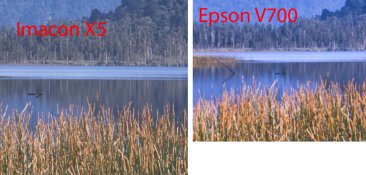
Here is a side by side comparison with my Epson V700 using the better scanning film holder. Versus the X5 Imacon. Epson is scanned at 2400pi which is what most pple say is the maximum detail that it gets. Attached photo is a 100% view crop section. Fuji Velvia 50 RVP 120 format, RB67.
Here is a side by side comparison with my Epson V700 using the better scanning film holder. Versus the X5 Imacon. Epson is scanned at 2400pi which is what most pple say is the maximum detail that it gets. Attached photo is a 100% view crop section. Fuji Velvia 50 RVP 120 format, RB67.
Attachments
| Photrio.com contains affiliate links to products. We may receive a commission for purchases made through these links. To read our full affiliate disclosure statement please click Here. |
PHOTRIO PARTNERS EQUALLY FUNDING OUR COMMUNITY:  |