


• Welcome to Photrio!
    Registration is fast and free. Join today to unlock search, see fewer ads, and access all forum features.
    Click here to sign up

I'm getting really thin negs...help :)

Recent Classifieds

Forum statistics

Threads
201,850
Messages
2,831,127
Members
100,984
Latest member
Larrygaga00
Recent bookmarks
0

pdeeh

Member
Allowing Ads
Joined
Jun 8, 2012
Messages
4,770
Location
UK
Format
Multi Format
It means that xmas has a a personal view of how fomapan responds to high contrast scenes, one which will not necessarily be shared by other people who have different views, eyes, cameras, meters, preferences.

if you try to listen to what everyone has to tell you about how to shoot film here, you can end up very confused indeed, because there are so many contradictory voices. There are a handful of people whose opinions and suggestions are really worth listening to but it takes a while to work out who they are. MattKing is one of them, I think.
 
OP
OP

cattonizer

Member
Allowing Ads
Joined
Sep 17, 2015
Messages
12
Format
4x5 Format
Your EDIT is correct.

If the purpose of your exercise is to calibrate your processing, you might want to use a subject that doesn't require bellows extension.

IIRC, anything at least 10x the lens' focal length should work as a subject distance.

Also, IIRC, others have pointed out that Fomapan's reciprocity failure characteristics are fairly extreme.

Thanks - I'll do some tests without extensions. I'm interested in streamlining film, camera and chemicals for a project I'll be working on for the next year or so. Mostly still life shot indoor with natural light. I've done a lot of colour, produced at lab, and this has been very easy. Although B/W was my personal entry to photography, 14 years ago, it's feels so good to be back...this time with 4x5. I love the troubleshooting and experimenting aspect.

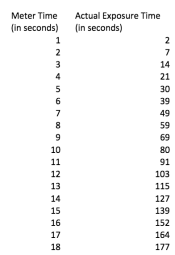
Yeah I found a reciprocity card via google. It looked extreme compared to what I'm used to myself. I've added a screenshot.
 

Attachments

  • Screen Shot 2015-09-18 at 10.49.58.png
    Screen Shot 2015-09-18 at 10.49.58.png
    34.7 KB · Views: 82
Joined
Sep 10, 2002
Messages
3,676
Location
Eugene, Oregon
Format
4x5 Format
Your developing seems not to be the problem; you should get something close to usable at that time.
You also seem to have ruled out the meter and shutter, since you get good results with them otherwise.

That leaves exposure, i.e., severe underexposure in your case. So check all the things that could cause that in your set-up; film loaded emulsion-side in (as Bill suggests), bellows extension not being taken into account, wrong ISO set on your meter, filters used and not compensated for, stopping down too far accidentally, a change in lighting between metering and shooting, metering a bright area with your meter instead of a mid-tone or shadow (for an averaging or spot meter), etc.

Try another test shot side-by-side with one of your color shots and see what you get.

Best,

Doremus
 

Xmas

Member
Allowing Ads
Joined
Sep 4, 2006
Messages
6,398
Location
UK
Format
35mm RF
It means that xmas has a a personal view of how fomapan responds to high contrast scenes, one which will not necessarily be shared by other people who have different views, eyes, cameras, meters, preferences.

if you try to listen to what everyone has to tell you about how to shoot film here, you can end up very confused indeed, because there are so many contradictory voices. There are a handful of people whose opinions and suggestions are really worth listening to but it takes a while to work out who they are. MattKing is one of them, I think.

My perspective is slightly different, Foma has less dynamic range than FP4+ when processed to the same gamma.
This is only critical with a high contrast scene, I still normally meter with 50 ISO/EI, unless I have time for a zone 1 spot.

Most people who use Foma 100 extensively would concur, it would be mean to not tell the OP and let him/her find out the hard way. You need to split grade template burn and dodge etc. to recover any compression. Or process for a lower gamma.

The data sheet link is not subjective.

I use Foma 100 a lot, no other comments...
 

Rick A

Subscriber
Allowing Ads
Joined
Mar 31, 2009
Messages
10,031
Location
Laurel Highlands
Format
8x10 Format
Sorry, Rick, but that's not correct. In the example you used, the bellows factor is the square of that ratio, i.e., (300/150)^2 = 4. So the meter's recommended shutter speed should be multiplied by four (not two). It probably bears repeating that both the 300 and 150 are distances from film plane to lensboard.

You're correct, my brain fart.
 

Xmas

Member
Allowing Ads
Joined
Sep 4, 2006
Messages
6,398
Location
UK
Format
35mm RF
Sorry, Rick, but that's not correct. In the example you used, the bellows factor is the square of that ratio, i.e., (300/150)^2 = 4. So the meter's recommended shutter speed should be multiplied by four (not two). It probably bears repeating that both the 300 and 150 are distances from film plane to lensboard.

With the proviso that you are not using eg a telephoto lens?
 

removed account4

Subscriber
Allowing Ads
Joined
Jun 21, 2003
Messages
29,832
Format
Hybrid
Hi!

So. My issue is very thin negs (almost transparent and impossible to scan). I'll try and explain my setup:

Film: 4x5 Fomapan 100
Developer: Ilfosol 3
Stop: EcoStop
Fix: EcoFix
Rinse: water and final with PhotoFlow

Shot with:
Speed Graflex
Handheld lightmeter

Ok. So I just made a test with the above. The subject being a plant, shot indoors with even light distributed by window:

I measured the light with settings on ISO 100.
The measured values where: 1/8 on 11.

1) I then did one exposure as: 1/8 on 11.
2) And another one as: 1sec on 11.

I pre-soaked for 5 minutes. Then developed the whole thing in Ilfosol 3 (one shot) at 1:9. 6 minutes. All chemicals at 20 degrees Celsius. Stop. Fix and Rinse. Dried them. The result was:

1) Almost transparent with very little visible information.
2) Much much closer to a usable neg with visible information. But not quite there.

What I'm looking for is to figure out where in my process I should adjust. Am I developing for too short a time? The lightmeter is working fine - but could I be doing something wrong when exposing? The lens seem to operate perfectly. The one bit of information I have on Fomapan in Ilfosol 3, is from the Massive Chart. One entry states 5 minutes at 1:9. Mine was, as noted above, at 6 minutes.

Any help is appreciated, and please do tell if I'm missing vital information.

All the best,

Kim

DISCLAIMER... My old account is no longer in use - I say this so you won't get the idea that I made this account for the purpose of firing off requests for help. I'm a long time user of APUG - both answering and questioning :smile:

hi kim

here's a thread on bellows extension and compensation
(there was a url link here which no longer exists)
post #28 explains it pretty well

you might consider bracketing your exposures and processing
until you decide how you like your system to be, its all inter-related.
you can bracket your exposures by putting a card infront of half your lens
so you don't waste too much film.
development times ( even suggested ones from manufacturers ) are usually a starting point
you might have to change the amount of time you process for ...
btw

how are you actually processing the film, in a automated system? hand tank?
shuffling in trays? in hangers ? depending on how you agitate your film will come out thin or denser as well.

good luck !
john
 

Kirks518

Member
Allowing Ads
Joined
Oct 5, 2013
Messages
1,494
Location
Flori-DUH
Format
Multi Format
Yeah I found a reciprocity card via google. It looked extreme compared to what I'm used to myself. I've added a screenshot.

FYI, each film will have it's own reciprocity failure rate, so the chart you posted may only be for one specific brand/type of film.

The book "Using the View Camera" by Steve Simmons has a good reciprocity failure chart for various films in chapter 7. A great book, with a bevy of info on learning and using LF. It even discusses bellows factor in an easy to understand manner.
 

winger

Subscriber
Allowing Ads
Joined
Jan 13, 2005
Messages
3,980
Location
southwest PA
Format
Multi Format
Yeah I found a reciprocity card via google. It looked extreme compared to what I'm used to myself. I've added a screenshot.

You need to find the one specific to the film you're using. Each film is a little different. I use an app on my iPhone - I think it's called reciprocity timer or something similar? It helps figure the correct time based on film, bellows factor, and filter factor. For those of us who are math challenged, it's GREAT. It's probably my favorite app.
 
OP
OP

cattonizer

Member
Allowing Ads
Joined
Sep 17, 2015
Messages
12
Format
4x5 Format
Hi guys. been away from the computer for some time and came back to even more replies. I wanna thank you all for your input. Some mentioned that each film has it's own specific reciprocity - The screenshot I attached was indeed for the exact film that I'm using, and the one that's being discussed in this thread (fomapan 100). But thanks for the heads up anyways.

hi kim

here's a thread on bellows extension and compensation
(there was a url link here which no longer exists)
post #28 explains it pretty well

you might consider bracketing your exposures and processing
until you decide how you like your system to be, its all inter-related.
you can bracket your exposures by putting a card infront of half your lens
so you don't waste too much film.
development times ( even suggested ones from manufacturers ) are usually a starting point
you might have to change the amount of time you process for ...
btw

how are you actually processing the film, in a automated system? hand tank?
shuffling in trays? in hangers ? depending on how you agitate your film will come out thin or denser as well.

good luck !
john

I developed in a patterson tank on a holder that takes six sheets. What I've done so far is to agitate for one 30 seconds and then for 10 seconds each 30 seconds...but I've moved on to agitating for 30 seconds and then 10 seconds each minute.
 

Xmas

Member
Allowing Ads
Joined
Sep 4, 2006
Messages
6,398
Location
UK
Format
35mm RF
Thanks - I'll do some tests without extensions. I'm interested in streamlining film, camera and chemicals for a project I'll be working on for the next year or so. Mostly still life shot indoor with natural light. I've done a lot of colour, produced at lab, and this has been very easy. Although B/W was my personal entry to photography, 14 years ago, it's feels so good to be back...this time with 4x5. I love the troubleshooting and experimenting aspect.

Yeah I found a reciprocity card via google. It looked extreme compared to what I'm used to myself. I've added a screenshot.

Your chart only goes out to 20 seconds the data sheet goes out to 100 seconds?
I trust you understand it is a non linear effect.

Noel
 

Xmas

Member
Allowing Ads
Joined
Sep 4, 2006
Messages
6,398
Location
UK
Format
35mm RF
That's correct. However, I'm not aware of any 150mm lenses for 4x5 that are telephotos. If one exists, then it would be apparent when focusing it at infinity and measuring the distance from the film plane to wherever its effective center is located (may not be anywhere on the lens).

Yes but I did not say you were wrong merely the general case might be different, and it is unlikely any one would use a telephoto close up eg for quality.
 

removed account4

Subscriber
Allowing Ads
Joined
Jun 21, 2003
Messages
29,832
Format
Hybrid
Hi guys. been away from the computer for some time and came back to even more replies. I wanna thank you all for your input. Some mentioned that each film has it's own specific reciprocity - The screenshot I attached was indeed for the exact film that I'm using, and the one that's being discussed in this thread (fomapan 100). But thanks for the heads up anyways.


I developed in a patterson tank on a holder that takes six sheets. What I've done so far is to agitate for one 30 seconds and then for 10 seconds each 30 seconds...but I've moved on to agitating for 30 seconds and then 10 seconds each minute.

hi

sorry i am not familiar with the paterson system, is that the mod54 insert ?
Dead Link Removed
the instructions on their website say agitate for 60 seconds first minute then 10 seconds every minute ( like you would for roll film )
it also says "don't be shy with the agitation"
so my guess is if you are using this system you aren't agitating enough ...
and i am guessing if you are under agitating your film so it is thin ...
i'd agitate as the instructions suggest and see how that goes ?
you can always increase your development time if even with the 1/min 10sec/min scheme doesn't give you enough meat.
when i typically over develop my film and over expose it a little to get the contrast range and density i like ...

i looked but couldn't find instructions for the metal 4x5 paterson reels, have seen'em but never heard of anyone using them ..
i am guessing if they are in a hand tank they get agitated the same way as other metal reel'd film, like the mod54,
i'd suggest agitating, 1 full min, 10sec/min after that ...
as suggested earlier, under agitation/under developing = thin film...


have fun ( and good luck ) !
john
 
Last edited by a moderator:
OP
OP

cattonizer

Member
Allowing Ads
Joined
Sep 17, 2015
Messages
12
Format
4x5 Format
Your chart only goes out to 20 seconds the data sheet goes out to 100 seconds?
I trust you understand it is a non linear effect.

Noel

It was just a quick cropped screenshot. The chart goes further.
 
OP
OP

cattonizer

Member
Allowing Ads
Joined
Sep 17, 2015
Messages
12
Format
4x5 Format
hi

sorry i am not familiar with the paterson system, is that the mod54 insert ?
Dead Link Removed
the instructions on their website say agitate for 60 seconds first minute then 10 seconds every minute ( like you would for roll film )
it also says "don't be shy with the agitation"
so my guess is if you are using this system you aren't agitating enough ...
and i am guessing if you are under agitating your film so it is thin ...
i'd agitate as the instructions suggest and see how that goes ?
you can always increase your development time if even with the 1/min 10sec/min scheme doesn't give you enough meat.
when i typically over develop my film and over expose it a little to get the contrast range and density i like ...

i looked but couldn't find instructions for the metal 4x5 paterson reels, have seen'em but never heard of anyone using them ..
i am guessing if they are in a hand tank they get agitated the same way as other metal reel'd film, like the mod54,
i'd suggest agitating, 1 full min, 10sec/min after that ...
as suggested earlier, under agitation/under developing = thin film...


have fun ( and good luck ) !
john

Exactly! It's the Mod54. Regarding agitating, if anything, I've been agitating too much. I mentioned in an earlier reply that I've started out actually agitating every 30 seconds. From now on Ill be doing it as stated on the mod54 website as well as the datasheets for Fomapan 100 (they seem to be identical). I believe my thin negs are caused by not taking into account both reciprocity failure and bellows.
 
Photrio.com contains affiliate links to products. We may receive a commission for purchases made through these links.
To read our full affiliate disclosure statement please click Here.

PHOTRIO PARTNERS EQUALLY FUNDING OUR COMMUNITY:


Ilford ADOX Freestyle Photographic Stearman Press Weldon Color Lab Blue Moon Camera & Machine
Top Bottom
