• Welcome to Photrio!
    Registration is fast and free. Join today to unlock search, see fewer ads, and access all forum features.
    Click here to sign up

I would like to shoot some Macro with my 500 C/M . . .

Valencia

A
Valencia

  • 1
  • 1
  • 52
Tied to the dock

D
Tied to the dock

  • 4
  • 0
  • 91

Recent Classifieds

Forum statistics

Threads
203,092
Messages
2,849,727
Members
101,659
Latest member
Dirksen
Recent bookmarks
0
OK, if it doesn't tilt (or swing), then it won't affect DoF at all. I wasn't clear on that. Shift (or rise/fall) doesn't affect it anyway.
If the bellows offers no movements, it's really the same as variable-length extension tube.

In this case the shift movement is quite helpful to bring back the center of the image to its initial position after tilting.
 
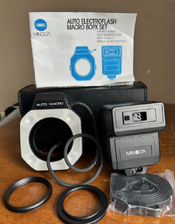
That 50mm macro on the X-370 is a great setup. My father-in-law used one on an X-570 to photograph the orchids he was breeding. As part of the MD system, Minolta also made an “Auto Macro” circular flash to mount specifically on that lens. I got one from KEH and plan to use the system, as you are, to learn macro photography. The flashes are $50-100 on eBay.

Edit: In a senior moment I forgot that this will begin on our next vacation in an area where lots of flowers are grown commercially.
 
Last edited:
That 50mm macro on the X-370 is a great setup. My father-in-law used one on an X-570 to photograph the orchids he was breeding. As part of the MD system, Minolta also made an “Auto Macro” circular flash to mount specifically on that lens. I got one from KEH and plan to use the system, as you are, to learn macro photography. The flashes are $50-100 on eBay.

Edit: In a senior moment I forgot that this will begin on our next vacation in an area where lots of flowers are grown commercially.

Thanks for the advice. Is this the unit you are referring to?
 

Attachments

  • Screenshot 2026-03-31 083706.png
    Screenshot 2026-03-31 083706.png
    606.6 KB · Views: 14
The main distinction is that with the bellows you can manipulate the focal plane using Scheimpflug movements. The actual depth of field for the same lens, same magnification and same aperture will actually be the same. This is a hard rule of physics. Very simply put: there's distance between the lens and the film and it matters not one whit whether the thing that spaces them is a ring, a bellows or a cardboard box.

Note furthermore that manipulating the focal plane can work if the desired focal plane is not parallel to the film plane, but also only for that purpose. E.g. it will not help (and in practice, even the opposite) to accommodate increased sharpness of a 3D-object - i.e. it will not make the depth of field larger.

Bellows = more flexible, that's for sure. Whether the nature of the flexibility they afford is relevant, depends on the situation.

No you can't. No Hasselblad bellows extension has any movements. They are all rigid. The Rollei SL66 had a bellows focusing mechanism that did allow some tilts (swings if you turn the camera sideways).

Get a set of extension tubes (Hasselblad had I think an 8mm, a 16mm, a 32mm, maybe a 45 or 48mm tube, a variable extension tube whose extension range I don't recall, and then the macro-bellows. In addition to the 120mm Makro-Planar (I had one of these, absolutely fantastic for macro work, a bit too sharp and harsh for being a good portrait lens), there is also the 135mm S-Planar that has no focusing helicoid of its own, so it must be used with the variable extension tube and/or the bellows. Because they require an accessory to focus, they are generally cheaper than the 120 Makro-Planar lenses.

 
No you can't. No Hasselblad bellows extension has any movements. They are all rigid. The Rollei SL66 had a bellows focusing mechanism that did allow some tilts (swings if you turn the camera sideways).

Get a set of extension tubes (Hasselblad had I think an 8mm, a 16mm, a 32mm, maybe a 45 or 48mm tube, a variable extension tube whose extension range I don't recall, and then the macro-bellows. In addition to the 120mm Makro-Planar (I had one of these, absolutely fantastic for macro work, a bit too sharp and harsh for being a good portrait lens), there is also the 135mm S-Planar that has no focusing helicoid of its own, so it must be used with the variable extension tube and/or the bellows. Because they require an accessory to focus, they are generally cheaper than the 120 Makro-Planar lenses.

There are no movements to any of the extension tubes and by the time you buy the above list, including the varitube, you should be spending the same amount of money as the bellows and 135c lens, and still have a greater range the tubes,

Unless you have regular set of lens to subject distance settings you work at, I suggest you get a bellows first, then expand your range of kit.

IMO
 
There are no movements to any of the extension tubes and by the time you buy the above list, including the varitube, you should be spending the same amount of money as the bellows and 135c lens, and still have a greater range the tubes,

Unless you have regular set of lens to subject distance settings you work at, I suggest you get a bellows first, then expand your range of kit.

IMO

I poorly edited that comment. I meant to say that that was the range of available options, not that they should buy them in that order. I would start with two or three of the tubes as they're easier to work with and (generally) cheaper. I did not say there were movements with the tubes - I was simply stating the fact that there are no movements available with the bellows extension of any variety.

If you want to use the 135 S-Planar, then you're looking at either the variable tube or the bellows, as it has no focusing mechanism of its own (which is why it is often cheaper than the 120 Makro-Planar). The inexpensive version of the bellows requires a double cable release, which is often separated from the bellows and is hard to find on its own. They're also fussy as you have to play with the positioning of each cable to make sure it fires the body and lens in the correct sequence. Otherwise you end up with blank film (or completely blown out film, but most likely the former). The newer version of the bellows has an automatic triggering mechanism that does not require a double cable release, and is much more useful (and several times more expensive).
 
You can use two, single cables to fire camera/bellows, and notes/tabs on each are a help


You can also use third party double releases, if you've a mind to
 
Photrio.com contains affiliate links to products. We may receive a commission for purchases made through these links.
To read our full affiliate disclosure statement please click Here.

PHOTRIO PARTNERS EQUALLY FUNDING OUR COMMUNITY:


Ilford ADOX Freestyle Photographic Stearman Press Weldon Color Lab Blue Moon Camera & Machine
Top Bottom