I need help fixing my RA4 workflow

Simpler Time

A
Simpler Time

  • 0
  • 0
  • 33
Rural Ohio

Rural Ohio

  • 3
  • 0
  • 36

Recent Classifieds

Forum statistics

Threads
201,055
Messages
2,818,324
Members
100,496
Latest member
Incredulousk
Recent bookmarks
0

soysos

Member
Allowing Ads
Joined
Oct 8, 2012
Messages
77
Format
Multi Format
Did my first color print session yesterday. Using Fuji crystal archive, and my own chemistry. I’m using a jobo for temperature control, with the developer and bleach trays, but the fixer at room temperature. Initially I was doing develop for 1:00, rinse with running water for 0:30, bleach for 2:00 in ferricyanide, rinse again, fix for 3:00. Ended up with a blue cast on the borders, so I thought I fogged the paper. But it got worse as I went. Thought it might not be fixing enough before turning the lights on. Mixed fresh fixer, went 5:00, continued to get worse. Eventually I skipped the bleach. White borders. So clearly the ferricyanide is getting contaminated very quickly. Any suggestions on how I can fix this? My thoughts so far have been bleaching after the fix. Maybe trying peroxide copper sulfate bleach instead. Or it might be as simple as adding a stop bath. Am I on the right track?
 

koraks

Moderator
Moderator
Joined
Nov 29, 2018
Messages
25,951
Location
Europe
Format
Multi Format
The problem most likely is that in your process, there is some developer carry-over into the ferricyanide bleach bath. This instantly oxidizes especially in the top layer of the paper, where the cyan dye coupler is. So you get a cyan cast. It may trend towards blue if the middle layer is also involved where the magenta coupler is.

Or it might be as simple as adding a stop bath.
That's one thing and I would also add a sulfite clearing bath after the stop bath.

The best advice I could give you is to not use a ferricyanide bleach. The paper is not made for this, and as you've observed, it can cause problems also during processing. To add to this, there are compounds in the paper that protect the dyes against oxidation by free radicals in the environment. By using a ferricyanide bleach, you destroy these compounds, which shortens the expected lifespan of the paper (also in dark storage). It's really not a good idea unless you're OK with your prints fading and/or yellowing prematurely. Don't blame Fuji in that case.

In anticipation of the question: I don't know if a copper sulfate bleach is sufficiently benign to avoid the archival problem indicated above.

If you are located in a Western country, the best option bar none is to use a proper RA4 blix. The process will also be quicker as it's a single step.
 
OP
OP

soysos

Member
Allowing Ads
Joined
Oct 8, 2012
Messages
77
Format
Multi Format
The problem most likely is that in your process, there is some developer carry-over into the ferricyanide bleach bath. This instantly oxidizes especially in the top layer of the paper, where the cyan dye coupler is. So you get a cyan cast. It may trend towards blue if the middle layer is also involved where the magenta coupler is.


That's one thing and I would also add a sulfite clearing bath after the stop bath.

The best advice I could give you is to not use a ferricyanide bleach. The paper is not made for this, and as you've observed, it can cause problems also during processing. To add to this, there are compounds in the paper that protect the dyes against oxidation by free radicals in the environment. By using a ferricyanide bleach, you destroy these compounds, which shortens the expected lifespan of the paper (also in dark storage). It's really not a good idea unless you're OK with your prints fading and/or yellowing prematurely. Don't blame Fuji in that case.

In anticipation of the question: I don't know if a copper sulfate bleach is sufficiently benign to avoid the archival problem indicated above.

If you are located in a Western country, the best option bar none is to use a proper RA4 blix. The process will also be quicker as it's a single step.

Copper sulfate was the standard formula, before switching over to ferric ammonium. That’s why I’m considering it. Because I can’t get ferric ammonium.
 

koraks

Moderator
Moderator
Joined
Nov 29, 2018
Messages
25,951
Location
Europe
Format
Multi Format
Copper sulfate was the standard formula, before switching over to ferric ammonium.

I don't think it ever was in RA4 and it definitely wasn't in the period when today's Fuji papers originated. But like I said, I don't know either way. I'd be hesitant.

I can’t get ferric ammonium.
Where you live you have no access to something like this? https://kodak.photosys.com/collections/color-pr/products/color-print-sp-bleach-fix-replenisher-10l
 
OP
OP

soysos

Member
Allowing Ads
Joined
Oct 8, 2012
Messages
77
Format
Multi Format
I don't think it ever was in RA4 and it definitely wasn't in the period when today's Fuji papers originated. But like I said, I don't know either way. I'd be hesitant.


Where you live you have no access to something like this? https://kodak.photosys.com/collections/color-pr/products/color-print-sp-bleach-fix-replenisher-10l

I do. But that’s 20L. It will go bad long before I’ve gotten my money’s worth. But it looks like adding a stop bath fixed the problem. Makes processing a bit of a hassle, since I can’t put them in a straight line. But it works.
 

Attachments

  • IMG_6847.jpeg
    IMG_6847.jpeg
    256.5 KB · Views: 35

mshchem

Subscriber
Allowing Ads
Joined
Nov 26, 2007
Messages
15,615
Location
Iowa City, Iowa USA
Format
Medium Format
I do. But that’s 20L. It will go bad long before I’ve gotten my money’s worth. But it looks like adding a stop bath fixed the problem. Makes processing a bit of a hassle, since I can’t put them in a straight line. But it works.

Well done!

If you can post your process in detail.
 

Samu

Member
Joined
Jul 4, 2023
Messages
232
Location
Lithuania
Format
35mm
Did my first color print session yesterday. Using Fuji crystal archive, and my own chemistry. I’m using a jobo for temperature control, with the developer and bleach trays, but the fixer at room temperature. Initially I was doing develop for 1:00, rinse with running water for 0:30, bleach for 2:00 in ferricyanide, rinse again, fix for 3:00. Ended up with a blue cast on the borders, so I thought I fogged the paper. But it got worse as I went. Thought it might not be fixing enough before turning the lights on. Mixed fresh fixer, went 5:00, continued to get worse. Eventually I skipped the bleach. White borders. So clearly the ferricyanide is getting contaminated very quickly. Any suggestions on how I can fix this? My thoughts so far have been bleaching after the fix. Maybe trying peroxide copper sulfate bleach instead. Or it might be as simple as adding a stop bath. Am I on the right track?

There are no separate bleach and fix steps in RA-4, although the concentrates are commonly sold in two parts. They are meant for making one solution, bleach-fix, which will perform both bleaching and fixing. This differs from the official versions of C-41, ECN-2 and E-6, which all use separate bleach and fix. Many "simplified" home kits" for the aforementioned processes are based on Tetenal´s press kits from the 1980´s, and use "blix" instead, as does standard RA-4. Using the bleach and fixer parts of the bleavh fix will probably not work as intended. There is some tolerance in temperature in RA´4, much more so than in film processes, In tubes, heating is probably not essential for 45 seconds long developing and bilx times. This does not mean you won´t need any temperature control though. Running this process in room temperature would have visible impact on results, but you don´t need a margin of +- 0.3°C for this process, nor does exceeding times by by a few seconds make any remarkable difference.
 

Samu

Member
Joined
Jul 4, 2023
Messages
232
Location
Lithuania
Format
35mm
Copper sulfate was the standard formula, before switching over to ferric ammonium. That’s why I’m considering it. Because I can’t get ferric ammonium.

Never in RA-4, or even in the Kodak standard of its predecessor, EP-2. I did those prints since I was about 13 years old - that was in 1988. It had similar blix as RA-4 has today. I did it both at home in drums, and I helped in a photo store, who had a minilab, This was n Finland, where I lived as a kid. Having been most my adult life in the Baltics though, I know there were some processes used in the Easterm bloc, mainly based on older Agfa processes. But I don´t know, did osme of them use CuSO4 instead of ferric ammonium EDTA.
 
OP
OP

soysos

Member
Allowing Ads
Joined
Oct 8, 2012
Messages
77
Format
Multi Format
There are no separate bleach and fix steps in RA-4, although the concentrates are commonly sold in two parts. They are meant for making one solution, bleach-fix, which will perform both bleaching and fixing. This differs from the official versions of C-41, ECN-2 and E-6, which all use separate bleach and fix. Many "simplified" home kits" for the aforementioned processes are based on Tetenal´s press kits from the 1980´s, and use "blix" instead, as does standard RA-4. Using the bleach and fixer parts of the bleavh fix will probably not work as intended. There is some tolerance in temperature in RA´4, much more so than in film processes, In tubes, heating is probably not essential for 45 seconds long developing and bilx times. This does not mean you won´t need any temperature control though. Running this process in room temperature would have visible impact on results, but you don´t need a margin of +- 0.3°C for this process, nor does exceeding times by by a few seconds make any remarkable difference.

I’m not using commercial chemistry. I’m making my own. Developer and fixer are easy enough. But since I can’t find ferric EDTA, I’m using ferricyanide instead. Which does not play well with fixer. Or developer. Or stop bath. And it doesn’t work well at room temperature.
 
OP
OP

soysos

Member
Allowing Ads
Joined
Oct 8, 2012
Messages
77
Format
Multi Format
Well done!

If you can post your process in detail.

I have a jobo rotary processor, but don’t have any drums for it. So I just use it as a temp controlled water bath. In it I have 2 5x7 trays with developer and ferricyanide bleach. With a third balanced precariously in the middle for stop bath. Then there’s a table to the right with my print washer and a tray of fixer. Develop 2:00, stop :30, wash :30, bleach 1:00, wash :30, fix 3:00. All that back and forth in total dark is a bit of a hassle. But my darkroom is 65°, so I really need the warmer. Might try just using 1 tray, with the chemistry in bottles in the warming bath. Or bleaching after fixing, with the lights on. Or just keep practicing till it’s normal. I don’t know yet.
 

mshchem

Subscriber
Allowing Ads
Joined
Nov 26, 2007
Messages
15,615
Location
Iowa City, Iowa USA
Format
Medium Format
I have a jobo rotary processor, but don’t have any drums for it. So I just use it as a temp controlled water bath. In it I have 2 5x7 trays with developer and ferricyanide bleach. With a third balanced precariously in the middle for stop bath. Then there’s a table to the right with my print washer and a tray of fixer. Develop 2:00, stop :30, wash :30, bleach 1:00, wash :30, fix 3:00. All that back and forth in total dark is a bit of a hassle. But my darkroom is 65°, so I really need the warmer. Might try just using 1 tray, with the chemistry in bottles in the warming bath. Or bleaching after fixing, with the lights on. Or just keep practicing till it’s normal. I don’t know yet.

Lots of people here can chime in. Not sure you need to stay in the dark once the developer is neutralized by the stop bath.

I, still, on occasion use an old Kodak Rapid Color processor, it's a great machine, however it needs total darkness for the 45 seconds of developer, once I get blix going I turn on a light. I've almost always have used a quick Kodak stop bath between the developer and the blix. Not really needed for 1 shot with standard RA4 chemistry, old habits die hard.
 

mshchem

Subscriber
Allowing Ads
Joined
Nov 26, 2007
Messages
15,615
Location
Iowa City, Iowa USA
Format
Medium Format


Back in the 60's this was revolutionary stuff. Point here is following developer is a stop bath, then white light is OK.
 

koraks

Moderator
Moderator
Joined
Nov 29, 2018
Messages
25,951
Location
Europe
Format
Multi Format
But that’s 20L. It will go bad long before I’ve gotten my money’s worth.
It's hard to predict whether that will happen - it depends. I've had blix concentrate stay perfectly fine for years, and I've had concentrate go bad within a few weeks. It all depends.

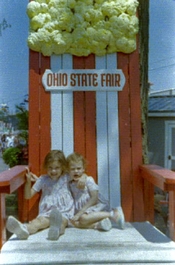
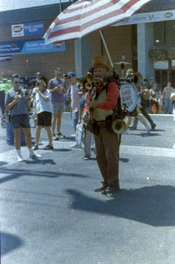
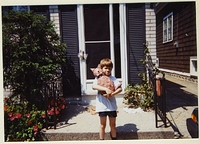
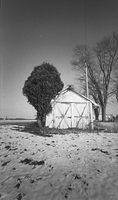
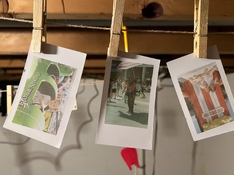
Your prints look in all honesty rather flat and desaturated with low contrast and dmax. Either your exposure times are consistently on the short side due to thin negatives, or (more likely), your developer lacks the 'oomph' of a commercial developer and you need to develop much longer, and/or may never get good density and saturation with it due to the formulation.

I briefly experimented with DIY RA4 developer. I can only recommend getting the proper stuff, although it can be fun starting out with just powders and ending up with color prints. If you're in it for the prints, it's a different story.
using ferricyanide instead. Which does not play well with fixer. Or developer. Or stop bath. And it doesn’t work well at room temperature.
Ferricyanide works just fine at room temperature; it's in fact a very aggressive bleach. That's part of the problem. In principle it works OK with the fixer as well, but has a habit of destroying the fixer, so you need a (or several) rinse bath between bleach and fix. The cyan staining issue is as explained earlier due to a similar effect of the ferricyanide on carried-over developer.

In it I have 2 5x7 trays with developer and ferricyanide bleach. With a third balanced precariously in the middle for stop bath.
Sounds like a chore.
I used to do room-temperature RA4. Just 4 trays; dev, stop, bleach, wash. No heating of anything. 90 second development time with Fuji developer. Lights can come on once the print is in the stop bath. I use (still do, also did back then) the developer and blix in a replenished system. That way, it always works and it's cheap.
 

halfaman

Subscriber
Allowing Ads
Joined
Sep 22, 2012
Messages
1,491
Location
Bilbao
Format
Multi Format
I do. But that’s 20L. It will go bad long before I’ve gotten my money’s worth. But it looks like adding a stop bath fixed the problem. Makes processing a bit of a hassle, since I can’t put them in a straight line. But it works.

Only the fixer part of a Blix is something to worry about, the bleach part needs no care. I keep the fixer in small glass bottles to avoid air oxidation and it works very well for more than a year. Nevertheless, your prints look like you may have also a problem with the developer.

If you are in Europe, Bellini has a 5 liter kit for a reasonable price.
 

arturo_rs

Member
Allowing Ads
Joined
May 4, 2022
Messages
131
Location
Spain
Format
35mm
@koraks I use the CPRA from Fuji for developing my RA4 paper. I don´t have any visible problems but even so, do you recommend using a clearing bath after the stop bath?
 
OP
OP

soysos

Member
Allowing Ads
Joined
Oct 8, 2012
Messages
77
Format
Multi Format
Only the fixer part of a Blix is something to worry about, the bleach part needs no care. I keep the fixer in small glass bottles to avoid air oxidation and it works very well for more than a year. Nevertheless, your prints look like you may have also a problem with the developer.

If you are in Europe, Bellini has a 5 liter kit for a reasonable price.

The low contrast and saturation is a negative issue. Entirely my fault. I got impatient. My chemistry wasn’t hot enough, so they’re underdeveloped. Even substantially compressing the curve, my digital inversions aren’t much better. I have another roll that’s much denser.
 

Attachments

  • APC_0467.jpeg
    APC_0467.jpeg
    119.6 KB · Views: 20
  • APC_0469.jpeg
    APC_0469.jpeg
    131.8 KB · Views: 14
  • APC_0466.jpeg
    APC_0466.jpeg
    120.2 KB · Views: 23
Photrio.com contains affiliate links to products. We may receive a commission for purchases made through these links.
To read our full affiliate disclosure statement please click Here.

PHOTRIO PARTNERS EQUALLY FUNDING OUR COMMUNITY:


Ilford ADOX Freestyle Photographic Stearman Press Weldon Color Lab Blue Moon Camera & Machine
Top Bottom