• Welcome to Photrio!
    Registration is fast and free. Join today to unlock search, see fewer ads, and access all forum features.
    Click here to sign up

I had a total Rodinal failure today . . .

Grill

H
Grill

  • 4
  • 0
  • 58
Cemetery Chapel

H
Cemetery Chapel

  • 3
  • 0
  • 81

Recent Classifieds

Forum statistics

Threads
202,785
Messages
2,845,521
Members
101,522
Latest member
marlinspike
Recent bookmarks
0

Ozark Wolverine

Subscriber
Allowing Ads
Joined
Feb 17, 2022
Messages
65
Location
Mountain Grove, MO
Format
Medium Format
. . . I got this partial bottle in a box of old darkroom stuff for free out of a garage in Albany NY about 10 years ago. It was old then. The labels were in German, it was ADOX with a small print in English "Identical with the product in Europe under the Adenol name". I used it about 6 or 7 years ago and it was fine. Did two 35mm rolls today of tri x 400 with Rodinal at 50 to 1. Almost a total failure The negatives came out solid medium gray with a negative image on the emulsion side. 😟

I was surprised because I have read that Rodinal is pretty much immortal. LOL . . . the bottle had sediment on the bottom so i gave it a good shake. I noticed when I poured it into the tank that the sediment was still separated . . . Oh Well . . live and learn.

No big loss because these were test rolls for some 35 mm cameras I was going to sell . . .
 
The negatives came out solid medium gray with a negative image on the emulsion side.
Well, if you develop TriX, you'd expect a negative image. "Solid medium gray" I interpret as significantly darker than the clear base of TriX. In this case, the problem would not be the developer, since it apparently was capable of developing a heavy layer of fog. It suggests there may be a different problem going on - such as your film having been passed through an airport CT scanner, or the film being expired and stored under adverse conditions.
 
sounds like there are potentially other factors besides the developer that may be influencing the outcome. lets see the negatives.
 
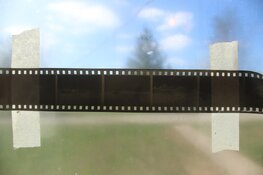
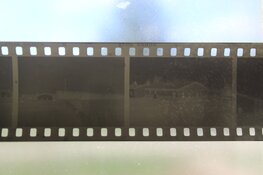
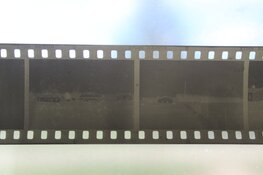
Thanks everyone for your comments. Here are the pics I promised. Note also the mottling. This is the fresh roll with a exp of 08/2027
 

Attachments

  • IMG_0779.JPG
    IMG_0779.JPG
    108.8 KB · Views: 40
  • IMG_0780.JPG
    IMG_0780.JPG
    369.1 KB · Views: 37
  • IMG_0781.JPG
    IMG_0781.JPG
    303.4 KB · Views: 34
  • IMG_0782.JPG
    IMG_0782.JPG
    284 KB · Views: 44
Last edited:
As you can see there is settling of the developer.

Re: the film.
One was a fresh roll purchased about 10 months ago from B&H and frozen, the other is from a brick I was given about 8 years ago and has been frozen for it's entire life, never had any problems with it. Both rolls exhibit exactly the same issues.
 

Attachments

  • IMG_0773.JPG
    IMG_0773.JPG
    121.1 KB · Views: 10
  • IMG_0774.JPG
    IMG_0774.JPG
    428.1 KB · Views: 8
  • IMG_0775.JPG
    IMG_0775.JPG
    395.7 KB · Views: 12
I had blazinal fail, but for me I just got completely blank negatives. Same issue, lots of "rocks" at the bottom of the bottle that wouldn't dissolve.
 
I just thought of something else . . here in the Ozarks our well water has a lot of limestone in it. I typically use Distilled Water for my film developers but this time I used well water.
 
That's a massive amount of dichroic fog. Rodinal 'sudden death' does not explain this in any way. Dead Rodinal gives blank negatives. You've got something else going on.

here in the Ozarks our well water has a lot of limestone in it.
That's insignificant. The massive amount of hydroxide in Rodinal totally swamps the marginal effect that the calcium carbonate in hard water would have on developer activity. It is possible that there's some other type and source of contamination.

Can you give some more details about your developing process, fixer used etc.?

The only time I've had something remotely similar to this happening was with a box of Shanghai sheet film that started to produce strong dichroic fog about a year or so after opening the box.
 
Historically, there have been several versions of Rodinal that can accurately be referred to as Rodinal.
The Blazinal version is one that is sometimes referenced as R-09, is/was probably manufactured by Calbe, and has just as much right to be called a version of Rodinal as a whole bunch of others.
ADOX was successful at getting the rights to use the name Rodinal itself, so they are actually allowed to put that on their labels.
Historically, not every version of Rodinal gave extraordinary longevity. Part of that longevity came from packaging choices.
If the bottle you found was one of the glass stoppered bottles with Agfa on the label, you might have had more chance to get good results, but it might have been better to sell it instead to a collector :smile:
Looking at that brown sludge, in that bottle, I wouldn't have expected it to work well, although I might have been tempted to waste a test roll.
 
Thanks everyone for your comments. Here are the pics I promised. Note also the mottling. This is the fresh roll with a exp of 08/2027

the film in the first photo looks like it is improperly fixed. You should be able to see a lightbulb through it if you hold it up to your eye. dip half a strip back in a tray of your fixer for a few minutes and see if it clears better. add a scrap of film leader for comparison perhaps and time the clear time. you can do it in room light as your film has already seen daylight
 
. . . I got this partial bottle in a box of old darkroom stuff for free out of a garage in Albany NY about 10 years ago. It was old then.

I wonder, did you get the fixer you used here from that same garage too?
 
Can you give some more details about your developing process, fixer used etc.?

I am pretty meticulous with my darkroom procedures to prevent cross contaminations. I developed with Rodinal 1 to 50 at 71 Degrees for 11 minutes or so. Then indicator stop bath for one minute, then a 10 minute wash. I did not fix because these were test rolls for several cameras I am selling. I did use a digital meat thermometer to confirm the developer and stop bath temps, but I rinsed it in between the two with running water. I use the Massive Dev app on my smart phone . . .
 

Attachments

  • IMG_0783.JPG
    IMG_0783.JPG
    128.4 KB · Views: 0
Definitely try to re-fix, if these negatives are worthy of the effort. Get some nice fresh juice next go. 😊

I Did not fix because these were test rolls. I typically use TF-5 Archival Fixer. I will presoak the negs and then Fix with TF-5
 
Last edited:
Look, if you don't fix, you have a truckload of undeveloped silver halide on the film. If you then wash for 10 minutes and somehow there's a reducer that makes its way into the wash (trace amounts of sulfur for instance), you'll get a massive amount of dichroic fog. That's probably what happened here.

B&W processing has considerable leeway in how you do the process, but if you stray too far from the path, problems can occur. Deliberately skipping fix is definitely something that can pose problems.
 
I'm sorry, I find it very hard to give a straight-faced answer at this point.

Develop film according to any basic guide and then see what happens.

This is my first time developing in 5 or 6 years. I must have confused fixer with HCA. I believe HCA can be skipped . . . but not Fixer . . my mistake. I will today fix and see what the results are.

Yes I am a dumbass 🙄 🙄
 
Last edited:
Wait, are you being serious about that?
 
Photrio.com contains affiliate links to products. We may receive a commission for purchases made through these links.
To read our full affiliate disclosure statement please click Here.

PHOTRIO PARTNERS EQUALLY FUNDING OUR COMMUNITY:


Ilford ADOX Freestyle Photographic Stearman Press Weldon Color Lab Blue Moon Camera & Machine
Top Bottom