• Welcome to Photrio!
    Registration is fast and free. Join today to unlock search, see fewer ads, and access all forum features.
    Click here to sign up

How would "Sunny 16" be applied at altitude, at the equator?

Somewhere...

D
Somewhere...

  • 2
  • 1
  • 63
Iriana

H
Iriana

  • 6
  • 1
  • 123

Recent Classifieds

Forum statistics

Threads
202,740
Messages
2,844,937
Members
101,494
Latest member
FlyingDutchman
Recent bookmarks
0

Loren Sattler

Subscriber
Allowing Ads
Joined
Dec 25, 2005
Messages
386
Location
Toledo, Ohio
Format
Medium Format
I was shooting Tmax 100 today at ASA50 on an outing in Equador at 11,000 ft altitude with a Nikon F2 with a yellow filter at mid day. The weather was cloudy, no shadows which would be a 3-4 stop increase from sunny 16. With heavy clouds (no shadows) the meter in my F2 was indicating f8 at 1/60th shutter speed when I expected it to read about f4 at that speed. This was about a two stops difference (underexposed) from the "sunny 16" rule. Note, I confirmed the F2 readings with my cell phone app. Note, I did not remove the yellow filter for metering.

I usually shoot film near sea level. Should I expect 2 stops more light in these conditions due to high altitude and mid day shooting at the equator? Any experience out there in these conditions?
 
I guess a yellow filter should block UV? Or am I completely wrong?
Thanks,
Etienne
 
It would block too much blue. The 1A should be the better choice.
 
ETN, I think you're correct that metering through the filter should prevent, or mostly negate, the meter reading being affected by UV. All I can say is, 'sunny-16' is a only starting point... but you already know this. Your supposition that altitude and sun angle affect scene brightness is at least partially correct. What I'm unsure of is if 'altitude' affects scene brightness, when UV is filtered out. I think it might but I honestly don't know.

EDIT: I just did a very cursory look for affects of altitude on astrophotographic imagery but didn't find anything specific in the couple of minutes I spent looking. I'd think if anyone would know, it would be those folks.
 
Last edited:
I seem to recall that the atmosphere absorbs about 50% of incident visible radiation at the surface compared to above the atmosphere in space, for overhead sun. This is a loss of one stop.
 
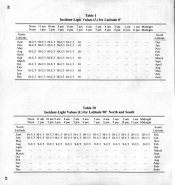
You can look up the various parameters (including latitude) for empiric exposure determination in tables and use a convenient equation to calculate the exposure. (From American Emergency Standard, Photographic Exposure Computer, ASA Z38.2.2--1942)

description.jpg
 
Yay, arithmetic! Back in the 1800s there were tables of relative exposure based on time o day and latitude. But I never saw this standard that gives nonrelative values. Thanks for letting me learn something new today!
 
I repeat.... Kodak made 3 HA filters for UV absorbtion. One is the 2B or 2E for ground level. The others were HA1, HA2, and HA3, each intended for 10,000 ft increments in altitude. Beyond that, things were up in the air. I discussed this with two astronauts trying to clarify things. At present, NASA has answers above this altitude.

PE
 
Alan is quite correct. As I recall from something read many decades ago, sunny 16 is specific for the mid latitudes, since that was where most people who were using cameras lived. Higher and lower latitudes required adjustments. Also seasons of the year. That’s why light meters were invented.
 
All true, but how much does 'altitude' affect exposure if UV is filtered out? :smile:
 
I repeat.... Kodak made 3 HA filters for UV absorbtion. One is the 2B or 2E for ground level. The others were HA1, HA2, and HA3, each intended for 10,000 ft increments in altitude. Beyond that, things were up in the air. I discussed this with two astronauts trying to clarify things. At present, NASA has answers above this altitude.

These were special filters for aerial surveying. They are are not to obtain off the shelf in standard filter mounts.
 
They do answer the question posed regarding exposure though.

And, to some extent, they can be gotten if needed.

PE
 
Yes, as those are gelatin filters you are basically right.
 
Why can't you use the reading given by your F2 light meter Lauren as a basis for your exposure, and bracket a couple of stops, either way,
monochrome film has about seven stops latitude ( three and a half stops either side of the correct one ), I know it isn't very scientific but you should get at least one or two good negatives.
 
Sunny 16 rule works between 10am and 2pm when the sun is high. Season of year and geographic latitude also effect the rule.

Alan is quite correct. As I recall from something read many decades ago, sunny 16 is specific for the mid latitudes, since that was where most people who were using cameras lived. Higher and lower latitudes required adjustments. Also seasons of the year. That’s why light meters were invented.

Yes, in spite of grousing otherwise, photons still work the same as they did in the past. Even with the advent of digital photography the photos still act the same.
 
Ralph W. Lambrecht ran a thread a while back here or on the other site LFFP and quite a few posted their readings of daylight sky. There was remarkable similarity all over the world.
 
With regard to altitude I have noted the following: when I lived in Portland, OR (near sea level) I found that my light meters confirmed the traditional 'sunny 16' light levels. When I lived in Tucson (approx 2500') the same meters confirmed 'sunny 16 1/4' light levels. Next stop was Salt Lake (5050') and the same meters consistently measured 'sunny 16 1/2' light levels. On a recent vacation to Wyoming I took some measurements on Togwotee Pass (approx. 10K') and recorded 'sunny 22.' Based on my data, about a half stop decrease in exposure is required per 5K feet.

All measurements were taken pointing incident meters* at a typical subject on a cloudless, clear blue sky day.

Can anyone else confirm my observations?

*Gossen/Sekonic//Quantum Calculight incident meters.
 
Last edited:
Sunny 16 will work at the equator well since the photons already know what to do.
 
Benjiboy
Why can't you use the reading given by your F2 light meter Lauren as a basis for your exposure, and bracket a couple of stops, either way,
monochrome film has about seven stops latitude ( three and a half stops either side of the correct one ), I know it isn't very scientific but you should get at least one or two good negatives.
Benjiboy, I always prefer to understand what is going on with the technical aspects of photography. Also, it is a nuisance to bracket exposures unless the light is especially difficult. Also, how do you bracket when shooting moving targets such as hand held portraits of young children. It is an asset to be confident in what you are doing.
 
Benjiboy

Benjiboy, I always prefer to understand what is going on with the technical aspects of photography. Also, it is a nuisance to bracket exposures unless the light is especially difficult. Also, how do you bracket when shooting moving targets such as hand held portraits of young children. It is an asset to be confident in what you are doing.
 
Photrio.com contains affiliate links to products. We may receive a commission for purchases made through these links.
To read our full affiliate disclosure statement please click Here.

PHOTRIO PARTNERS EQUALLY FUNDING OUR COMMUNITY:


Ilford ADOX Freestyle Photographic Stearman Press Weldon Color Lab Blue Moon Camera & Machine
Top Bottom