• Welcome to Photrio!
    Registration is fast and free. Join today to unlock search, see fewer ads, and access all forum features.
    Click here to sign up

How to make your print more "three-dimensional"

Gateway in Ronda

A
Gateway in Ronda

  • 1
  • 0
  • 6
Rio Chama 2

A
Rio Chama 2

  • 0
  • 0
  • 25

Forum statistics

Threads
202,622
Messages
2,843,167
Members
101,413
Latest member
USMC46
Recent bookmarks
1

darkosaric

Member
Joined
Apr 15, 2008
Messages
4,567
Location
Hamburg, DE
Format
Multi Format
Hi,

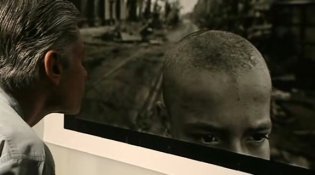
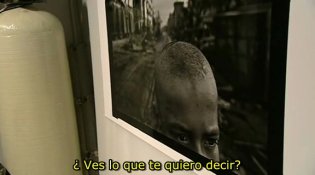
while watching "War photographer" movie I noticed that final prints from James Nachtwey are extremely three-dimensional (ok - they are done by some top fine print expert, but anyhow ...).

Are there some tricks to make prints more "three-dimensional"? I have been told that leitz lenses are more "3D" than other? Or maybe to use some other paper developer than my standard one (ilford multigrade)?

thanks,
 
Try carbon printing -- the prints can be literally 3-D...the blacks rise higher off the paper than the whites, creating a raised relief.

Sorry, not the answer you were looking for, but could not resist! :wink:
 
As is so often the case, it will be a combination of factors. Having good lenses won't hurt, neither will exposing right and seeing and using the light. But I suspect the printing controls like dodging, burning, local contrast enhancement, toning and so on make the most difference. He has a good printer.
 
I think 3d has a lot to do with contrast. Getting it to look really good means many factors have come together properly, including an effective f-stop for a given subject and its distance from the camera. I have a Canon 35/2 with the concave element, and it is tricky to handle just right. What has happened to me with some images is that the subject stands so apart from the background that it looks cut out and pasted on—3d, but in a bad way in this instance.

A back light at about 180 degrees to the key light will greatly enhance the depth of an image. If it is balanced just about 1/2 stop brighter than the key, it looks subtle, without a tell-tale halo, but the depth is enhanced.
 
There are no special tricks here. You need to not discount the skill of the printer. It's not about equipment.
 
Darko,

Could you show us examples, or give us links to examples, of pictures that you see as 3D? Perhaps that would help me understand what you mean and us answer your question.

John Powers
 
Darko,

Could you show us examples, or give us links to examples, of pictures that you see as 3D? Perhaps that would help me understand what you mean and us answer your question.

John Powers

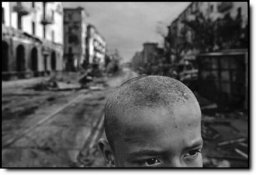
This example is from that movie. Other photos also, but this one most.
 

Attachments

  • james_nachtwey.jpg
    james_nachtwey.jpg
    28.6 KB · Views: 468
Here are the top 5....

5. Expose enough, but not too much. A deep, pure black gives us shadow accents that help us perceive depth in the 2 D pictures.
4. Develop enough, but not too much. Local contrast sets detail against detail, necessary to the illusion.
3. Use light to separate form and mass. We're photographing the light, aren't we ?
2. Use contrasting tones to make the picture. Nachtwey is drawn to scenes that reveal themselves.
1. Learn to see.

Study, learn, practice. Post your successes.

.
 
Did you see prints in person? Can't make any decisions about prints without seeing the real thing...Evan Clarke
 
Posted wirelessly..

Before reading through the replies and having not even looked at the photograph, my first suggestion was shoot close up and opened up as far as feasible. That, coupled with good contrast and, at the very least, decent printing skills would provide a visually engaging image. As long as the camera is not aimed at the trash heap.
 
I agree with pretty much everything stated, but I also think this is a clear case of "good bokah". The out of focus areas blur in a manner similar to how your eye will blur. To my mind this enhances the 3D effect a lot. It is something I noticed when I moved from cheap aftermarket zooms to Nikkor primes, the prints had a lot more "snap" to them.

-Harry
 
The example photograph has a 3 dimensional appearance because, among other things:

1) There is a clear foreground, and an obvious background, and they are well differentiated;
2) The foreground subject is both 3 dimensional, and of a shape that is known to be 3 dimensional, so we recognize it as such. In comparison, the background is somewhat 2 dimensional;
3) The tones and micro-contrast in the foreground are distinctive and attractive. The background is blurred, has more macro-contrast than micro-contrast, and generally is of a different tone, so the foreground and background are strongly differentiated.
 
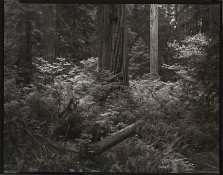
Here is a scan of a carbon print -- you can't see the raised relief, but the image itself seems to have depth to it -- all is in focus, "normal" lens for the format (300mm on 8x10).

It seems to cover the points df mentioned, and the first point (and perhaps the second) the Matt mentioned.
 

Attachments

  • RedwoodVineMaple.jpg
    RedwoodVineMaple.jpg
    128.8 KB · Views: 272
Last edited by a moderator:
darkosaric, weren't you just last week asking about the techniques Salgado used in achieving his "look" ? I think you're missing or (possibly ignoring) very important points that there is no magic recipe or bullet for any of this. Even if a particular look or style could be distilled to something specific, merely using it would not impart the same feeling - and it surely wouldn't appear genuine.

Hard work and attempting to learn what they see will send you down a more fruitful avenue than any attempt at explaining how something was printed. Nachtwey and his printer are both experts at what they do. They didn't get that way overnight.
 
So true

darkosaric, weren't you just last week asking about the techniques Salgado used in achieving his "look" ? I think you're missing or (possibly ignoring) very important points that there is no magic recipe or bullet for any of this. Even if a particular look or style could be distilled to something specific, merely using it would not impart the same feeling - and it surely wouldn't appear genuine.

Hard work and attempting to learn what they see will send you down a more fruitful avenue than any attempt at explaining how something was printed. Nachtwey and his printer are both experts at what they do. They didn't get that way overnight.

Photography just like anything else in life, you just gotta keep practicing to get better. Just like playing a piano or riding a bike. So all APUGers, pick up a camera and shoot some film! :D
 
I do shoot a lot :smile: and print a lot :smile: , specially now in spring and summer ... but in parallel I am trying to discuss with you guys here about some theoretical aspects - I think that this will help me also in making my work better. When I see something that get my attention - I ask here about this. This is only place where I can discuss about it ... it is not like I have 10 friends that are also using film. Everybody around me have D700, D90 and other digi stuff.
 
I do shoot a lot :smile: and print a lot :smile: , specially now in spring and summer ... but in parallel I am trying to discuss with you guys here about some theoretical aspects - I think that this will help me also in making my work better. When I see something that get my attention - I ask here about this. This is only place where I can discuss about it ... it is not like I have 10 friends that are also using film. Everybody around me have D700, D90 and other digi stuff.

Your absolute best bet would be to examine what it is IN the photography you admire that makes your eyes open and react positively to it. One cannot reduce this down to a mathematical or otherwise formula, they can only attempt to figure out some semblance of it and walk in the footsteps of masters. Somewhere during that walk you'll start your own trail.
 
Photrio.com contains affiliate links to products. We may receive a commission for purchases made through these links.
To read our full affiliate disclosure statement please click Here.

PHOTRIO PARTNERS EQUALLY FUNDING OUR COMMUNITY:


Ilford ADOX Freestyle Photographic Stearman Press Weldon Color Lab Blue Moon Camera & Machine
Top Bottom