• Welcome to Photrio!
    Registration is fast and free. Join today to unlock search, see fewer ads, and access all forum features.
    Click here to sign up

How to expose and process expired Ektachrome

Wilhelmine

H
Wilhelmine

  • 0
  • 0
  • 7
JcI_colina.jpg

H
JcI_colina.jpg

  • 0
  • 0
  • 50

Recent Classifieds

Forum statistics

Threads
203,075
Messages
2,849,453
Members
101,637
Latest member
Yashica FX-3 fix
Recent bookmarks
0
How has it been stored?
How much of it do you have, and what format is it?
 
It will be a crap shoot, and the results will be all over the place. It all depends how they were stored.

I typically shoot them at box ISO, and develop in E6 chemistry at normal temperature and time. And pray.

I had a lot of failures with EPP, while mostly ok with less expired E100G.
 
The way I shoot out-of-date Ektachrome (4x5 in my case) is to shoot one sheet at box speed with normal development and assess the results. Then introduce compensation, as indicated. I'd do the same in other formats even if I only has one roll with which to experiment. Tehre are too many variables involved to really support guesswork.
 
How has it been stored?
How much of it do you have, and what format is it?

it is 35mm, from 2003, stored at room temp. I have 18 rolls. Also a few rolls from 1980's and 1970s. I want to develop them as a normal color positive film, for projection on the wall or scanning.
 
Specifics would be helpful...
What version of Ektachrome?
Expired what year, or decade?
How has it been stored?
18 rolls of these, from 2000, says develop before 2003. All stored at room temp.
1692581735543.png


and about 5 of each from 1993, 2002, and 1987 in the respective order.
1692581785999.png


1692581816972.png


can't locate the 1970s rolls yet.
 
Last edited:
I will definitely keep some of them as artefacts/time-capsules, along with my kodachrome rolls.
 
The way I shoot out-of-date Ektachrome (4x5 in my case) is to shoot one sheet at box speed with normal development and assess the results. Then introduce compensation, as indicated. I'd do the same in other formats even if I only has one roll with which to experiment. Tehre are too many variables involved to really support guesswork.

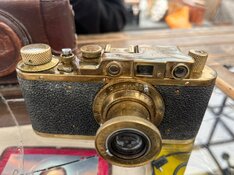
I am thinking of cutting a short snip test-piece and sliding in the back of my Leica iiif, exposing at box speed, developing, then compensating on the next piece. I've done this with other film and the old Leica model makes it easy. Avoids wasting entire roll for a test. But need some initial guidance for development, especially the old film.
 
Last edited:
Develop your test(s) normally.
E6 process was introduced in 1976. When you locate the 1970s film, be sure to check that it wasn't designed for the older processes, such as E4.
 
My experience has been very poor with outdated EPP (Ektachrome 100 Plus).
I have had good experience with outdated EN (Ektachrome 100) and Ektachrome 64 that had been frozen.
If your tests show poor results in E6 process, they might cross-process well in C-41...with resulting higher contrast and artsy color shifts.
 
Photrio.com contains affiliate links to products. We may receive a commission for purchases made through these links.
To read our full affiliate disclosure statement please click Here.

PHOTRIO PARTNERS EQUALLY FUNDING OUR COMMUNITY:



Ilford ADOX Freestyle Photographic Stearman Press Weldon Color Lab Blue Moon Camera & Machine
Top Bottom