
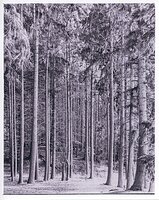
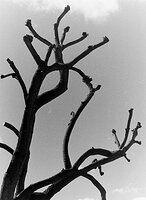

And I think it's because there was no haze to get. So I conclude Atget got haze in his photos when it was present.
And when it wasn't present, he didn't get it
View attachment 423401
Rue St. Rustique, Montmartre, 1922
Agreed. And we'd expect the very blue-sensitive emulsion to show it for sure when it was there, yes?
Anyone know whether it's possible to distinguish halation from flair in Atget's photos? When I get veiling flare with modern coated lenses, the result is ugly degradation of broad and unpredictable areas, not the heartening glow that Atget got.In this photo (Bievres (eglise). 1924), I can see hard shadows, so probably not misty or foggy (but could be smoke). The effect of most atmospheric haze, whether due to moisture or particulate pollution, looks greater in the far distance, but is much less noticeable when viewing objects in the foreground. It is intertesting that the foilage in the upper right, gets very hazy where it meets the sky. But the foilage is relatively near to the camera, so unlikely due to mist, fog, or smoke. I have noticed that most of the hazy atmospheric effect seen in Atget's photos is most obvious in a zone adjacent to the bright sky. To me, this suggests something like film halation or possibly lens flair is more likely the cause of this effect rather than mist or smoke?
