• Welcome to Photrio!
    Registration is fast and free. Join today to unlock search, see fewer ads, and access all forum features.
    Click here to sign up

How to emulate the Atget look

Fusion Energy

A
Fusion Energy

  • 1
  • 0
  • 28
The Outhouse

A
The Outhouse

  • 2
  • 2
  • 38

Recent Classifieds

Forum statistics

Threads
203,470
Messages
2,855,275
Members
101,857
Latest member
FreeRanger
Recent bookmarks
0
I think the time of day had a lot to do with it. Some look like very early morning shots. Perhaps he couldn't sleep unless he was out there living his dream?

You have to wonder how he got to all these places at an early hour. Paris itself is not small, and if we include the outlying villages, it’s quite remarkable. Did he hitch lifts with carters, or walk through the night?
 
I would just get my hands on some ortho film, or even that FPP 120 xray film...If you want to take advantage of no AH layer. I have a roll that I've been meaning to use. Are you planning on hand holding or using a tripod?
I totally missed the 120 X-Ray film on FPP's website -- thanks for bringing it to my attention!

When there is enough light, I sometimes hand-hold my Rolleicord and Zeiss Icon 517/2, but my Agfa Clack needs to be on a tripod due to its slow shutter speed. Sometimes I use the tripod with the Rolleicord even when there is plenty of light because it allows me to frame the scene more precisely.
 
Not so much that, but the general image [of the Holga 120?] has a 19th C. look, low contrast plus the slight vignetting in the corners. And if it is hazy you might get that too, especially against the light. Might be worth a try.
I don't have a Holga, but I do have a FPP DEBONAIR Plastic Filmtastic 120, which I believe may have the same lens(?)
 
You have to wonder how he got to all these places at an early hour. Paris itself is not small, and if we include the outlying villages, it’s quite remarkable. Did he hitch lifts with carters, or walk through the night?
According to Maria Morris Hambourg, Atget traveled by train and tramway from Paris to the villages and countryside south of Paris*. In her Notes to "Old France" (Volume 1 of "The Work of Atget" MOMA), she says:
"...Atget lived near the southern rim of the city, only a block or two from the Montparnasse and Denfert stations from which the southern-bound trains departed, and not much farther from the southern tramway termini. [...] The railroads that served the southern environs, for example, the Ligne de Sceaux and the Ligne d'Arpajon, were short-haul or commuter lines..." [p.153]
"In Album n 11, environs Atget noted the trains and trams that took him to the villages he photographed." [pg. 167]

Atget also did some early "environs" photos in the countryside north of Paris (Somme), but he lived in that region from 1888 to 1892, so he was not traveling from Paris then.

* of course, if you have ever traveled by train, you know the train station is not often located close to where you want to go, so I'm sure he did plenty of walking, too!

 
Last edited:
I am not trying to copy Atget to any great degree, so the title is somewhat misleading. In my defense, I did not write the title of this thread. The title was done by the moderator who created this thread from my post in another thread (@MattKing?).

I am going to treat this as a request for a change - my 1st choice was merely a best guess :smile:
 
As a lesson in contrast (in dual senses of that term), take a look at the blue plate work of Timothy O' Sullivan, of an even earlier era of equipment, but who often shot in the clear air of the West instead of smoggy conditions, e.g., his Black Canon (canyon) of the Colorado shot.
 
I am going to treat this as a request for a change - my 1st choice was merely a best guess :smile:
Yes, thank you. But I am not trying to emulate the Atget look in its entirety, so the revised title is still misleading. My goal is only to discover how or why many of Atget's photos appear to have atmospheric haze -- and, if any of the materials or techniques which contributed to that effect can be practically adapted to medium format photography.

So maybe a more precise title would be something like, "Atget's Atmospheric Haze -- how did he do it?"
 
Yes, thank you. But I am not trying to emulate the Atget look in its entirety, so the revised title is still misleading. My goal is only to discover how or why many of Atget's photos appear to have atmospheric haze -- and, if any of the materials or techniques which contributed to that effect can be practically adapted to medium format photography.

So maybe a more precise title would be something like, "Atget's Atmospheric Haze -- how did he do it?"

It was my impression that you were asking how you could emulate that Atmospheric Haze now - "if I wanted to" - not how Atget did it.
Kindly clarify for this poor, confused moderator's understanding.
 
According to Maria Morris Hambourg, Atget traveled by train and tramway from Paris to the villages and countryside south of Paris*. In her Notes to "Old France" (Volume 1 of "The Work of Atget" MOMA), she says:
"...Atget lived near the southern rim of the city, only a block or two from the Montparnasse and Denfert stations from which the southern-bound trains departed, and not much farther from the southern tramway termini. [...] The railroads that served the southern environs, for example, the Ligne de Sceaux and the Ligne d'Arpajon, were short-haul or commuter lines..." [p.153]
"In Album n 11, environs Atget noted the trains and trams that took him to the villages he photographed." [pg. 167]

Atget also did some early "environs" photos in the countryside north of Paris (Somme), but he lived in that region from 1888 to 1892, so he was not traveling from Paris then.

* of course, if you have ever traveled by train, you know the train station is not often located close to where you want to go, so I'm sure he did plenty of walking, too!

Thanks very much! I even have that volume, but had forgotten ever reading that!
 
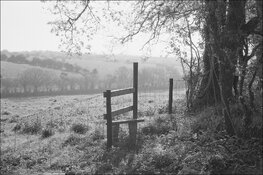
Plenty of atmospheric haze this morning - see attached.
0327_33 (2)-1500-border.jpg
April 23, 08:00 by the sun (3 hours after sunrise), Delta 100 (ie fully panchromatic), light yellow-green #0 filter, BT 2-bath developer, scanned from the negative. Yesterday there were sheep and lambs in the foreground but I had no camera. Today I had the camera, but no sheep.

Not Atget's stile, of course 😉. (Sorry, couldn't resist that.)
 
I read somewhere, possibly in an Abbot book, that Atget used a paste made of Glycin as a developer.
 
As a lesson in contrast (in dual senses of that term), take a look at the blue plate work of Timothy O' Sullivan, of an even earlier era of equipment, but who often shot in the clear air of the West instead of smoggy conditions, e.g., his Black Canon (canyon) of the Colorado shot.
I had seen some of Timothy O'Sullivan's Civil War photos, but not his work in the American West. Thanks for bringing that to my attention.

Without doing more research, I don't really know, so getting in over my head here, but...

O'Sullivan's work in the American West is mostly free from the kind of middle distance atmospheric haze I see in much of Atget's work. From that, I might conclude the haze is determined mostly by location and local weather/pollution, and not much by equipment, materials or methods.

But that conclusion depends on assumption that both photographers were using similar equipment and materials. Did I read that O'Sullivan was using wet plates -- the "earlier era of equipment" you refer to? I have not yet verified what "film" Atget used, but I think it was dry plates, yes? no?

No doubt, switching from wet plate photography to dry plates was a huge gain in speed and convenience for photographers. What I don't know is if this convenience came with some other trade-off or compromise. In other words, is it possible that the dry plate emulsions would have been more prone to exaggerating atmospheric haze than the earlier wet plates? Seems unlikely, but would be necessary to rule out before concluding local air conditions are the sole reason O'Sullivan's photos are relatively free from atmospheric haze effects compared to Atget.
 
I'm not qualified to comment on the difference between wet and dry plates in that respect, but have seen a lot of wet plate work from frontier days. Just how clear the air could be in many places in the West prior to coal fired power plants and jet contrails would surprise many today. It's amazing just how more blue the air became around here during the pandemic, with Port activity slowed down, and few commercial jets flying overhead.

Then there's the factor of the print medium. Albumen has a wonderful warm scale, but is of limited DMax in the print itself. It lends itself to atmospheric views. On the wall beside me is a lovely 8x10 albumen contact print from around 1915 of my mother and her younger brother. It was shot in the house and professionally posed. My mother is holding a kitten, and her brother, 3 at the time, is dressed up in a little army costume. I think if I was ever going to get into UV contact printing, my choice of medium would be albumen.
 
Photrio.com contains affiliate links to products. We may receive a commission for purchases made through these links.
To read our full affiliate disclosure statement please click Here.

PHOTRIO PARTNERS EQUALLY FUNDING OUR COMMUNITY:


Ilford ADOX Freestyle Photographic Stearman Press Weldon Color Lab Blue Moon Camera & Machine
Top Bottom