
• Welcome to Photrio!
    Registration is fast and free. Join today to unlock search, see fewer ads, and access all forum features.
    Click here to sign up

How to change aperture on a lens in a recessed lens panel

Recent Classifieds

Forum statistics

Threads
203,397
Messages
2,854,020
Members
101,817
Latest member
goodman1999
Recent bookmarks
0

Trond

Subscriber
Allowing Ads
Joined
Jul 21, 2004
Messages
859
Location
Harestua, Norway
Format
Multi Format
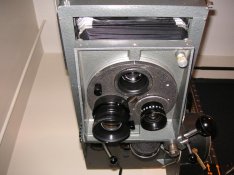
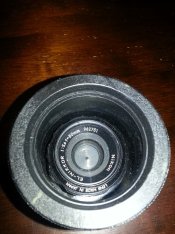
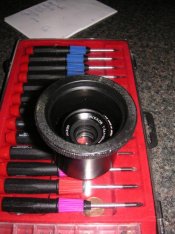
I have a EL-Nikkor 80mm 5.6 mounted in a deeply recessed lens panel for my "new" IFF Ampliator enlarger. The lens panel is very narrow and it's impossible to get the fingers in there to change the aperture. The Nikkor is, I suppose, one of the few 80mm small enough to fit in there at all.

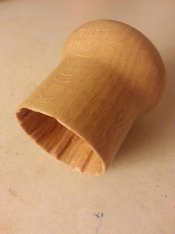
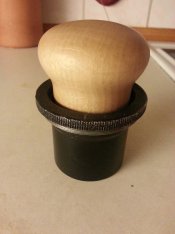
I was thinking about making an aperture changing tool, perhaps some kind of tube that will fit the aperture ring.

Any suggestions?

Trond
 

Attachments

  • PICT4349.jpg
    PICT4349.jpg
    88.2 KB · Views: 228
Why not upside down and inside out? That is maybe mounted the wrong way round: the lens should not be in the recessed part, but on top of it.
Dont see the use of this kind of deeply recessed panel on enlarger.
 
This enlarger uses screw in type lens panels mounted in a turret, and the lens panel can't be mounted any other way. I don't think it would be possible to focus the 80mm on a flat lens panel.

Trond
 
It's amazing that the enlarger requires such a deeply recessed board for an 80mm.
In any case, some flexible tubing that you can push onto the aperture ring when necessary would work, or possiibly shrink tubing used by electricians. In that case, you buy the closest diameter that fits, then it is shrunk to the exact size with heat.
If you have a good grain focuser, consider setting it at f/11 or so and leave it set.
 
Thanks for the suggestions so far. I think the flexible tubing probably is the easiest solution, apart from keeping the lens at f/11. A permanently attached arm sound nice too, I will look into that.

It's possible that the board is more recessed than necessary, but that's the board I've got. I've never seen similar screw in type boards actually.

Trond
 
Last edited by a moderator:
This enlarger uses screw in type lens panels mounted in a turret, and the lens panel can't be mounted any other way. I don't think it would be possible to focus the 80mm on a flat lens panel.

Trond

Is that not what you are essentially doing here? (in photo)
I can state with almost certainty that no self respecting engineer would design a collar for an enlarging lens. Your assembly can not be correct.

Does your cone mount from the narrow end or the wide end?
Every cone-lens extender I have used mounted to the enlarger at the wide end and the lens mounted to the cone at the narrow end (rear element towards the negative). It was an efficient way of putting some distance between the lens and negative without over-extending the bellows.

I think your cone is designed to mount a lens in the neighborhood of 360mm, minimizing bellows draw.

The wide flange of your cone probably fits the same slot as your three lens turret. Use one or the other?
 
There was likely an extension ring made for that purpose. Durst supplied Schneider lenses in recessed mounts complete with dedicated extenders that screwed into the front of the lens. They also had a universal fit extender supplied with one lens mounting board extender assembly.
 
I'm also suspicious of the assembly. My Philips PCS130 enlarger uses a reversible lens board. It's mounted so that the lens board extends upward/inward for 50mm lenses and downward/outward for 75mm/80mm lenses. (The amount of "dip" is trivial compared to what's in your photo, though.) If your enlarger is the same way, mounting a 50mm lens would require an even more recessed mount, and then the question becomes: Was the designer a sadist or just plain insane?

My advice: Mount the board in the enlarger as it is and see if you can focus. If you can't, reverse your assembly. Don't worry about the aperture ring until you figure out how it's supposed to be mounted.
 
1) If you must use that mounting board, then turn it around and then when you use it, move the lens further away from the easel to compensate for the mount length. That will give you access to the lens focus and the lens aperture.

2) Pick up a flat mounting board and avoid the problem.

Steve
 
The lens board isn't reversible, and if the lens was mounted on a flat board it would be impossible to focus. But the lens board doesn't have to be as deep as this one, it could perhaps be 1.5 - 2 cm shallower (I have tested). I have a feeling that lens boards for this enlarger are hard to come by, but I suppose I could get someone to make one.

I have attached a photo to illustrate how it's mounted.

Trond
 

Attachments

  • PICT4368.JPG
    PICT4368.JPG
    102.2 KB · Views: 179
Last edited by a moderator:
How about a longer (i.e. 135mm) lens. Then, if that doesn't work, given the price of good used enllargers I would relegate your "Ampilator" to the trash heap. It can't be any good since A) I never heard of it, and B) what ninny would build a machine requiring such an arrangement?
 
Is that not what you are essentially doing here? (in photo)
I can state with almost certainty that no self respecting engineer would design a collar for an enlarging lens. Your assembly can not be correct.

Does your cone mount from the narrow end or the wide end?
Every cone-lens extender I have used mounted to the enlarger at the wide end and the lens mounted to the cone at the narrow end (rear element towards the negative). It was an efficient way of putting some distance between the lens and negative without over-extending the bellows.

I think your cone is designed to mount a lens in the neighborhood of 360mm, minimizing bellows draw.

The wide flange of your cone probably fits the same slot as your three lens turret. Use one or the other?

Apparently I was wrong, except the part about a self respecting engineer....
From your picture, it would appear that you have one hell of a nice enlarger, albeit one designed with 5"x7" negatives in mind, not 6x6.

My advice would be to remove the 80mm lens, bend some 12 gauge copper wire in a forked loop that bends out of the way of the light path, slip the forks into the grooves on the aperture ring, and then tape the hell out of it. Then remount the lens.

Good luck.
 
Apparently I was wrong, except the part about a self respecting engineer....
From your picture, it would appear that you have one hell of a nice enlarger, albeit one designed with 5"x7" negatives in mind, not 6x6.

My advice would be to remove the 80mm lens, bend some 12 gauge copper wire in a forked loop that bends out of the way of the light path, slip the forks into the grooves on the aperture ring, and then tape the hell out of it. Then remount the lens.

Thanks for the suggestions! I have lots of great suggestions and ideas to play with now.

I will have to agree with you about the engineer part, but I have a very strong suspicion that the board is partly home made, and not an original recessed IFF board. The previous owner is a hobby mechanic, and it's quite possible that he made the board himself out of bit and pieces he had available. But he could at least avoided making it so deep.

Trond
 
You are lucky to have recieved that lens mount with your enlarger! I'm still looking for the Durst equivelant ( LARATUB ) to use an 80mm on my Durst. I'd probably just set it at F8 or F11 and keep it there.

I have a mount almost that deep to use a 25mm on my 4x5 enlarger. But my 25mm is a very tiny lens and I can get my fingers around the aperture ring.
 
Good morning, Trond;

Ic-Racer mentioned the Durst People and their lens systems. Back in the 1960's they had a sheet metal clamp that went around the aperture control ring of a 50mm lens (Schneider Componon-S 50mm f:4.0) and it had a long tab that hung down from one side. The lens was screwed into a recessed lens board (the IXOTUB for the Durst 606) and the lens was adjusted using this little lever or tab that hung down from the lens inside the recessed lens board. I cannot remember the name or the Durst nomenclature for this accessory.

It should be possible to make something like this out of sheet metal, brass or perhaps mild steel, and a small screw and nut.
 
Photrio.com contains affiliate links to products. We may receive a commission for purchases made through these links.
To read our full affiliate disclosure statement please click Here.

PHOTRIO PARTNERS EQUALLY FUNDING OUR COMMUNITY:


Ilford ADOX Freestyle Photographic Stearman Press Weldon Color Lab Blue Moon Camera & Machine
Top Bottom